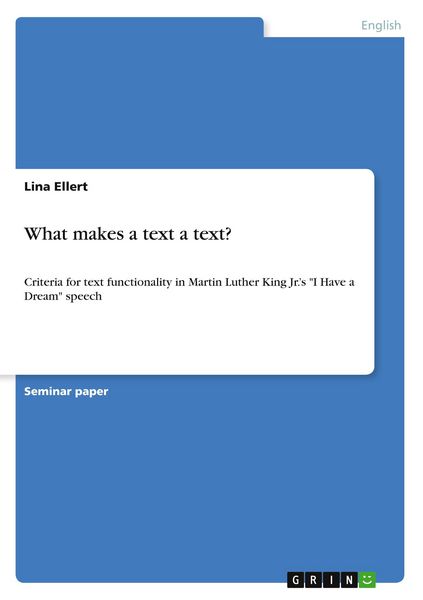
What makes a text a text? Criteria for text functionality in Martin Luther King Jr.'s "I Have a Dream" speech
-
- Englisch ausgewählt
11,95 €
inkl. gesetzl. MwSt.,
Beschreibung
Produktdetails
Einband
Taschenbuch
Erscheinungsdatum
23.02.2026
Verlag
GRINSeitenzahl
16
Maße (L/B/H)
21/14,8/0,2 cm
Gewicht
40 g
Auflage
1. Auflage
Sprache
Englisch
ISBN
978-3-389-18008-2
Seminar paper from the year 2025 in the subject American Studies - Linguistics, grade: 1,0, AKAD University of Applied Sciences Stuttgart (International Business Communication), course: EKO04, language: English, abstract: In contemporary society, textuality is an omnipresent phenomenon that shapes communication in both written and spoken form. Texts are encountered in everyday life through books, newspaper articles, social media posts, or oral performances such as speeches. Especially in political contexts, speeches are a significant medium because they not only transmit information but also seek to persuade, mobilize, and inspire audiences. They constitute a central arena where linguistic strategies and rhetorical devices directly interact with historical and cultural circumstances. This paper therefore engages with the question of what makes a text a text. Following de Beaugrande and Dressler's framework, seven standards of textuality are considered essential for distinguishing a genuine text from a mere collection of words: cohesion, coherence, informativity, intentionality, acceptability, situationality, and intertextuality. These criteria offer a systematic approach to evaluating both written and oral communication. To illustrate the application of these standards, one prominent example will be analyzed: Martin Luther King Jr.'s speech I Have a Dream. Delivered during the March on Washington in 1963, this speech has become one of the most iconic political texts in modern history. King's famous sentence "I have a dream" has become a symbol of the Civil Rights Movement and continues to resonate in contemporary debates on equality and justice. By combining linguistic analysis with historical contextualization, this paper examines whether and how King's speech fulfills the criteria of textuality. In doing so, it highlights the importance of political speeches as texts that are not only functional but also deeply embedded in cultural and social struggles.
Ein neues Kapitel für Ihre Bücher
Ein neues Kapitel für Ihre Bücher
Schenken Sie Ihren alten Schätzen ein zweites Leben und erhalten Sie dafür eine Thalia Geschenkkarte.
Noch keine Bewertungen vorhanden
Verfassen Sie die erste Bewertung zu diesem Artikel
Helfen Sie anderen Kundinnen und Kunden durch Ihre Meinung.
Kurze Frage zu unserer Seite
Vielen Dank für Ihr Feedback
Wir nutzen Ihr Feedback, um unsere Produktseiten zu verbessern. Bitte haben Sie Verständnis, dass wir Ihnen keine Rückmeldung geben können. Falls Sie Kontakt mit uns aufnehmen möchten, können Sie sich aber gerne an unseren Kund*innenservice wenden.
zum Kundenservice