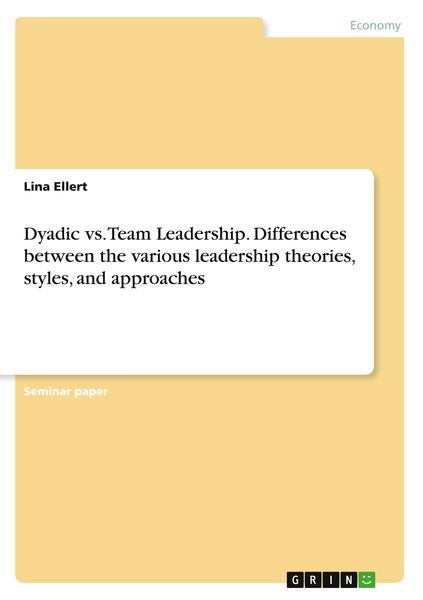
Dyadic vs. Team Leadership. Differences between the various leadership theories, styles, and approaches
-
- Englisch ausgewählt
16,95 €
inkl. gesetzl. MwSt.,
Beschreibung
Produktdetails
Einband
Taschenbuch
Erscheinungsdatum
23.02.2026
Verlag
GRINSeitenzahl
20
Maße (L/B/H)
21/14,8/0,2 cm
Gewicht
45 g
Auflage
1. Auflage
Sprache
Englisch
ISBN
978-3-389-18010-5
Seminar paper from the year 2025 in the subject Leadership and Human Resources - Leadership, grade: 1,3, AKAD University of Applied Sciences Stuttgart (International Business Communication), course: PER73, language: English, abstract: Leadership plays a central role in how organizations coordinate work, motivate employees, and achieve shared objectives. Although widely studied, it remains conceptually difficult to delineate, as scholars describe it as a multifaceted phenomenon involving skills, relational dynamics, and social influence processes that guide individuals toward collective goals. The breadth of this debate is reflected in the fact that more than 350 definitions have been identified. Despite this diversity, a common view emerges that leadership is fundamentally a process of influencing others, structuring meaning, and enabling coordinated behavior toward shared objectives. In today's globalized and competitive environment, characterized by rapid market shifts, technological change, and culturally diverse workforces, effective leadership has gained strategic significance. As competitive pressures intensify, particularly in service sectors, leadership research has shifted from mechanistic, control-oriented models toward people-centered approaches that highlight communication, motivation, and well-being as key drivers of organizational performance. This evolution underscores that human interaction, rather than structural control alone, increasingly shapes organizational adaptability in modern work environments. The aim of this assignment is to analyze leadership from two complementary perspectives: the dyadic level, which focuses on individualized leader-follower relationships, and the team level, which examines how leaders guide and coordinate entire groups. To fulfill this aim, the assignment further seeks to clarify the conceptual foundations of leadership, identify the mechanisms that differentiate dyadic and team leadership in structural and psychological terms, and explore how these mechanisms unfold in a hospitality context to derive implications for leadership design and communication management. Together, these objectives contribute to a more comprehensive understanding of how leadership operates across relational levels in complex service environments.
Ein neues Kapitel für Ihre Bücher
Ein neues Kapitel für Ihre Bücher
Schenken Sie Ihren alten Schätzen ein zweites Leben und erhalten Sie dafür eine Thalia Geschenkkarte.
Noch keine Bewertungen vorhanden
Verfassen Sie die erste Bewertung zu diesem Artikel
Helfen Sie anderen Kundinnen und Kunden durch Ihre Meinung.
Kurze Frage zu unserer Seite
Vielen Dank für Ihr Feedback
Wir nutzen Ihr Feedback, um unsere Produktseiten zu verbessern. Bitte haben Sie Verständnis, dass wir Ihnen keine Rückmeldung geben können. Falls Sie Kontakt mit uns aufnehmen möchten, können Sie sich aber gerne an unseren Kund*innenservice wenden.
zum Kundenservice