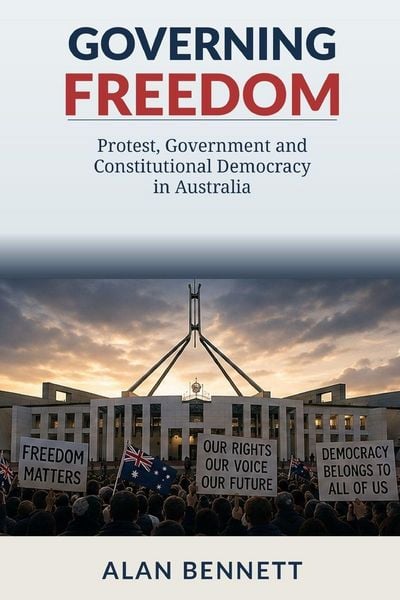
Governing Freedom Protest, Government and Constitutional Democracy in Australia
-
- Englisch ausgewählt
34,99 €
inkl. gesetzl. MwSt.,
Beschreibung
Produktdetails
Einband
Taschenbuch
Erscheinungsdatum
11.08.2026
Verlag
Amazon Digital Services LLC - KdpSeitenzahl
626
Maße (L/B/H)
22,9/15,2/3,2 cm
Gewicht
826 g
Sprache
Englisch
EAN
9798192048115
What does a constitutional democracy owe its citizens when political disagreement moves from debate into protest, disruption and civil disobedience? And what, in turn, do citizens owe the institutions that govern them?
Governing Freedom: Protest, Government and Constitutional Democracy in Australia examines these questions in the Australian setting. It begins with the foundations of government: why human beings create governments, what makes political authority legitimate, how Australia's constitutional structure distributes power, and what citizenship, liberty, the rule of law and institutional trust require in practice.
From that foundation, the book turns to protest as a democratic stress test. Protest allows citizens to express grievance, challenge government and draw attention to causes that may otherwise be ignored. Yet protest can also impose costs on others. Roads may be blocked, businesses disrupted, religious services disturbed, public institutions occupied, and police required to balance freedom of assembly against public safety and the rights of people who are not participating.
The central argument of Governing Freedom is that democratic freedom cannot be understood by looking at one right in isolation. Protesters possess important freedoms of speech, assembly and political participation, but other citizens also possess freedoms: to move, work, worship, obtain medical care and live without unnecessary coercion. Government must protect both. The difficult task is not to decide that one freedom always prevails, but to establish lawful, fair and intelligible rules by which competing claims can coexist.
The book examines the responsibilities of protesters, police, political leaders, courts, parliaments, the media and social media. It considers when protest becomes disruption, the limits of civil disobedience, the role of courts in constitutional judgment, the importance of legislative guidance for police and administrative decision-makers, and the danger of allowing sympathy for a particular cause to determine the legal protection it receives.
Although grounded in Australia, the discussion draws on wider democratic experience, including comparative approaches to public assembly, policing and protest regulation. It argues for clearer legislative frameworks, greater transparency, appropriate independent review and a better civic understanding of the relationship between citizen and state.
The final sections move from diagnosis to reform. They develop a practical framework for governing protest, propose principles for better democratic decision-making, and include a model legislative approach intended to make the exercise of public power clearer, more reviewable and more even-handed.
Governing Freedom is not an argument against protest, nor is it an argument for unrestricted protest. It asks how a free society can remain both free and governable when citizens disagree deeply about politics, morality, public policy and the use of public space.
Its broader concern is democratic character. Governments must exercise power lawfully, proportionately and with reasons capable of public scrutiny. Citizens must retain the right to dissent, but democratic citizenship also carries responsibilities towards institutions, political opponents and other members of the community.
At a time of visible protest, political polarisation and distrust of institutions, Governing Freedom asks a question that reaches beyond any single demonstration or political cause: what qualities should free citizens be entitled to expect from those who govern them, and what responsibilities must citizens themselves accept if constitutional democracy is to endure?
Ein neues Kapitel für Ihre Bücher
Ein neues Kapitel für Ihre Bücher
Schenken Sie Ihren alten Schätzen ein zweites Leben und erhalten dafür eine Thalia Geschenkkarte.
Noch keine Bewertungen vorhanden
Verfassen Sie die erste Bewertung zu diesem Artikel
Helfen Sie anderen Kundinnen und Kunden durch Ihre Meinung.
Kurze Frage zu unserer Seite
Vielen Dank für Ihr Feedback
Wir nutzen Ihr Feedback, um unsere Produktseiten zu verbessern. Bitte haben Sie Verständnis, dass wir Ihnen keine Rückmeldung geben können. Falls Sie Kontakt mit uns aufnehmen möchten, können Sie sich aber gerne an unseren Kund*innenservice wenden.
zum Kundenservice