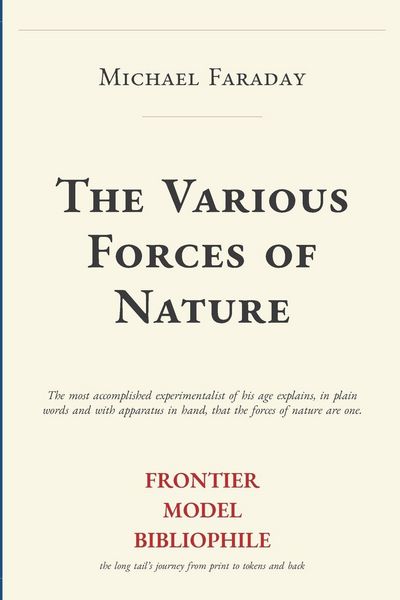
The Various Forces of Nature
-
- Englisch ausgewählt
19,99 €
inkl. gesetzl. MwSt.,
Beschreibung
Produktdetails
Einband
Taschenbuch
Erscheinungsdatum
01.06.2027
Verlag
W. Frederick ZimmermanSeitenzahl
132
Maße (L/B/H)
22,9/15,2/0,7 cm
Gewicht
186 g
Sprache
Englisch
EAN
9798259503533
Six lectures, delivered by Michael Faraday at the Royal Institution and edited by William Crookes, on gravitation, cohesion, chemical affinity, heat, magnetism, and electricity. Throughout runs the conviction that guided Faraday's greatest discoveries: that the forces of nature are not separate powers but convertible expressions of one another. Plainly spoken and built from the familiar, the lectures endure as a primary document of Victorian science and a model of clear explanation. The lectures collected here belong to a distinctively Victorian institution: the public scientific lecture as both education and entertainment. When Faraday delivered them at the Royal Institution in London, he was addressing the tradition he himself had done more than anyone to establish. Founded in 1799, the Royal Institution had become, under Humphry Davy and then under Faraday, the foremost stage in Britain for the demonstration of natural philosophy to a general audience. Its Friday Evening Discourses and, above all, its Christmas Lectures for a juvenile audience - which Faraday inaugurated in 1825 - made experimental science a public spectacle in an age hungry for it. The lecture theatre was steeply raked, the bench equipped for live demonstration, and the audience expected to see nature perform, not merely to hear it described. The six lectures on the forces of nature were taken down as Faraday spoke and afterwards edited into connected prose by William Crookes, himself a chemist and physicist of standing and the discoverer of thallium. Crookes's editorial labor is the reason a spoken performance survives as a readable book; he supplied the continuity that the spoken word, with its gestures toward apparatus on the bench, leaves implicit. The Chatto & Windus illustrated edition reproduced in this volume preserves both the lecture text and the figures that let a reader reconstruct the demonstrations Faraday's listeners watched. The scientific argument of the lectures is the unifying idea that governed Faraday's life's work. He takes his young audience through gravitation, cohesion, chemical affinity, heat, magnetism, and electricity, and at every turn he presses the claim that these are not independent powers but convertible and related forces - that the same nature which makes a stone fall makes particles cohere, makes substances combine, makes a magnet attract, and makes a current flow. This was not a rhetorical flourish. It was the conviction that had led Faraday to his greatest experimental triumphs. His demonstration of electromagnetic rotation in 1821 showed that electricity and magnetism could be made to do mechanical work upon one another. His discovery of electromagnetic induction in 1831 - moving a magnet to generate a current, and so converting motion into electricity - was the experimental proof that the forces were two faces of one thing. By the time of these lectures he had also established the laws of electrolysis, shown that the plane of polarized light could be rotated by a magnetic field (the Faraday effect, 1845), and argued for diamagnetism as a property of all matter. Behind these particular results stood his most far-reaching idea: that force is conveyed not by action at a distance but through lines of force filling the surrounding space, a continuous field that the older Newtonian picture had no place for. The lectures should therefore be read as the popular distillation of a research program. What Faraday could not prove to a juvenile audience with mathematics he could show with apparatus and explain in ordinary English, and the showing carried real conviction precisely because the underlying science was sound.
Ein neues Kapitel für Ihre Bücher
Ein neues Kapitel für Ihre Bücher
Schenken Sie Ihren alten Schätzen ein zweites Leben und erhalten Sie dafür eine Thalia Geschenkkarte.
Noch keine Bewertungen vorhanden
Verfassen Sie die erste Bewertung zu diesem Artikel
Helfen Sie anderen Kundinnen und Kunden durch Ihre Meinung.
Kurze Frage zu unserer Seite
Vielen Dank für Ihr Feedback
Wir nutzen Ihr Feedback, um unsere Produktseiten zu verbessern. Bitte haben Sie Verständnis, dass wir Ihnen keine Rückmeldung geben können. Falls Sie Kontakt mit uns aufnehmen möchten, können Sie sich aber gerne an unseren Kund*innenservice wenden.
zum Kundenservice