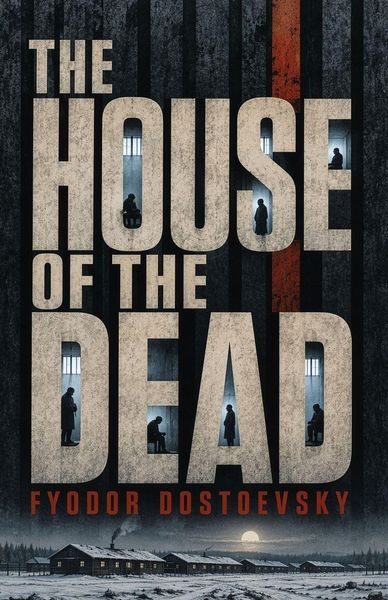
The House of the Dead A Siberian Prison Narrative of Suffering, Survival, and Human Dignity
-
- Englisch ausgewählt
19,99 €
inkl. gesetzl. MwSt.,
Beschreibung
Produktdetails
Einband
Taschenbuch
Erscheinungsdatum
01.09.2026
Verlag
Curated Collection PublishingSeitenzahl
346
Maße (L/B/H)
21,6/14/2 cm
Gewicht
489 g
Sprache
Englisch
EAN
9798182772907
Through the fictional memoir of nobleman Aleksandr Petrovich Goryanchikov, Dostoevsky recreates life inside a Siberian hard-labor prison: forced work, corporal punishment, crowded barracks, rigid routines, violence, illness, humor, hierarchy, and unexpected moments of human dignity. The book develops through portraits, recollections, and episodes rather than a conventional plot. Goryanchikov observes murderers, thieves, soldiers, peasants, political prisoners, and men shaped by very different histories, discovering that the prison population cannot be reduced to a single moral category. Brutality and generosity, cruelty and loyalty, humiliation and pride exist side by side. Dostoevsky pays close attention to the structures of prison life: the exhausting labor, the informal hierarchies among convicts, the small economies of money and possessions, punishments administered by officials, the desperation surrounding illness, and the rare occasions when routine gives way to celebration. Even moments of entertainment, storytelling, bathing, or holiday observance become important because they briefly restore individuality within an institution designed to suppress it. The narrator gradually learns to see his fellow prisoners not simply through the crimes that brought them there, but through temperament, memory, suffering, contradiction, and the desire to preserve some measure of self-respect. That perspective gives the work much of its power. Dostoevsky neither romanticizes the convicts nor treats punishment as morally simple; instead, he shows how confinement exposes both the worst and the most resilient elements of human character. Published serially between 1860 and 1862, The House of the Dead was deeply informed by Dostoevsky's own four years of imprisonment in a Siberian penal camp after his arrest in 1849. The fictional framework allowed him to transform personal experience into a broader study of punishment, social isolation, endurance, and the psychology of people living under extreme constraint. Part memoir, part social observation, and part psychological study, The House of the Dead remains one of Dostoevsky's most direct examinations of suffering and human dignity. Its force comes from the accumulation of lived detail and from its insistence that even within a brutal system, no person can be fully understood by a sentence, a crime, or a social label.
Ein neues Kapitel für Ihre Bücher
Ein neues Kapitel für Ihre Bücher
Schenken Sie Ihren alten Schätzen ein zweites Leben und erhalten dafür eine Thalia Geschenkkarte.
Noch keine Bewertungen vorhanden
Verfassen Sie die erste Bewertung zu diesem Artikel
Helfen Sie anderen Kundinnen und Kunden durch Ihre Meinung.
Kurze Frage zu unserer Seite
Vielen Dank für Ihr Feedback
Wir nutzen Ihr Feedback, um unsere Produktseiten zu verbessern. Bitte haben Sie Verständnis, dass wir Ihnen keine Rückmeldung geben können. Falls Sie Kontakt mit uns aufnehmen möchten, können Sie sich aber gerne an unseren Kund*innenservice wenden.
zum Kundenservice