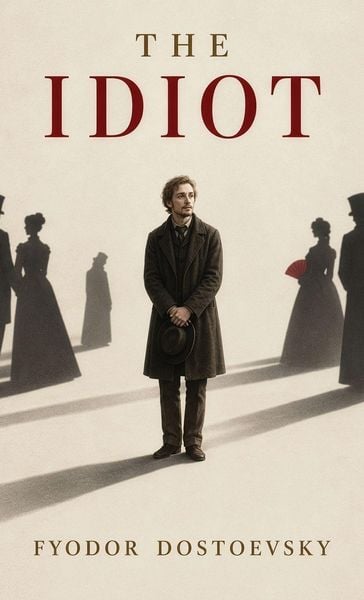
The Idiot A Tragic Novel of Compassion, Obsession, and the Cost of Radical Goodness
1-
- Hardcover ausgewählt
- Taschenbuch
- eBook
- Hörbuch
-
Sprache:Englisch
- Englisch 37,99 € ausgewählt
- Französisch 43,99 €
-
Verlag:Curated Collection Publishing
- Norton and Co Ltd 42,99 €
- Alan Rodgers Books LLC 53,99 €
- Everyman's Library Hardback 25,99 €
- The Library of Alexandria 57,99 €
- Lushena Books 83,99 €
- Creative Media Partners, LLC 39,99 €
- Benediction Classics 35,99 €
- Simon & Brown 46,99 €
- Curated Collection Publishing 37,99 € ausgewählt
- Miller 34,99 €
- Penguin Books Ltd 31,99 €
37,99 €
inkl. gesetzl. MwSt.,
Beschreibung
Produktdetails
Einband
Gebundene Ausgabe
Erscheinungsdatum
01.09.2026
Verlag
Curated Collection PublishingSeitenzahl
716
Maße (L/B/H)
22,2/14,5/4,5 cm
Gewicht
1126 g
Sprache
Englisch
EAN
9798182773225
Prince Myshkin returns to Russia with unusual openness, compassion, and moral innocence. In a society shaped by money, pride, jealousy, humiliation, and social ambition, his instinctive sympathy for others is repeatedly mistaken for weakness or foolishness. Myshkin is drawn into the troubled life of Nastasya Filippovna, a woman marked by exploitation, shame, and a fierce refusal to accept the roles others impose on her. His compassion for her collides with Rogozhin's possessive passion, while his growing attachment to Aglaya Epanchin creates another competing vision of love and happiness. Around them, pity, desire, pride, jealousy, and self-destruction become increasingly difficult to separate. Dostoevsky uses Myshkin's goodness not as a simple moral solution but as a test. His sincerity exposes the vanity, cruelty, and calculation of the society around him, yet compassion alone cannot easily repair damaged lives or overcome obsession. Again and again, good intentions enter situations shaped by forces stronger and darker than Myshkin understands. Nastasya Filippovna stands at the emotional center of that conflict. She alternates between defiance and self-condemnation, attraction and flight, as those around her attempt to rescue, possess, judge, or define her. Rogozhin embodies another extreme: love transformed into fixation and possession. Myshkin's attempts to respond with mercy place him between people whose desires are far less controlled. First serialized from 1868 to 1869, The Idiot grew from Dostoevsky's stated ambition to portray a genuinely good and beautiful person within a compromised world. The result is not an idealized moral fable but a tragic examination of what happens when innocence and compassion encounter pride, erotic obsession, social cruelty, and psychological instability. The novel moves between drawing rooms, family conflicts, financial schemes, romantic rivalries, and moments of spiritual intensity, while continually asking whether goodness can remain effective without becoming helpless. Dostoevsky refuses an easy answer. Myshkin's compassion is real, but so are the wounds, desires, and destructive choices of the people he hopes to help. Tragic, psychologically intense, and morally unsettled, The Idiot explores compassion, obsession, innocence, and the cost of radical goodness in a world where loving another person does not necessarily mean being able to save them.
Ein neues Kapitel für Ihre Bücher
Ein neues Kapitel für Ihre Bücher
Schenken Sie Ihren alten Schätzen ein zweites Leben und erhalten dafür eine Thalia Geschenkkarte.
Kundinnen und Kunden meinen
Unsere Meinungen
-
Zum Bewerterprofil von Sidney Howe

Sidney Howe
Thalia Bad Oldesloe
Buchhändler*in
Es ist ein Problem aufgetreten. Bitte laden Sie die Seite neu und versuchen es noch einmal.
Buch (Taschenbuch)
Mind blowing
"The Idiot" war mein aller erstes Werk von Dostoyevsky. Und ich wurde nicht enttäuscht. Ich finde man muss sich wirklich ein wenig Zeit nehmen für dieses Werk. Prinz Myshkin ist ein sehr besonderer und vor allem interessanter Charakter. Er wird als "pur" dargestellt. Interessiert sich nicht für Geld oder soziales Ansehen. Er ist der Grausamkeit der Welt schutzlos ausgesetzt und an vielen Stellen tat er mir unendlich leid, weil er so innocent ist. Dieses Buch geht unglaublich tief und hat son bisschen bei mir die Interesse an der Klassik geweckt. Denn ich habe the Idiot unglaublich gerne gelesen und empfinde es als ein wirklich prägendes Werk. -
Zum Bewerterprofil von Sophie Dorn

Sophie Dorn
Thalia Langenfeld – Stadtgalerie
Buchhändler*in
Es ist ein Problem aufgetreten. Bitte laden Sie die Seite neu und versuchen es noch einmal.
Buch (Taschenbuch)
Dostoevskys Magnum opus
"People would much rather believe an out-and-out liar with a sense of humour than a respectable, worthy storyteller." The Idiot ist einer der mächtigsten Werke von Dostoevsky. Die Zentrale Frage des Romans ist, ob ein wirklich guter Mensch in der egoistischen Welt überleben kann. Themen von Nihilismus bis zur Leidenschaft werden im Roman besprochen und Fürste Myschkin nimmt uns mit auf eine lange Reise, um uns mit diesen Themen auseinanderzusetzen. Dabei zeigt er uns die komplexen Seiten der menschlichen Natur. Ein Magnum opus das mir sehr nahe getreten ist.
Kurze Frage zu unserer Seite
Vielen Dank für Ihr Feedback
Wir nutzen Ihr Feedback, um unsere Produktseiten zu verbessern. Bitte haben Sie Verständnis, dass wir Ihnen keine Rückmeldung geben können. Falls Sie Kontakt mit uns aufnehmen möchten, können Sie sich aber gerne an unseren Kund*innenservice wenden.
zum Kundenservice