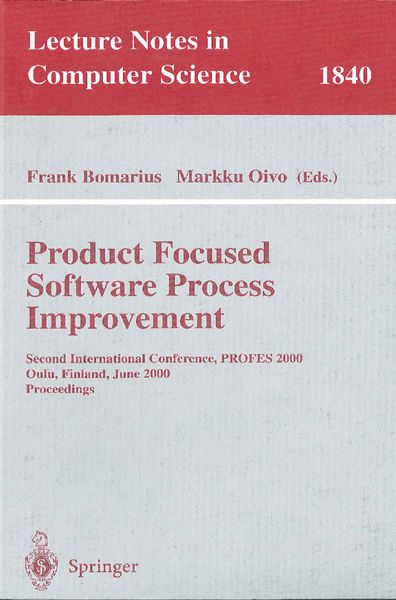
• Produktbild: Product Focused Software Process Improvement
  • Produktbild: Product Focused Software Process Improvement
Band 1840

Product Focused Software Process Improvement Second International Conference, PROFES 2000, Oulu, Finland, June 20-22, 2000 Proceedings

49,99 €

inkl. gesetzl. MwSt., Versandkostenfrei


Beschreibung

Produktdetails

Einband

Taschenbuch

Erscheinungsdatum

07.06.2000

Herausgeber

Frank Bomarius + weitere

Verlag

Springer Berlin

Seitenzahl

426

Maße (L/B/H)

23,5/15,5/2,4 cm

Gewicht

621 g

Auflage

2000

Sprache

Englisch

ISBN

978-3-540-67688-1

Beschreibung

Produktdetails

Einband

Taschenbuch

Erscheinungsdatum

07.06.2000

Herausgeber

Verlag

Springer Berlin

Seitenzahl

426

Maße (L/B/H)

23,5/15,5/2,4 cm

Gewicht

621 g

Auflage

2000

Sprache

Englisch

ISBN

978-3-540-67688-1

Herstelleradresse

Springer-Verlag KG
Sachsenplatz 4-6
1201 Wien
AT

Email: GPSR Kontakt

Ein neues Kapitel für Ihre Bücher

Ein neues Kapitel für Ihre Bücher

Schenken Sie Ihren alten Schätzen ein zweites Leben: Einfach Barcode scannen, Versandetikett ausdrucken, Bücher verschicken und Thalia Geschenkkarte erhalten.

Jetzt verkaufen
Jetzt verkaufen

Noch keine Bewertungen vorhanden

Verfassen Sie die erste Bewertung zu diesem Artikel

Helfen Sie anderen Kundinnen und Kunden durch Ihre Meinung.

Kundinnen und Kunden meinen

Bewertungen (0)

  • Produktbild: Product Focused Software Process Improvement
  • Produktbild: Product Focused Software Process Improvement
  • Keynote Address: The Cascading Benefits of Software Process Improvement.- Keynote Address: The Cascading Benefits of Software Process Improvement.- Keynote Address: Capitalizing on Experience.- Keynote Address: Software Development Challenges for the 2000’s.- Panel Session: Corporate Software Engineering Knowledge Networks: How Can They Improve Training of the Workforce in Software Organisations?.- Process Improvement.- Active Probes Synergy in Experience-Based Process Improvement.- A Framework for the Continuous Monitoring and Evaluation of Improvement Programmes.- No Improvement without Learning: Prerequisites for Learning the Relations between Process and Product Quality in Practice.- Introducing the Data Role in Models for Database Assessment.- Applying Benchmarking to Learn from Best Practices.- Modelling Usability Capability – Introducing the Dimensions.- Using Simulation to Visualise and Analyse Product-Process Dependencies in Software Development Projects.- Transforming Software Organizations with the Capability Maturity Model.- Empirical Software Engineering.- The Effect of Constraint Notification within a Case Tool Environment on Design Productivity and Quality.- Is a Design Rationale Vital when Predicting Change Impact? – A Controlled Experiment on Software Architecture Evolution.- Modeling and Analysis of Software Aging Process.- Industrial Experiences.- Usability Engineering in Concurrent Product Development.- An Industrial Experience in Using Problem Resolution Process for Software Porting.- Managing Engineering and Product Technology: A Method for Technology Assessment.- The Benefits of Networking.- Project Experience Database: A Report Based on First Practical Experience.- SPI – A Guarantee for Success? – A Reality Story from Industry -.- Product Driven Process Improvement PROFES Experiences at Dräger.- Experiences on Lean Techniques to Manage Software Suppliers.- The PROFES Improvement Methodology – Enabling Technologies and Methodology Design.- Methods and Tools.- Object-Oriented Design in Real-Time Embedded Robot Control Software.- Managing Distributed Software Development – A Portfolio Based Methodology.- Software and Process Modelling.- Formalizing SCM Use Cases within the Virtual Software Corporation.- The FEAST Approach to Quantitative Process Modelling of Software Evolution Processes.- A Description of a ‘Framework Approach’ to Evolutionary Systems Development.- Software and Process Measurement.- An Evaluation of Functional Size Methods and a Bespoke Estimation Method for Real-Time Systems.- Instrumenting Measurement Programs with Tools.- Organizational Learning and Experience Factory.- A Relationship-Based View to Software Engineering Competence.- Software Experience Bases: A Consolidated Evaluation and Status Report.- LIDs: A Light-Weight Approach to Experience Elicitation and Reuse.