















































KI-Beratung Beta

Gutscheinbedingungen

Gültig bis 30.11.2026 | Gültig für nicht preisgebundene fremdsprachige Bücher | Einzelne Artikel können ausgeschlossen sein | Online auf thalia.de und in der Thalia App einlösbar | Click & Collect nur mit Online-Zahlung (Paypal/Kreditkarte) vorab | Nicht kombinierbar mit anderen Gutscheinen oder Preisaktionen | Nur einmal pro Einkauf einlösbar | Gutschein wird auf max. 500€ Bestellwert angerechnet | Keine Barauszahlung | Nicht gültig für Versandkosten und Services

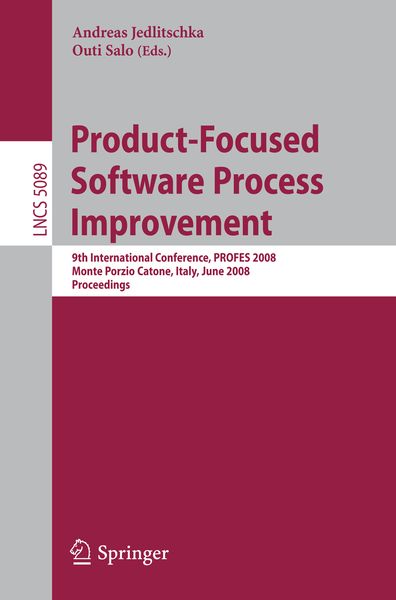
  • Produktbild: Product-Focused Software Process Improvement
  • Produktbild: Product-Focused Software Process Improvement
Band 5089

Product-Focused Software Process Improvement 9th International Conference, PROFES 2008, Monte Porzio Catone, Italy, June 23-25, 2008, Proceedings

49,99 €

inkl. gesetzl. MwSt., Versandkostenfrei


Beschreibung

On behalf of the PROFES Organizing Committee, we are proud to present to you the proceedings of the 9th International Conference on Product-Focused Software Process Improvement (PROFES 2008) held in Frascati - Monteporzio Catone, Rome, Italy. Since 1999, PROFES has established itself as one of the recognized...

Beschreibung

On behalf of the PROFES Organizing Committee, we are proud to present to you the proceedings of the 9th International Conference on Product-Focused Software Process Improvement (PROFES 2008) held in Frascati - Monteporzio Catone, Rome, Italy. Since 1999, PROFES has established itself as one of the recognized international process improvement conferences. The main theme of PROFES is professional so- ware process improvement (SPI) motivated by product and service quality needs. Focussing on a product to be developed, PROFES 2008 addressed both quality en- neering and management topics including processes, methods, techniques, tools, - ganizations, and enabling SPI. Both solutions found in practice and the relevant research results from academia were presented. Domains such as the automotive and mobile applications industry are growing r- idly, resulting in a strong need for professional development and improvement. Nowadays, the majority of embedded software is developed in collaboration, and distribution of embedded software development continues to increase. Thus, PROFES 2008 addressed different development modes, roles in the value chain, stakeholders’ viewpoints, collaborative development, as well as economic and quality aspects. - ile development was included again as one of the themes. Since the beginning of the series of PROFES conferences, the purpose has been to bring to light the most recent findings and novel results in the area of process - provement, and to stimulate discussion among researchers, experienced professionals, and technology providers from around the world.

Produktdetails

Einband

Taschenbuch

Erscheinungsdatum

16.06.2008

Abbildungen

XIV, 448 p.

Herausgeber Andreas Jedlitschka + weitere

Produktdetails

Einband

Taschenbuch

Erscheinungsdatum

16.06.2008

Abbildungen

XIV, 448 p.

Herausgeber
Verlag Springer Berlin
Seitenzahl

448

Maße (L/B/H)

23,5/15,5/2,6 cm

Gewicht

703 g

Auflage

2008

Sprache

Englisch

ISBN

978-3-540-69564-6

Herstelleradresse

Springer-Verlag KG
Sachsenplatz 4-6
1201 Wien
AT

Email: ProductSafety@springernature.com

Ein neues Kapitel für Ihre Bücher

Ein neues Kapitel für Ihre Bücher

Schenken Sie Ihren alten Schätzen ein zweites Leben und erhalten Sie dafür eine Thalia Geschenkkarte.

Jetzt verkaufen
Jetzt verkaufen

Noch keine Bewertungen vorhanden

Verfassen Sie die erste Bewertung zu diesem Artikel

Helfen Sie anderen Kundinnen und Kunden durch Ihre Meinung.

Kundinnen und Kunden meinen

Bewertungen (0)

  • Produktbild: Product-Focused Software Process Improvement
  • Produktbild: Product-Focused Software Process Improvement
  • Keynote Addresses.- Software Testing Forever: Old and New Processes and Techniques for Validating Today’s Applications.- Culture of Error Management “Why Admit an Error When No One Will Find Out?”.- Supporting Experience and Information Flow in Software Projects.- Quality and Measurement I.- Goal-Oriented Setup and Usage of Custom-Tailored Software Cockpits.- MIS-PyME Software Measurement Maturity Model-Supporting the Definition of Software Measurement Programs.- Predicting Software Metrics at Design Time.- A Metrics Suite for Measuring Quality Characteristics of JavaBeans Components.- Software Cost Estimation Inhibitors - A Case Study.- Impact of Base Functional Component Types on Software Functional Size Based Effort Estimation.- Managing Uncertainty in ERP Project Estimation Practice: An Industrial Case Study.- The Effect of Entity Generalization on Software Functional Sizing: A Case Study.- Towards a Capability Model for the Software Release Planning Process — Based on a Multiple Industrial Case Study.- From CMMI to SPICE – Experiences on How to Survive a SPICE Assessment Having Already Implemented CMMI.- A Model for Requirements Change Management: Implementation of CMMI Level 2 Specific Practice.- Experience Report on the Effect of Software Development Characteristics on Change Distribution.- Virtual Prototypes in Developing Mobile Software Applications and Devices.- Comparing Assessment Methodologies for Free/Open Source Software: OpenBRR and QSOS.- Quality and Measurement II.- Predicting Software Fault Proneness Model Using Neural Network.- Automating the Measurement of Functional Size of Conceptual Models in an MDA Environment.- How Does a Measurement Programme Evolve in Software Organizations?.- A Fault Prediction Model with Limited Fault Data toImprove Test Process.- Big Improvements with Small Changes: Improving the Processes of a Small Software Company.- Software Process Improvement Methodologies for Small and Medium Enterprises.- An Empirical Study on Software Engineering Knowledge/Experience Packages.- Customized Predictive Models for Process Improvement Projects.- Lessons Learned and Best Practices I.- Improving Customer Support Processes: A Case Study.- Influential Factors on Incident Management: Lessons Learned from a Large Sample of Products in Operation.- Pitfalls in Remote Team Coordination: Lessons Learned from a Case Study.- A Model to Identify Refactoring Effort during Maintenance by Mining Source Code Repositories.- The Application of ISO 9001 to Agile Software Development.- Study of the Evolution of an Agile Project Featuring a Web Application Using Software Metrics.- Lessons Learned and Best Practices II.- Identifying and Understanding Architectural Risks in Software Evolution: An Empirical Study.- A Hands-On Approach for Teaching Systematic Review.- An Empirical Study Identifying High Perceived Value Practices of CMMI Level 2.- 2nd International Workshop on Measurement-Based Cockpits for Distributed Software and Systems Engineering Projects (SOFTPIT 2008).- 10th International Workshop on: Learning Software Organizations –Methods, Tools, and Experiences–.- Implementing Product Line Engineering in Industry: Feedback from the Field to Research.- What to Learn from Different Standards and Measurement Approaches? Is a Pragmatic Integrative Approach Possible?.