















































KI-Beratung Beta

Gutscheinbedingungen

Gültig bis 30.11.2026 | Gültig für nicht preisgebundene fremdsprachige Bücher | Einzelne Artikel können ausgeschlossen sein | Online auf thalia.de und in der Thalia App einlösbar | Click & Collect nur mit Online-Zahlung (Paypal/Kreditkarte) vorab | Nicht kombinierbar mit anderen Gutscheinen oder Preisaktionen | Nur einmal pro Einkauf einlösbar | Gutschein wird auf max. 500€ Bestellwert angerechnet | Keine Barauszahlung | Nicht gültig für Versandkosten und Services

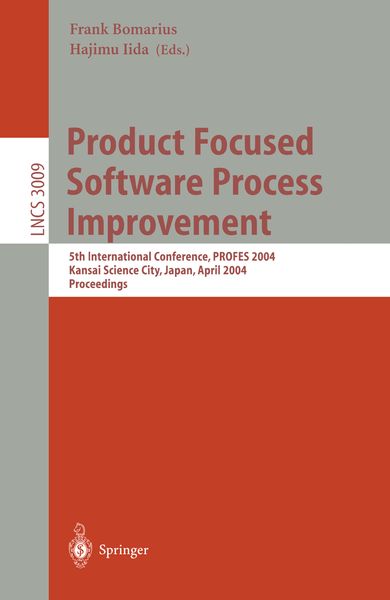
Produktbild: Product Focused Software Process Improvement
Band 3009

Product Focused Software Process Improvement 5th International Conference, PROFES 2004, Kansai Science City, Japan, April 5-8, 2004, Proceedings

49,99 €

inkl. gesetzl. MwSt., Versandkostenfrei


Beschreibung

On behalf of the PROFES organizing committee we are proud to present to you the proceedings of the 5th International Conference on Product Focused Software Process Improvement (PROFES 2004), held in Kansai Science City, Japan. Since 1999, PROFES has established itself as one of the recognized international...

Beschreibung

On behalf of the PROFES organizing committee we are proud to present to you the proceedings of the 5th International Conference on Product Focused Software Process Improvement (PROFES 2004), held in Kansai Science City, Japan. Since 1999, PROFES has established itself as one of the recognized international process improvement conferences. In 2004 the conference left Europe for the first time and moved to Japan. Japan and its neighboring countries are intensifying their efforts to improve software engineering excellence, so it was a logical step to select Japan as the venue for PROFES 2004. The purpose of the conference is to bring to light the most recent findings and results in the area and to stimulate discussion between researchers, experienced professionals, and technology providers. The large number of participants coming from industry confirms that the conference provides a variety of up-to-date topics and tackles industry problems. The main theme of PROFES is professional software process improvement (SPI) motivated by product and service quality needs. SPI is facilitated by software process assessment, software measurement, process modeling, and technology transfer. It has become a practical tool for quality software engineering and management. The conference addresses both the solutions found in practice and the relevant research results from academia. This is reflected in the 41 full papers, which are a balanced mix of academic papers as well as industrial experience reports.

Produktdetails

Einband

Taschenbuch

Erscheinungsdatum

25.03.2004

Abbildungen

XIV, 584 p.

Herausgeber Frank Bomarius + weitere

Produktdetails

Einband

Taschenbuch

Erscheinungsdatum

25.03.2004

Abbildungen

XIV, 584 p.

Herausgeber
Verlag Springer Berlin
Seitenzahl

584

Maße (L/B/H)

23,5/15,5/3,3 cm

Gewicht

896 g

Auflage

2004

Sprache

Englisch

ISBN

978-3-540-21421-2

Herstelleradresse

Springer-Verlag KG
Sachsenplatz 4-6
1201 Wien
AT

Email: ProductSafety@springernature.com

Ein neues Kapitel für Ihre Bücher

Ein neues Kapitel für Ihre Bücher

Schenken Sie Ihren alten Schätzen ein zweites Leben und erhalten Sie dafür eine Thalia Geschenkkarte.

Jetzt verkaufen
Jetzt verkaufen

Noch keine Bewertungen vorhanden

Verfassen Sie die erste Bewertung zu diesem Artikel

Helfen Sie anderen Kundinnen und Kunden durch Ihre Meinung.

Kundinnen und Kunden meinen

Bewertungen (0)

  • Produktbild: Product Focused Software Process Improvement
  • Software Process Improvement.- A Model for the Implementation of Software Process Improvement: An Empirical Study.- Does Use of Development Model Affect Estimation Accuracy and Bias?.- Managing Software Process Improvement (SPI) through Statistical Process Control (SPC).- Towards Hypotheses on Creativity in Software Development.- Using Software Inspection as a Catalyst for SPI in a Small Company.- Comparing Global (Multi-site) SPI Program Activities to SPI Program Models.- Starting SPI from Software Configuration Management: A Fast Approach for an Organization to Realize the Benefits of SPI.- Software Quality.- Evaluating the Calmness of Ubiquitous Applications.- Quality Attributes in Mobile Web Application Development.- Introducing Quality System in Small and Medium Enterprises: An Experience Report.- Measurement.- Definition and Empirical Validation of Metrics for Software Process Models.- Multiview Framework for Goal Oriented Measurement Plan Design.- Eliminating Over-Confidence in Software Development Effort Estimates.- Measuring the Object-Oriented Properties in Small Sized C++ Programs – An Empirical Investigation.- Methods and Tools.- An Empirical Investigation on the Impact of Training-by-Examples on Inspection Performance.- Refactoring Support Based on Code Clone Analysis.- Introducing the Next Generation of Software Inspection Tools.- Intelligent Support for Software Release Planning.- Experimental Software Engineering.- An Empirical Evaluation of Predicting Runaway Software Projects Using Bayesian Classification.- Effort Estimation Based on Collaborative Filtering.- Effective Software Project Management Education through Simulation Models: An Externally Replicated Experiment.- Software Engineering Research Strategy: Combining Experimental and ExplorativeResearch (EER).- Industrial Experiences.- Automatic Measurement at Nokia Mobile Phones: A Case of SDL Based Software Development.- Using a Reference Application with Design Patterns to Produce Industrial Software.- Using RUP for Process-Oriented Organisations.- Web-Based System Development: Status in the Norwegian IT Organizations.- Agile Methods.- Achieving CMMI Level 2 with Enhanced Extreme Programming Approach.- Usability Assessment of an Extreme Programming Project: Close Co-operation with the Customer Does Not Equal to Good Usability.- Empirical Evaluation of Agile Software Development: The Controlled Case Study Approach.- Good-Enough Software Process in Nokia.- An Ideal Process Model for Agile Methods.- Experimental Development of a Prototype for Mobile Environmental Information Systems (MEIS).- Software Process Assessment.- Selecting CMMI Appraisal Classes Based on Maturity and Openness.- Combining Capability Assessment and Value Engineering: A BOOTSTRAP Example.- Assessing the State of Software Documentation Practices.- Requirements Engineering.- Requirements Prioritization Challenges in Practice.- A Requirement Elicitation Method in Collaborative Software Development Community.- Development of a Normative Package for Safety-Critical Software Using Formal Regulatory Requirements.- Software Reuse / COTS.- A Study of Developer Attitude to Component Reuse in Three IT Companies.- Managing COTS Components Using a Six Sigma-Based Process.- Using Dynamic Modeling and Simulation to Improve the COTS Software Process.