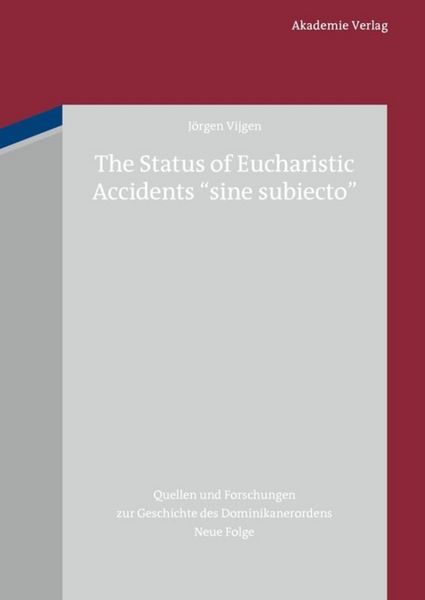
The Status of Eucharistic Accidents "sine subiecto" An Historical Survey up to Thomas Aquinas and Selected Reactions
174,95 €
inkl. gesetzl. MwSt.,
Beschreibung
Produktdetails
Einband
Gebundene Ausgabe
Erscheinungsdatum
17.07.2013
Verlag
De GruyterSeitenzahl
412
Maße (L/B/H)
24,6/17,5/2,9 cm
Gewicht
890 g
Auflage
1
Sprache
Deutsch
ISBN
978-3-05-006084-2
If, at the moment of the Eucharistic consecration, solely the accidents remain – as our senses testify – the question inevitably arises: Is it possible for an accident to exist and at the same time not inhere in a subject? This study addresses that question and traces the development of the discussions surrounding the status of Eucharistic accidents that exist without a subject. It covers the period in the Middle Ages up to Thomas Aquinas and examines selected reactions from the first generation of thinkers after Aquinas. It identifies the fundamental philosophical concerns of these authors, their principal insights and conclusions, partly based on hitherto unpublished texts. The entire debate centers on the need to safeguard divine omnipotence; for even God cannot make contradictories, such as accidents existing without a subject, true. On several occasions Thomas Aquinas expressed his concern that the faith, when shown to be false or impossible, would be held up to the ridicule of non-believers. The rise of ‘radical Aristotelianism’ urged Aquinas and his contemporaries to defend philosophically the possibility of accidents existing sine subiecto. Starting with Berengar of Tours, this study provides a detailed chronological account of the debate in the various 12th century ‘schools’ and in the early Summae. The most important authors prior to Thomas Aquinas are treated extensively, with a particular emphasis on the authenticity of the treatise De corpore Domini, attributed to Albertus Magnus. The analysis of Aquinas’ key texts on the question is carried out in relation to the whole of his thought and its reception by Peter of Tarentasia, Hannibaldus de Hannibaldis and Adenulf of Anagnia. The final part of this study considers the criticism by the Parisian members of the Faculty of Arts: Dietrich of Freiberg, Godfrey of Fontaines, Giles of Rome, John of Paris, John of Sterngassen and HervaeusNatalis. Lengthy attention is also devoted to the famous anonymous Commentary on the Sentences, contained in Ms. 491 of the city library of Bruges (Belgium).
Ein neues Kapitel für Ihre Bücher
Ein neues Kapitel für Ihre Bücher
Schenken Sie Ihren alten Schätzen ein zweites Leben und erhalten dafür eine Thalia Geschenkkarte.
Noch keine Bewertungen vorhanden
Verfassen Sie die erste Bewertung zu diesem Artikel
Helfen Sie anderen Kundinnen und Kunden durch Ihre Meinung.
Kurze Frage zu unserer Seite
Vielen Dank für Ihr Feedback
Wir nutzen Ihr Feedback, um unsere Produktseiten zu verbessern. Bitte haben Sie Verständnis, dass wir Ihnen keine Rückmeldung geben können. Falls Sie Kontakt mit uns aufnehmen möchten, können Sie sich aber gerne an unseren Kund*innenservice wenden.
zum Kundenservice