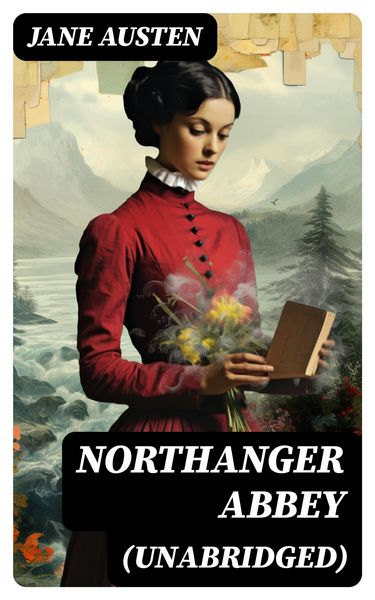
Northanger Abbey (Unabridged)
2-
- Hardcover
- Taschenbuch
- eBook ausgewählt
- Hörbuch
- Bunt / Beige
-
Form:Einzelkauf Download
-
Sprache:Englisch
- Deutsch 7,49 €
- Englisch ausgewählt
- Deutsch, Englisch 8,99 €
-
eBook Format:ePUB
- ePUB 3 0,49 €
- ePUB ausgewählt
-
Verlag:DigiCat
- Dreamscape Media 0,49 €
- Merkaba Press 0,91 €
- Top Five Books 0,49 €
- Apebook Verlag 0,99 €
- Seltzer Books 0,91 €
- Classica Libris 0,49 €
- Flip 0,49 €
- BoD - Books on Demand 0,99 €
- Biblioteca Nacional de España 0,00 €
- DigiCat ausgewählt
- Paperless 0,99 €
- HarperCollins Canada 0,84 €
- Avia Artis 0,99 €
- The Masterpieces 0,49 €
- Jazzybee Verlag 0,49 €
- Booklassic 0,88 €
- Good Press 0,49 €
0,99 €
inkl. gesetzl. MwSt.Beschreibung
Produktdetails
Format
ePUB
Kopierschutz
Nein
Family Sharing
Ja
Text-to-Speech
Ja
Erscheinungsdatum
25.12.2023
Verlag
DigiCatSeitenzahl
214 (Printausgabe)
Dateigröße
651 KB
Sprache
Englisch
EAN
8596547763918
Northanger Abbey is Jane Austen's brilliantly crafted parody of the Gothic novel, showcasing her signature wit and keen social commentary. Written in the early 19th century, this unabridged text introduces readers to Catherine Morland, an imaginative young woman whose penchant for sensational literature leads her to the mysterious Northanger Abbey. Through a sharp yet humorous lens, Austen critiques the excesses of Gothic tropes while deftly exploring themes of romanticism, social class, and the intricacies of family dynamics. The novel's epistolary style and rich character development reflect Austen's mastery of irony and her pioneering role in the evolution of the novel as a form of commentary on contemporary society. Jane Austen, an influential figure in English literature, was born in 1775 and developed her passion for writing in a family that embraced intellectual discourse. Her experiences growing up in rural England provided her with profound insights into social hierarchies, gender roles, and the limitations placed on women of her time. Austen's firsthand knowledge of the literary landscape-especially the popular Gothic genre-shapes Northanger Abbey, making it a nuanced critique of its conventions. Northanger Abbey is essential reading for anyone seeking an understanding of early 19th-century literature and the complexities of women's lives during this period. Austen's satirical yet tender portrayal of Catherine's journey from innocence to experience offers profound reflections on individuality and societal expectations. This novel remains an enduring classic, inviting modern readers to appreciate its humor, depth, and timeless relevance.
Kundinnen und Kunden meinen
Unsere Meinungen
-
Zum Bewerterprofil von Markus Felsmann

Markus Felsmann
Thalia Mayersche Köln – Neumarkt
Buchhändler*in
Es ist ein Problem aufgetreten. Bitte laden Sie die Seite neu und versuchen es noch einmal.
Buch (Taschenbuch)
Gothic Dreams & Reality Checks – Austen at Her Witty Best!
Catherine Morland dreams of being like the heroines in her favorite novels. But she is neither wealthy nor remarkably beautiful, mistakes politeness for affection, and believes in the grand romances of her books. When she meets Henry Tilney at a ball, it feels like her own fairy tale is coming true. But soon, she realizes that real life follows its own rules—and Henry’s family puts her to the test ... »Northanger Abbey« is a brilliant satire of the Gothic novel, showcasing Jane Austen at her best. With a stunning modern design, this new edition invites readers to rediscover Austen’s classic. Featuring elegant and fresh cover artwork by illustrator Laurie-Anne Poquet, five more of Austen’s works from Penguin Books also shine in a new light.
Kurze Frage zu unserer Seite
Vielen Dank für Ihr Feedback
Wir nutzen Ihr Feedback, um unsere Produktseiten zu verbessern. Bitte haben Sie Verständnis, dass wir Ihnen keine Rückmeldung geben können. Falls Sie Kontakt mit uns aufnehmen möchten, können Sie sich aber gerne an unseren Kund*innenservice wenden.
zum Kundenservice