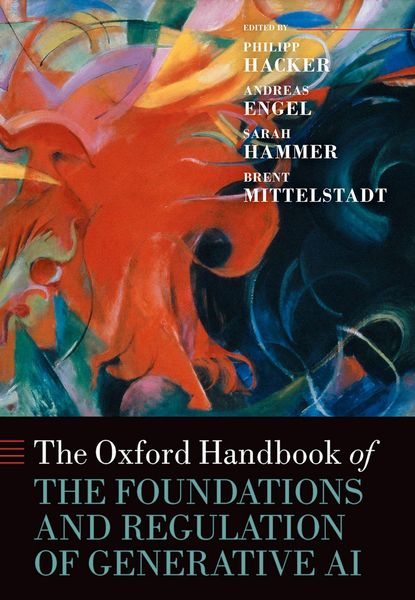
Produktbild: The Oxford Handbook of the Foundations and Regulation of Generative AI
Vorbesteller Neu

The Oxford Handbook of the Foundations and Regulation of Generative AI

232,99 €

inkl. gesetzl. MwSt., Versandkostenfrei


Beschreibung

Produktdetails

Einband

Gebundene Ausgabe

Erscheinungsdatum

25.11.2026

Verlag

Oxford Academic

Seitenzahl

944

Maße (L/B/H)

5,6/18,5/25,2 cm

Gewicht

1760 g

Sprache

Englisch

ISBN

978-0-19-894027-2

Beschreibung

Produktdetails

Einband

Gebundene Ausgabe

Erscheinungsdatum

25.11.2026

Verlag

Oxford Academic

Seitenzahl

944

Maße (L/B/H)

5,6/18,5/25,2 cm

Gewicht

1760 g

Sprache

Englisch

ISBN

978-0-19-894027-2

Herstelleradresse

Libri GmbH
Europaallee 1
36244 Bad Hersfeld
DE

Email: gpsr@libri.de

Ein neues Kapitel für Ihre Bücher

Ein neues Kapitel für Ihre Bücher

Schenken Sie Ihren alten Schätzen ein zweites Leben und erhalten dafür eine Thalia Geschenkkarte.

Jetzt verkaufen
Jetzt verkaufen

Noch keine Bewertungen vorhanden

Verfassen Sie die erste Bewertung zu diesem Artikel

Helfen Sie anderen Kundinnen und Kunden durch Ihre Meinung.

Kundinnen und Kunden meinen

Bewertungen (0)

Die Leseprobe wird geladen.
  • Produktbild: The Oxford Handbook of the Foundations and Regulation of Generative AI
    • I. Introduction
    • 1: Philipp Hacker, Andreas Engel, Sarah Hammer, and Brent Mittelstadt: Foundations and Regulation of Generative AI: An Introduction
    • II. Foundations
    • 2: Gerard de Melo, Sanmi Koyejo, and Stephan Mandt: Generative AI and Foundation Models: A Gentle Technical Introduction
    • 3: Rumman Chowdhury: Responsible Data Practices and Generative AI: Organizational, Legal, and Technical Perspectives
    • 4: Gerard de Melo: The Art of Generative AI Prompting
    • 5: Wojciech Samek: Explaining and Interpreting Generative AI
    • 6: Eleanor Watson: The Challenges of Agentic AI Safety
    • 7: Neel Guha, Julian Nyarko, Daniel E. Ho, and Christopher Ré: Building GenAI Benchmarks: A Case Study in Legal Applications
    • 8: Gerard de Melo: Detecting AI-Generated Content: Challenges and Opportunities
    • 9: Henry Shevlin: Ethics at the Frontier of Human-AI Relationships
    • 10: Lynette Webb and Daniel Schönberger: 1. Generative AI and the Problem of Existential Risk
    • III. Regulatory Challenges
    • 11: Cary Coglianese and Colton R. Krum: Regulating Multifunctionality
    • 12: Roger Brownsword: Generative AI and the Rule of Law
    • 13: Jonas Schuett, Markus Anderljung, Alexis Carlier, Leonie Koessler, and Ben Garfinkel: From Principles to Rules: A Regulatory Approach for Frontier AI
    • 14: Seb Krier, Harry Law, and Kevin Klyman: How Risky are Open Frontier Models?
    • 15: Leah Junck, Fola Adeleke, and Rachel Adams: GAI as a Modality of Interdependencies: Imagining Tech Futures in Majority World Settings
    • 16: Jerry John Kponyo, Francis Kemausuor, Eric Tutu Tchao, Henry Nunoo Mensah, and Rachel Yayra Adjoe: Promoting Transparency in Generative AI: A Focus on Africa
    • 17: Philipp Hacker, Frederik Zuiderveen Borgesius, Brent Mittelstadt, and Sandra Wachter: Generative Discrimination: What Happens When Generative AI Exhibits Bias, and What Can Be Done About It
    • 18: Jan Trzaskowski and Marie Jull Sørensen: Generative AI and Consumer Protection
    • 19: Jeremias Adams-Prassl: Platform and Worker Rights in the Age of Generative AI
    • 20: Pietro Ortolani: Generative AI and Content Moderation
    • 21: Reuben Binns and Lilian Edwards: ChatGPT Tells Fibs About Me: Are Data Protection and Libel Adequate Tools to Protect Reputation in the LLM Era?
    • 22: Peter Henderson, Tatsunori Hashimoto, and Mark A. Lemley: Liability for AI-Generated Speech
    • 23: Graziana Kastl-Riemann: Regulation of Generative AI Speech: An EU Perspective
    • 24: Amy L. Stein: Generative AI and Sustainability
    • 25: Irene Solaiman, Zeerak Talat, and others: Evaluating the Social Impact of Generative AI Systems
    • 26: Andreas Engel: Generative AI and Copyright
    • 27: Herbert Zech: AI and Patents: The Role of Inventorship
    • IV. Applications
    • 28: Laurence Ales, Christophe Combemale, and Ramayya Krishnan: Generative AI, Adoption, and the Structure of Tasks
    • 29: Alex P. Miller, Kartik Hosanagar, and Ramayya Krishnan: Harnessing AI for Business Insight: Key Considerations for Deploying LLMs in Summarization Pipelines
    • 30: Alexandre Zavaglia Coelho: Data, Automation, and Artificial Intelligence: (Generative) AI in Legal Practice
    • 31: Elizabeth Chan, Kiran Gore, and Eliza Jiang: Generative AI in International Arbitration: Finding Balance in a Changing Landscape
    • 32: Kelly Richdale: AI and Health: Exploring the Opportunities, Risks, and Challenges
    • 33: Joyce Nakatumba-Nabende, Ann Lisa Nabiryo, Peter Nabende, Jennifer Winfred Namuyanja, Andrew Katumba, and Derrick Sekidde: Generative AI in Agriculture for Smallholder Agricultural Advisory in Sub-Saharan Africa
    • 34: Julia Powles: Generative AI and Education
    • 35: Sarah Hammer: Navigating the Neural Network: Artificial Intelligence in Finance and Recalibration of the Regulatory Framework
    • 36: Thomas Wischmeyer and Michael B. Strecker: Generative AI and Cybersecurity
    • V. Global and Regional Considerations
    • 37: Jeannie Marie Paterson: Regulating Generative AI in Australia: Challenges of Regulatory Design and Regulator Capacity
    • 38: Dora Kaufman: Generative AI Regulation in Brazil
    • 39: Ignacio Cofone: Generative AI Regulation in the US and Canada
    • 40: Rogier Creemers: The Regulation of Generative AI in China
    • 41: Kai Zenner: The Genesis of the EU Foundation Model Regulation: How Brussels has Adjusted the AI Act After the Release of ChatGPT
    • 42: Debayan Gupta: Generative AI in India
    • 43: Adrian Ang and Alexander Yap: Generative AI Regulation in Singapore
    • 44: Christopher T. Marsden: Generative AI Regulation in the UK
    • 45: Matthijs Maas and José Villalobos: International Perspectives