















































KI-Beratung Beta

Gutscheinbedingungen

Gültig bis 30.11.2026 | Gültig für nicht preisgebundene fremdsprachige Bücher | Einzelne Artikel können ausgeschlossen sein | Online auf thalia.de und in der Thalia App einlösbar | Click & Collect nur mit Online-Zahlung (Paypal/Kreditkarte) vorab | Nicht kombinierbar mit anderen Gutscheinen oder Preisaktionen | Nur einmal pro Einkauf einlösbar | Gutschein wird auf max. 500€ Bestellwert angerechnet | Keine Barauszahlung | Nicht gültig für Versandkosten und Services

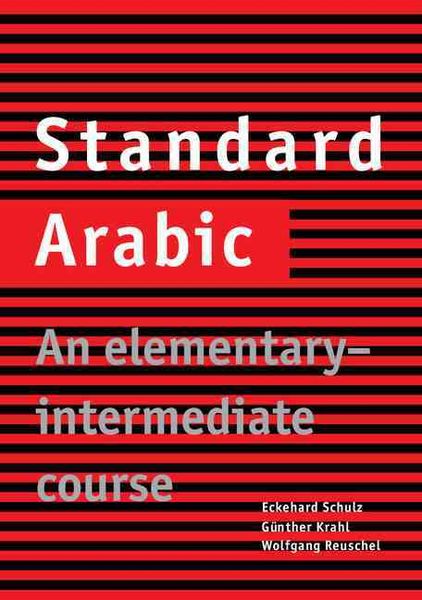
  • Produktbild: Standard Arabic
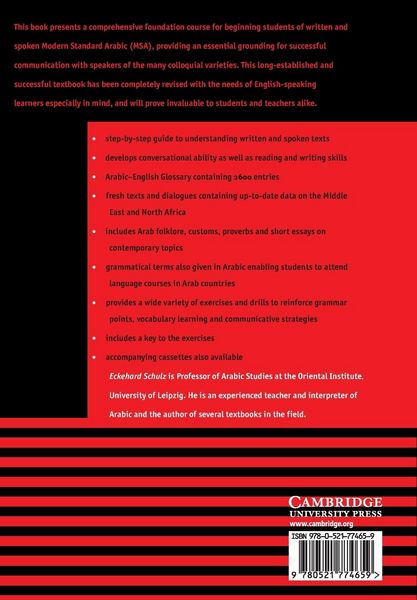
  • Produktbild: Standard Arabic

Standard Arabic An Elementary-Intermediate Course

69,99 €

inkl. gesetzl. MwSt., Versandkostenfrei


Beschreibung

A comprehensive foundation course for beginning students of written and spoken Modern Standard Arabic (MSA).

Beschreibung

A comprehensive foundation course for beginning students of written and spoken Modern Standard Arabic (MSA).

Produktdetails

ISBN

978-0-521-77465-9

Erscheinungsdatum

01.08.2000

Einband

Taschenbuch

Verlag Cambridge University Press

Produktdetails

ISBN

978-0-521-77465-9

Erscheinungsdatum

01.08.2000

Einband

Taschenbuch

Verlag Cambridge University Press
Seitenzahl

641

Maße (L/B/H)

24,4/17/3,5 cm

Gewicht

1147 g

Sprache

Englisch

Herstelleradresse

Libri GmbH
Europaallee 1
36244 Bad Hersfeld
DE

Email: gpsr@libri.de

Noch keine Bewertungen vorhanden

Verfassen Sie die erste Bewertung zu diesem Artikel

Helfen Sie anderen Kundinnen und Kunden durch Ihre Meinung.

Kundinnen und Kunden meinen

Bewertungen (0)

Weitere Artikel finden Sie in

  • Produktbild: Standard Arabic
  • Produktbild: Standard Arabic
  • Lesson 1. The alphabet (pronunciation and writing); Lesson 2. Article; Gender; The equational sentence; Agreement in gender; Lesson 3. Number; The personal pronoun; The noun and the adjective; The adjective; Lesson 4. Radical, root, pattern; The broken plural; Declension and nunation; Stress; Prepositions; Lesson 5. The perfect tense; The verbal sentence; The objective clause; The Nisba-ending; Lesson 6. The genitive construction; Affixed pronouns; Definiteness (summary); The adverb; Lesson 7. The imperfect tense; Demonstrative pronouns; Diptotes; Lesson 8. Subjunctive and jussive; The imperative; Negation; Lesson 9. The dual; The numerals 1 and 2; 'How much/many'; The names of the months; Lesson 10. Cardinal numerals; The year; Lesson 11. The perfect tense of verbs; Word order and the subject of the sentence; Lesson 12. The imperfect tense of verbs; Subjunctive and jussive of verbs; The imperative of verbs; The verbs; Lesson 13. Temporal auxiliary verbs; Lesson 14. Forms II, III and IV of the verb; The attributive relative clause; Lesson 15. Forms II, III and IV of verbs continued; The nominal relative clause; Lesson 16. Ordinal numbers; Dates; The time; Numeral adverbs; Fractional numbers; Numeral adverbs of reiteration; Decimal numbers; Lesson 17. Forms V and VI of the verb; Word order; Genitive constructions; Lesson 18. Forms VII, VIII and X of the verb; Lesson 19. The passive voice; About the construction of doubly transitive verbs; Some characteristic features of the derived forms; Lesson 20. The collective; Names of nationalities; The feminine Nisba; Lesson 21. The participle; Patterns of the participle; The usage of the participles; Shortened relative clauses; The participle as predicate; The False Idafa; Participles and adjectives as 1st or 2nd term of the Idafa; Impersonal expressions; Lesson 22. The infinitive; The use; The infinitive instead of a subordinate clause; Functional verbs; Functional verbs instead of passive constructions; Adverb and adverbial constructions; The usage; The cognate accusative; Lesson 23. Subordinate clauses: a survey; Temporal clauses; Lesson 24. Verbs R2=R3; Verbs with Hamza; The spelling of Hamza; Clauses of reason; Lesson 25. The pattern; The elative as positive; The elative as comparative; The elative as superlative; Common elatives; Specification; Lesson 26. Conditional sentences; The real conditional sentence; The unreal conditional sentence; The concessive clause; Lesson 27. Exceptives; Other exceptive particles; Diminutives; Lesson 28. The Hal-accusative; The Hal-clause; Survey of use of the accusative; Exclamations in the accusative.