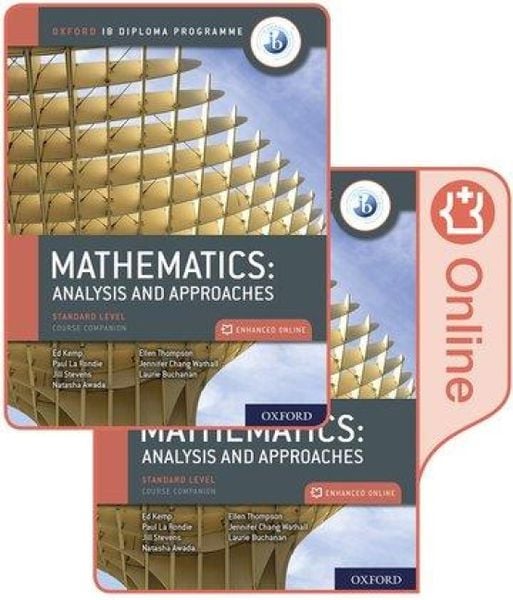
Produktbild: Oxford IB Diploma Programme: IB Mathematics: analysis and approaches

Oxford IB Diploma Programme: IB Mathematics: analysis and approaches

99,99 €

inkl. gesetzl. MwSt., Versandkostenfrei


Produktdetails

ISBN

978-0-19-842710-0

Erscheinungsdatum

21.02.2019

Unterrichtsfächer

Mathematik

Einband

Taschenbuch

Verlag

Oxford Children's Books

Seitenzahl

725

Maße (L/B/H)

19,6/25,3/3 cm

Gewicht

1614 g

Sprache

Englisch

Produktdetails

ISBN

978-0-19-842710-0

Erscheinungsdatum

21.02.2019

Unterrichtsfächer

Mathematik

Einband

Taschenbuch

Verlag

Oxford Children's Books

Seitenzahl

725

Maße (L/B/H)

19,6/25,3/3 cm

Gewicht

1614 g

Sprache

Englisch

Herstelleradresse

Libri GmbH
Europaallee 1
36244 Bad Hersfeld
DE

Email: GPSR Kontakt

Noch keine Bewertungen vorhanden

Verfassen Sie die erste Bewertung zu diesem Artikel

Helfen Sie anderen Kundinnen und Kunden durch Ihre Meinung.

Kundinnen und Kunden meinen

Bewertungen (0)

Weitere Artikel finden Sie in

  • Produktbild: Oxford IB Diploma Programme: IB Mathematics: analysis and approaches
    • From patterns to generalizations: sequences and series
    • 1.1: Number patterns and sigma notation
    • 1.2: Arithmetic and geometric sequences
    • 1.3: Arithmetic and geometric series
    • 1.4: Modelling using arithmetic and geometric series
    • 1.5: The binomial theorem
    • 1.6: Proofs
    • Representing relationships: introducing functions
    • 2.1: What is a function?
    • 2.2: Functional notation
    • 2.3: Drawing graphs of functions
    • 2.4: The domain and range of a function
    • 2.5: Composition of functions
    • 2.6: Inverse functions
    • Modelling relationships: linear and quadratic functions
    • 3.1: Parameters of a linear function
    • 3.2: Linear functions
    • 3.3: Transformations of functions
    • 3.4: Graphing quadratic functions
    • 3.5: Solving quadratic equations by factorization and completing the square
    • 3.6: The quadratic formula and the discriminant
    • 3.7: Applications of quadratics
    • Equivalent representations: rational functions
    • 4.1: The reciprocal function
    • 4.2: Transforming the reciprocal function
    • 4.3: Rational functions of the form ax+b/cx+d
    • Measuring change: differentiation
    • 5.1: Limits and convergence
    • 5.2: The derivative function
    • 5.3: Differentiation rules
    • 5.4: Graphical interpretation of first and second derivatives
    • 5.5: Application of differential calculus: optimization and kinematics
    • Representing data: statistics for univariate data
    • 6.1: Sampling
    • 6.2: Presentation of data
    • 6.3: Measures of central tendency
    • 6.4: Measures of dispersion
    • Modelling relationships between two data sets: statistics for bivariate data
    • 7.1: Scatter diagrams
    • 7.2: Measuring correlation
    • 7.3: The line of best fit
    • 7.4: Least squares regression
    • Quantifying randomness: probability
    • 8.1: Theoretical and experimental probability
    • 8.2: Representing probabilities: Venn diagrams and sample spaces
    • 8.3: Independent and dependent events and conditional probability
    • 8.4: Probability tree diagrams
    • Representing equivalent quantities: exponentials and logarithms
    • 9.1: Exponents
    • 9.2: Logarithms
    • 9.3: Derivatives of exponential functions and the natural logarithmic function
    • From approximation to generalization: integration
    • 10.1: Antiderivatives and the indefinite integral
    • 10.2: More on indefinite integrals
    • 10.3: Area and definite integrals
    • 10.4: Fundamental theorem of calculus
    • 10.5: Area between two curves
    • Relationships in space: geometry and trigonometry in 2D and 3D
    • 11.1: The geometry of 3D shapes
    • 11.1: Right-angles triangle trigonometry
    • 11.3: The sine rule
    • 11.4: The cosine rule
    • 11.5: Applications of right and non-right angled trigonometry
    • Periodic relationships: trigonometric functions
    • 12.1: Radian measure, arcs, sectors and segments
    • 12.2: Trigonometric ratios in the unit circle
    • 12.3: Trigonometric identities and equations
    • 12.4: Trigonometric functions
    • Modelling change: more calculus
    • 13.1: Derivatives with sine and cosine
    • 13.2: Applications of derivatives
    • 13,3: Integration with sine, cosine and substitution
    • 13.4: Kinematics and accumulating change
    • Valid comparisons and informed decisions: probability distributions
    • 14.1: Random variables
    • 14.2: The binomial distribution
    • 14.3: The normal distribution
    • Exploration