From the reviews:
"As an introductory text, Beginning functional analysis delivers what it says: a fast moving introduction into this world of abstract analysis. … There is a great deal to recommend this book: it is clearly and concisely written, and works to overcome some of the dryness from which many similar books suffer. … In reviewing it, I found it an enjoyable read, which, more than once, found its way to my bedside table." (James Gazet, The Mathematical Gazette, March, 2005)
"According to the author, her primary goal was to write a text for (advanced undergraduates or beginning graduate) students that would introduce them to ‘the beautiful field of functional analysis’. This objective is certainly achieved with this attractive monograph. … In conclusion: a good companion for students interested in functional analysis." (Lucas Quarta, Belgian Mathematical Society-Simon Stevin Bulletin, Vol. 10 (2), 2003)
"There are really two levels to this book. First, it is an introductory text. Second, it provides a glimpse into the history of functional analysis and the personalities who developed the subject. Saxe has succeeded in presenting both of these subjects. … This is a good book for students to learn functional analysis. It is also one that students will enjoy using and out of which they will get more than just the nuts and bolts of the topics." (Robert W. Vallin, MAA Online, September, 2002)
"This is an excellent introductory text in functional analysis; it is more than just another book on the subject because of the author’s pleasant and vivid manner of writing and her original pedagogical point of view. The material has been adequately selected, each chapter is supplied with problems of different grades of difficulty and the bibliography contains the best books in the area. … Containing ‘what everyone should know about functional analysis’, this book has all the qualities to ensure a pedagogicalsuccess.” (Ioana Cioranescu, Mathematical Reviews, Issue 2002 m)
"The author offers a course of functional analysis for beginners in less than 200 pages: the prerequisites are a basic knowledge of linear algebra and real analysis. … The author’s style is stimulating, and she includes numerous comments on the development of the discipline." (European Mathematical Society Newsletter, September, 2002)
"The text is carefully written throughout. Many exercises varying from straightforward to challenging, are useful for self-study or independent study of the book. … The text contains many interesting remarks on the historical origins of mathematical concepts and theorems, and biographical information on mathematicians who contributed to the theories presented (e.g. M. Fréchet, F. Riesz, P. Enflo, M. Stone). The book is highly recommendable for a first course in functional analysis." (Joachim Naumann, Zentralblatt MATH, Vol. 1002 (2), 2003)
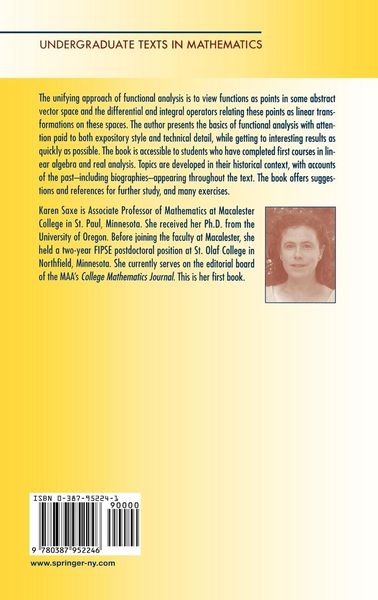
"The author presents the basics of functional analysis with attention paid to both expository style and technical detail, while getting to interesting results as quickly as possible. The book is accessible to students who have completed first courses in linear algebra and real analysis." (L’Enseignement Mathematique, Vol. 48 (1-2), 2002)
"The book is accessible to students who have completed first courses in linear algebra and real analysis. … Beginning Functional Analysis is designed as a text for a first course on functional analysis for advanced undergraduates or for beginning graduate students. … It can also be used for self-study or independent study. … It contains information about the historical development of the material and biographical information of key developers of the theories." (Karen Saxe, Wordtrade, 2009)