
















































KI-Beratung Beta

Gutscheinbedingungen

Gültig bis 30.11.2026 | Gültig für nicht preisgebundene fremdsprachige Bücher | Einzelne Artikel können ausgeschlossen sein | Online auf thalia.de und in der Thalia App einlösbar | Click & Collect nur mit Online-Zahlung (Paypal/Kreditkarte) vorab | Nicht kombinierbar mit anderen Gutscheinen oder Preisaktionen | Nur einmal pro Einkauf einlösbar | Gutschein wird auf max. 500€ Bestellwert angerechnet | Keine Barauszahlung | Nicht gültig für Versandkosten und Services

  • Produktbild: 3D QSAR in Drug Design
  • Produktbild: 3D QSAR in Drug Design
Band 3

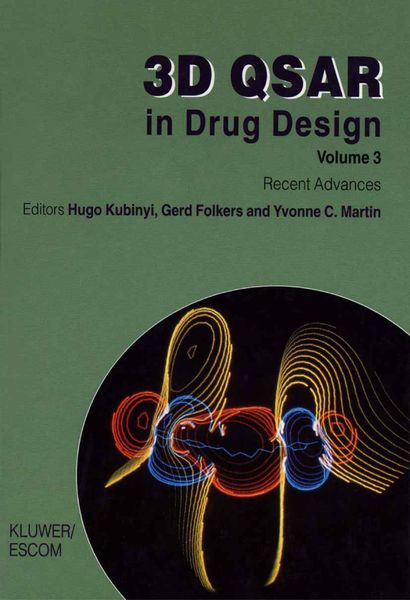
3D QSAR in Drug Design Recent Advances

213,99 €

inkl. gesetzl. MwSt., Versandkostenfrei


Beschreibung

Significant progress has been made in the study of three-dimensional quantitative structure-activity relationships (3D QSAR) since the first publication by Richard Cramer in 1988 and the first volume in the series, 3D QSAR in Drug Design. Theory, Methods and Applications, published in 1993. The aim of...

Beschreibung

Significant progress has been made in the study of three-dimensional quantitative structure-activity relationships (3D QSAR) since the first publication by Richard Cramer in 1988 and the first volume in the series, 3D QSAR in Drug Design. Theory, Methods and Applications, published in 1993. The aim of that early book was to contribute to the understanding and the further application of CoMFA and related approaches and to facilitate the appropriate use of these methods. Since then, hundreds of papers have appeared using the quickly developing techniques of both 3D QSAR and computational sciences to study a broad variety of biological problems. Again the editor(s) felt that the time had come to solicit reviews on published and new viewpoints to document the state of the art of 3D QSAR in its broadest definition and to provide visions of where new techniques will emerge or new appli- tions may be found. The intention is not only to highlight new ideas but also to show the shortcomings, inaccuracies, and abuses of the methods. We hope this book will enable others to separate trivial from visionary approaches and me-too methodology from in- vative techniques. These concerns guided our choice of contributors. To our delight, our call for papers elicited a great many manuscripts.

Rezension

`
...
Volume 3
is a valuable resource text for scientists with a background or serious interest in 3D QSAR who are interested in CoMFA and related methodology. overall this 3 book series is a wonderful reference source for scientists interested 3D QSAR.
'
SIM News, 49:4 (1999)

Produktdetails

Einband

Gebundene Ausgabe

Erscheinungsdatum

30.04.1998

Abbildungen

IX, 353 p.

Herausgeber Hugo Kubinyi + weitere

Produktdetails

Einband

Gebundene Ausgabe

Erscheinungsdatum

30.04.1998

Abbildungen

IX, 353 p.

Herausgeber
Verlag Springer Netherland
Seitenzahl

353

Maße (L/B/H)

24,1/16/2,7 cm

Gewicht

726 g

Auflage

Volume 2 also available as Volumes 9-11 (1997) and Volume 3 as Volumes 12-14 (1998) of PERSPECTIV...

Sprache

Englisch

ISBN

978-0-7923-4791-0

Herstelleradresse

Springer-Verlag GmbH
Europaplatz 3
69115 Heidelberg
DE

Email: ProductSafety@springernature.com

Ein neues Kapitel für Ihre Bücher

Ein neues Kapitel für Ihre Bücher

Schenken Sie Ihren alten Schätzen ein zweites Leben und erhalten Sie dafür eine Thalia Geschenkkarte.

Jetzt verkaufen
Jetzt verkaufen

Noch keine Bewertungen vorhanden

Verfassen Sie die erste Bewertung zu diesem Artikel

Helfen Sie anderen Kundinnen und Kunden durch Ihre Meinung.

Kundinnen und Kunden meinen

Bewertungen (0)

  • Produktbild: 3D QSAR in Drug Design
  • Produktbild: 3D QSAR in Drug Design
  • 3D QSAR Methodology CoMFA and Related Approaches.- 3D QSAR: Current State, Scope, and Limitations.- Recent Progress in CoMFA Methodology and Related Techniques.- Improving the Predictive Quality of CoMFA Models.- Cross-Validated R2 Guided Region Selection for CoMFA Studies.- GOLPE-Guided Region Selection.- Comparative Molecular Similarity Indices Analysis: CoMSIA.- Alternative Partial Least-Squares (PLS) Algorithms.- Receptor Models and Other 3D QSAR Approaches.- Receptor Surface Models.- Pseudoreceptor Modelling in Drug Design: Applications of Yak and PrGen.- Genetically Evolved Receptor Models (GERM) as a 3D QSAR Tool.- 3D QSAR of Flexible Molecules Using Tensor Representation.- Comparative Molecular Moment Analysis (CoMMA).- 3D QSAR Applications.- The CoMFA Steroids as a Benchmark Dataset for Development of 3D QSAR Methods.- Molecular Similarity Characterization Using CoMFA.- Building a Bridge between G-Protein-Coupled Receptor Modelling, Protein Crystallography and 3D QSAR Studies for Ligand Design.- A Critical Review of Recent CoMFA Applications.