















































KI-Beratung Beta

  • Produktbild: Computational Logic in Multi-Agent Systems
  • Produktbild: Computational Logic in Multi-Agent Systems
Band 3487

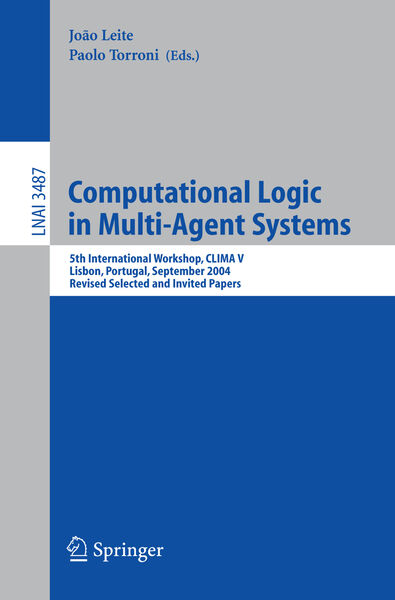
Computational Logic in Multi-Agent Systems 5th International Workshop, CLIMA V, Lisbon, Portugal, September 29-30, 2004, Revised Selected and Invited Papers

68,99 €

inkl. gesetzl. MwSt., Versandkostenfrei


Beschreibung

The notion of agency has recently increased its in?uence in the research and - velopment of computational logic based systems, while at the same time sign- cantly gaining from decades of research in computational logic. Computational logic provides a well-de?ned, general, and rigorous framework for studying...

Beschreibung

The notion of agency has recently increased its in?uence in the research and - velopment of computational logic based systems, while at the same time sign- cantly gaining from decades of research in computational logic. Computational logic provides a well-de?ned, general, and rigorous framework for studying s- tax, semantics and procedures, for implementations, environments, tools, and standards, facilitating the ever important link between speci?cation and ver- cation of computational systems. The purpose of the Computational Logic in Multi-agent Systems (CLIMA) international workshop series is to discuss techniques, based on computational logic, for representing, programming, and reasoning about multi-agent systems in a formal way. Former CLIMA editions were conducted in conjunction with other major computational logic and AI events such as CL in July 2000, ICLP in December 2001, FLoC in August 2002, and LPNMR and AI-Math in January 2004. The ?fth edition of CLIMA was held Lisbon, Portugal, in September 29–30, 2004.We,asorganizers,andinagreementwiththeCLIMASteeringCommittee, opted for co-location with the 9th European Conference on Logics in Arti?cial Intelligence (JELIA 2004), wishing to promote the CLIMA research topics in the broader community of logics in AI, a community whose growing interest in multi-agent issues has been demonstrated by the large number of agent-related papers submitted to recent editions of JELIA. The workshop received 35 submissions – a sensible increase from the previous edition.Thesubmittedpapersshowedthatthelogicalfoundationsofmulti-agent systems are felt by a large community to be a very important research topic, upon which classical AI and agent-related issues are to be addressed.

Produktdetails

Einband

Taschenbuch

Erscheinungsdatum

20.07.2005

Abbildungen

XII, 284 p.

Herausgeber João Leite + weitere

Produktdetails

Einband

Taschenbuch

Erscheinungsdatum

20.07.2005

Abbildungen

XII, 284 p.

Herausgeber
Verlag Springer Berlin
Seitenzahl

284

Maße (L/B/H)

23,5/15,5/1,7 cm

Gewicht

458 g

Auflage

2005

Sprache

Englisch

ISBN

978-3-540-28060-6

Herstelleradresse

Springer-Verlag KG
Sachsenplatz 4-6
1201 Wien
AT

Email: ProductSafety@springernature.com

Ein neues Kapitel für Ihre Bücher

Ein neues Kapitel für Ihre Bücher

Schenken Sie Ihren alten Schätzen ein zweites Leben und erhalten Sie dafür eine Thalia Geschenkkarte.

Jetzt verkaufen
Jetzt verkaufen

Noch keine Bewertungen vorhanden

Verfassen Sie die erste Bewertung zu diesem Artikel

Helfen Sie anderen Kundinnen und Kunden durch Ihre Meinung.

Kundinnen und Kunden meinen

Bewertungen (0)

  • Produktbild: Computational Logic in Multi-Agent Systems
  • Produktbild: Computational Logic in Multi-Agent Systems
  • Foundations.- A Logic for Knowledge, Correctness, and Real Time.- Dynamic Logic for Plan Revision in Intelligent Agents.- Contextual Taxonomies.- From Logic Programs Updates to Action Description Updates.- Dynamic Logic Programming: Various Semantics Are Equal on Acyclic Programs.- Architectures.- Declarative Agent Control.- Metareasoning for Multi-agent Epistemic Logics.- Graded BDI Models for Agent Architectures.- Interaction.- Inferring Trust.- Coordination Between Logical Agents.- A Computational Model for Conversation Policies for Agent Communication.- Verifying Protocol Conformance for Logic-Based Communicating Agents.- Planning and Applications.- An Application of Global Abduction to an Information Agent Which Modifies a Plan Upon Failure – Preliminary Report.- Planning Partially for Situated Agents.- Desire-Space Analysis and Action Selection for Multiple Dynamic Goals.- Organising Software in Active Environments.