
















































KI-Beratung Beta

  • Produktbild: Nanowires and Nanobelts: Materials, Properties and Devices
  • Produktbild: Nanowires and Nanobelts: Materials, Properties and Devices

Nanowires and Nanobelts: Materials, Properties and Devices Volume 2: Nanowires and Nanobelts of Functional Materials

97,99 €

inkl. gesetzl. MwSt., Versandkostenfrei


Beschreibung

Nanowires, nanobelts, nanoribbons, nanorods , are a new class of quasi-o- dimensional materials that have been attracting a great research interest in the last few years. These non-carbon based materials have been demonstrated to exhibit superior electrical, optical, mechanical and thermal properties,...

Beschreibung

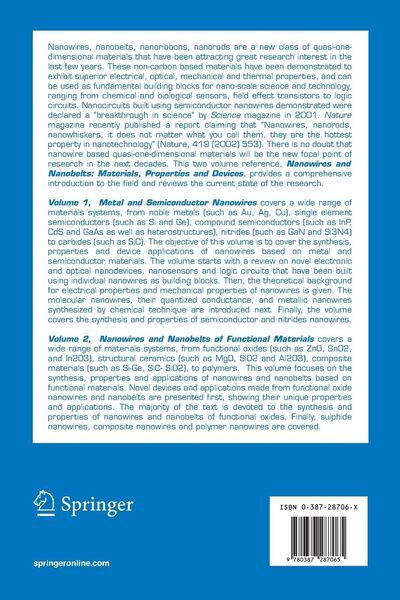
Nanowires, nanobelts, nanoribbons, nanorods , are a new class of quasi-o- dimensional materials that have been attracting a great research interest in the last few years. These non-carbon based materials have been demonstrated to exhibit superior electrical, optical, mechanical and thermal properties, and can be used as fundam- tal building blocks for nano-scale science and technology, ranging from chemical and biological sensors, field effect transistors to logic circuits. Nanocircuits built using semiconductor nanowires demonstrated were declared a breakthrough in science by Science magazine in 2001. Nature magazine recently published a report claiming that Nanowires, nanorods, nanowhiskers, it does not matter what you call them, they are the hottest property in nanotechnology (Nature 419 (2002) 553). There is no doubt that nanowire based quasi-one-dimensional materials will the new focal point of research in the next decades. Volume 1: Metal and Semiconductor Nanowires covers a wide range of ma- rials systems, from noble metals (such as Au,Ag, Cu), single element semiconductors (such as Si and Ge), compound semiconductors (such as InP, CdS and GaAs as well as heterostructures), nitrides (such as GaN and Si N ) to carbides (such as SiC). The 3 4 objective of this volume is to cover the synthesis, properties and device applications of nanowires based on metal and semiconductor materials. The volume starts with a review on novel electronic and optical nanodevices, nanosensors and logic circuits that have been built using individual nanowires as building blocks.

Produktdetails

Einband

Taschenbuch

Erscheinungsdatum

29.09.2005

Abbildungen

XIII, 300 p.

Herausgeber Zhong Lin Wang

Produktdetails

Einband

Taschenbuch

Erscheinungsdatum

29.09.2005

Abbildungen

XIII, 300 p.

Herausgeber Zhong Lin Wang
Verlag Springer Us
Seitenzahl

300

Maße (L/B/H)

23,5/15,5/2 cm

Gewicht

546 g

Sprache

Englisch

ISBN

978-0-387-28706-5

Herstelleradresse

Springer-Verlag KG
Sachsenplatz 4-6
1201 Wien
AT

Email: ProductSafety@springernature.com

Ein neues Kapitel für Ihre Bücher

Ein neues Kapitel für Ihre Bücher

Schenken Sie Ihren alten Schätzen ein zweites Leben und erhalten Sie dafür eine Thalia Geschenkkarte.

Jetzt verkaufen
Jetzt verkaufen

Noch keine Bewertungen vorhanden

Verfassen Sie die erste Bewertung zu diesem Artikel

Helfen Sie anderen Kundinnen und Kunden durch Ihre Meinung.

Kundinnen und Kunden meinen

Bewertungen (0)

  • Produktbild: Nanowires and Nanobelts: Materials, Properties and Devices
  • Produktbild: Nanowires and Nanobelts: Materials, Properties and Devices
  • Nanodevices Based on Nanowires and Nanobelts.- Nanodevice, Nanosensors and Nanocantilevers Based on Semiconducting Oxide Nanobelts.- Oxide Nanowires and Nanolasers.- Functional Oxide Nanowires and Nanobelts.- Nanobelts and Nanostructures of Transparent Conducting Oxides.- Nanomechanics and Mechanical Behavior of Nanobelts.- Ferroelectric Nanowires.- Growth of Oxide Nanorods through Sol Electrophoretic Deposition.- Nanowires of Functional Oxides.- Controlled Growth and Optical Properties of Zinc Oxide Nanostructures.- One-Step Hydrothermal Synthesis and Characterizations of Titanate Nanostructures.- Nanowires and Nanotubes of Complex Oxides.- Silica Nanowires/Nanotubes.- Sulphide, Polymer and Composite Nanowires.- Sulphide Nanowires.- Generalized Solution Synthesis of Large Arrays of Extended and Oriented Nanowires.- Composite Nanowires.- Polymer Nanowires and Nanofibers.