
















































KI-Beratung Beta

Gutscheinbedingungen

Gültig bis 30.11.2026 | Gültig für nicht preisgebundene fremdsprachige Bücher | Einzelne Artikel können ausgeschlossen sein | Online auf thalia.de und in der Thalia App einlösbar | Click & Collect nur mit Online-Zahlung (Paypal/Kreditkarte) vorab | Nicht kombinierbar mit anderen Gutscheinen oder Preisaktionen | Nur einmal pro Einkauf einlösbar | Gutschein wird auf max. 500€ Bestellwert angerechnet | Keine Barauszahlung | Nicht gültig für Versandkosten und Services

  • Produktbild: Surviving Globalization?
  • Produktbild: Surviving Globalization?

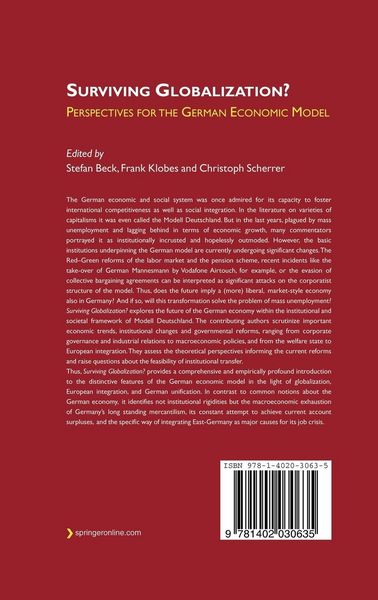
Surviving Globalization? Perspectives for the German Economic Model

106,99 €

inkl. gesetzl. MwSt., Versandkostenfrei


Beschreibung

society, and state (Streeck, 1999; Simonis, 1998). Interspersed between these most commonly named elements are the following: First, the high political integrating force of the German Model after WWII was based on the adoption and transformation of corporatist political structures from National Socialist...

Beschreibung

society, and state (Streeck, 1999; Simonis, 1998). Interspersed between these most commonly named elements are the following: First, the high political integrating force of the German Model after WWII was based on the adoption and transformation of corporatist political structures from National Socialist Germany. Liberal capitalism was (re)introduced under political competition between Christian Democrats and Social Democrats, who eventually found common ground in the politically mediated compromise between capital and labor: “This compromise was negotiated and institutionalized at a time when the communist wing of the workers movement and the authoritarian voices of German capital – for various reasons – were excluded from political participation” (Streeck, 1999, p. 15; translation: SB). The partnership between firms and unions manifested itself in manifold institutional structures. Apart from the social partners’ autonomy in matters of wage policy, worker codetermination at plant level and in operations is regarded as one of the special achievements of the German Model and has contributed substantially to social peace. The political coordination forms of concerted action, round tables, as well as modernization and crisis cartels gave birth to a highly complex political decision-making structure which, based on a federalist setup, has rightly been called “negotiation state” (Esser, 1998, p. 123). Second, the material foundation of this “Social Democratic class compromise” (Buci-Glucksmann & Therborn, 1981) consisted in the Federal Republic’s – in the words of Göste Esping-Andersen – “conservative-liberal” form of welfare state.

Produktdetails

Einband

Gebundene Ausgabe

Erscheinungsdatum

04.04.2005

Abbildungen

VII, 243 p.

Herausgeber Stefan Beck + weitere

Produktdetails

Einband

Gebundene Ausgabe

Erscheinungsdatum

04.04.2005

Abbildungen

VII, 243 p.

Herausgeber
Verlag Springer Us
Seitenzahl

243

Maße (L/B/H)

24,1/16/1,9 cm

Gewicht

495 g

Auflage

2005

Sprache

Englisch

ISBN

978-1-4020-3063-5

Herstelleradresse

Springer-Verlag GmbH
Europaplatz 3
69115 Heidelberg
DE

Email: ProductSafety@springernature.com

Ein neues Kapitel für Ihre Bücher

Ein neues Kapitel für Ihre Bücher

Schenken Sie Ihren alten Schätzen ein zweites Leben und erhalten Sie dafür eine Thalia Geschenkkarte.

Jetzt verkaufen
Jetzt verkaufen

Noch keine Bewertungen vorhanden

Verfassen Sie die erste Bewertung zu diesem Artikel

Helfen Sie anderen Kundinnen und Kunden durch Ihre Meinung.

Kundinnen und Kunden meinen

Bewertungen (0)

  • Produktbild: Surviving Globalization?
  • Produktbild: Surviving Globalization?

  • Acknowledgements.- 1. Introduction (Stefan Beck, Frank Klobes and Christoph Scherrer).- 2. Can Germany Learn from the USA? (Christoph Scherrer).- 3. After the Miracle (Stefan Beck).- 4. The Dynamics of Industrial Restructuring (Frank Klobes).- 5. The German Way (Michael Fichter).- 6. Disentangling Deutschland AG (Christian Kellermann).- 7. Transforming the Welfare State (Kai Mosebach).- 8. Erosion of the Tax Basis (Kai Mosebach).- 9. European Integration (Gülay Çaglar).- 10. Explaining the Dynamics of Red-Green Economic Reforms (Stefan Beck, Christoph Scherrer).- 11. Conclusion (Stefan Beck, Frank Klobes and Christoph Scherrer).- Subject Index.