















































KI-Beratung Beta

Gutscheinbedingungen

Gültig bis 11.11.2026 | Gültig für Spielzeug, Filme, Musik, Software, Games, Geschenke & Trends, Schreibwaren, Hörbücher und Hörbuch-Downloads (außer Abo & Shelfies), gebrauchte Bücher, nicht preisgebundene Bücher und Kalender | Einlösbar unter thalia.de und in der Thalia App | Click & Collect nur mit Online-Zahlung (Paypal/Kreditkarte) vorab | Einzelne Artikel können ausgeschlossen sein | Nicht kombinierbar mit anderen Gutscheinen oder Preisaktionen | Nur einmal pro Einkauf einlösbar | Gutschein wird auf max. 500€ Bestellwert angerechnet | Keine Barauszahlung | Digitale Hörbücher nur für Android  | Nicht gültig für preisgebundene Artikel (aufgrund der Buchpreisbindung sind Gutscheine nicht auf Bücher, eBooks, Presse einlösbar), tolino eReader & Zubehör, Abonnements & Flatrates, Geschenkkarten, Versandkosten und Services

  • Produktbild: Dynamic Power Management
  • Produktbild: Dynamic Power Management

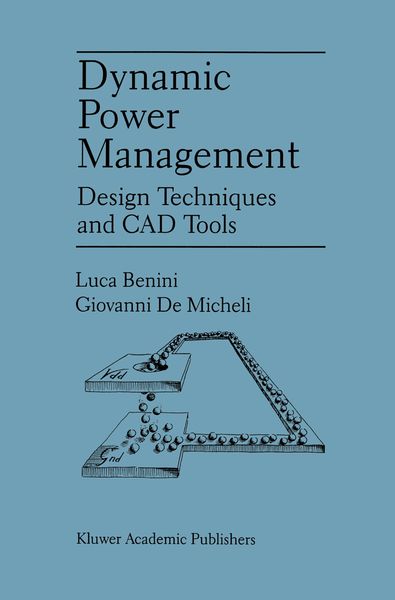
Dynamic Power Management Design Techniques and CAD Tools

159,99 €

inkl. gesetzl. MwSt., Versandkostenfrei


Beschreibung

Dynamic power management is a design methodology aiming at controlling performance and power levels of digital circuits and systems, with the goal of extending the autonomous operation time of battery-powered systems, providing graceful performance degradation when supply energy is limited, and adapting...

Beschreibung

Dynamic power management is a design methodology aiming at controlling performance and power levels of digital circuits and systems, with the goal of extending the autonomous operation time of battery-powered systems, providing graceful performance degradation when supply energy is limited, and adapting power dissipation to satisfy environmental constraints.
Dynamic Power Management: Design Techniques and CAD Tools
addresses design techniques and computer-aided design solutions for power management. Different approaches are presented and organized in an order related to their applicability to control-units, macro-blocks, digital circuits and electronic systems, respectively. All approaches are based on the principle of exploiting idleness of circuits, systems, or portions thereof. They involve both the detection of idleness conditions and the freezing of power-consuming activities in the idle components.
The book also describes some approaches to system-level power management, including Microsoft's OnNow architecture and the `Advanced Configuration and Power Management' standard proposed by Intel, Microsoft and Toshiba. These approaches migrate power management to the software layer running on hardware platforms, thus providing a flexible and self-configurable solution to adapting the power/performance tradeoff to the needs of mobile (and fixed) computing and communication.
Dynamic Power Management: Design Techniques and CAD Tools
is of interest to researchers and developers of computer-aided design tools for integrated circuits and systems, as well as to system designers.

Produktdetails

Einband

Gebundene Ausgabe

Erscheinungsdatum

30.11.1997

Abbildungen

XV, 231 p.

Verlag Springer Us

Produktdetails

Einband

Gebundene Ausgabe

Erscheinungsdatum

30.11.1997

Abbildungen

XV, 231 p.

Verlag Springer Us
Seitenzahl

231

Maße (L/B/H)

24,1/16/1,9 cm

Gewicht

495 g

Auflage

1998

Sprache

Englisch

ISBN

978-0-7923-8086-3

Herstelleradresse

Springer-Verlag GmbH
Europaplatz 3
69115 Heidelberg
DE

Email: ProductSafety@springernature.com

Ein neues Kapitel für Ihre Bücher

Ein neues Kapitel für Ihre Bücher

Schenken Sie Ihren alten Schätzen ein zweites Leben und erhalten Sie dafür eine Thalia Geschenkkarte.

Jetzt verkaufen
Jetzt verkaufen

Noch keine Bewertungen vorhanden

Verfassen Sie die erste Bewertung zu diesem Artikel

Helfen Sie anderen Kundinnen und Kunden durch Ihre Meinung.

Kundinnen und Kunden meinen

Bewertungen (0)

  • Produktbild: Dynamic Power Management
  • Produktbild: Dynamic Power Management
  • 1. Introduction.- 1.1 Motivation.- 1.2 Sources of power consumption.- 1.3 Design techniques for low power.- 1.4 CAD techniques for low power.- 1.5 Power management.- 2. Background.- 2.1 Introduction.- 2.2 Boolean algebra and finite-state machines.- 2.3 Implicit representation of discrete functions.- 2.4 Markov analysis of finite-state machines.- 3. Fundamental Concepts.- 3.1 Introduction.- 3.2 Fundamentals.- 3.3 Power management circuitry.- 3.4 Conclusion.- 4. Power Management for Control Units.- 4.1 Introduction.- 4.2 Top-down synthesis.- 4.3 Top-down decomposition.- 4.4 Conclusion.- 5. Power Management for Functional Units.- 5.1 Introduction.- 5.2 Clock distribution design.- 5.3 Logic-level techniques.- 5.4 RTL techniques.- 5.5 Behavioral-level techniques.- 5.6 Conclusion.- 6. Power Management for Systems.- 6.1 Introduction.- 6.2 Operating system-based power management.- 6.3 Advanced configuration and power management.- 6.4 Modeling power management.- 6.5 The policy optimization problem 205 6.5.1 Disk power management.- 6.6 Conclusion.- 7. Conclusion.- 7.1 Summary.- 7.2 Prospects.- References.