















































KI-Beratung Beta

Gutscheinbedingungen

Gültig bis 30.11.2026 | Gültig für nicht preisgebundene fremdsprachige Bücher | Einzelne Artikel können ausgeschlossen sein | Online auf thalia.de und in der Thalia App einlösbar | Click & Collect nur mit Online-Zahlung (Paypal/Kreditkarte) vorab | Nicht kombinierbar mit anderen Gutscheinen oder Preisaktionen | Nur einmal pro Einkauf einlösbar | Gutschein wird auf max. 500€ Bestellwert angerechnet | Keine Barauszahlung | Nicht gültig für Versandkosten und Services

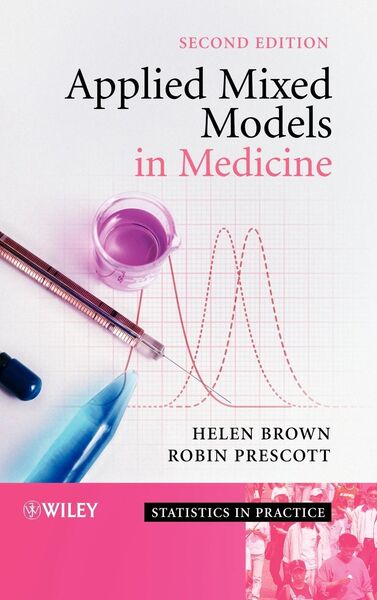
Produktbild: Applied Mixed Models in Medicine 2e

Applied Mixed Models in Medicine 2e

Aus der Reihe Statistics in Practice

156,99 €

inkl. gesetzl. MwSt., Versandkostenfrei


Beschreibung

A mixed model allows the incorporation of both fixed and random variables within a statistical analysis. This enables efficient inferences and more information to be gained from the data. The application of mixed models is an increasingly popular way of analysing medical data, particularly in the pharmaceutical...

Beschreibung

A mixed model allows the incorporation of both fixed and random variables within a statistical analysis. This enables efficient inferences and more information to be gained from the data. The application of mixed models is an increasingly popular way of analysing medical data, particularly in the pharmaceutical industry. There have been many recent advances in mixed modelling, particularly regarding the software and applications. This new edition of a groundbreaking text discusses the latest developments, from updated SAS techniques to the increasingly wide range of applications.
* Presents an overview of the theory and applications of mixed models in medical research, including the latest developments and new sections on bioequivalence, cluster randomised trials and missing data.
* Easily accessible to practitioners in any area where mixed models are used, including medical statisticians and economists.
* Includes numerous examples using real data from medical and health research, and epidemiology, illustrated with SAS code and output.
* Features new version of SAS, including the procedure PROC GLIMMIX and an introduction to other available software.
This much-anticipated second edition is ideal for applied statisticians working in medical research and the pharmaceutical industry, as well as teachers and students of statistics courses in mixed models. The text will also be of great value to a broad range of scientists, particularly those working the medical and pharmaceutical areas.

Rezension

" easy to read, interesting, and informative " ( Journal of Biopharmaceutical Statistics , Vol. 17, Issue 4, 2007) "This second edition gives an overview of the theory of mixed models and its application to data in medical research." ( Zentralblatt MATH, April 2007) " takes a practical rather than theoretical approach and requires understanding of only basic statistics." ( MAA Reviews , October 30, 2006)

Produktdetails

Einband

Gebundene Ausgabe

Erscheinungsdatum

01.06.2006

Verlag John Wiley & Sons Inc
Seitenzahl

480

Produktdetails

Einband

Gebundene Ausgabe

Erscheinungsdatum

01.06.2006

Verlag John Wiley & Sons Inc
Seitenzahl

480

Maße (L/B/H)

23,5/15,7/3,2 cm

Gewicht

923 g

Auflage

2nd edition

Sprache

Englisch

ISBN

978-0-470-02356-3

Herstelleradresse

Libri GmbH
Europaallee 1
36244 Bad Hersfeld
DE

Email: gpsr@libri.de

Ein neues Kapitel für Ihre Bücher

Ein neues Kapitel für Ihre Bücher

Schenken Sie Ihren alten Schätzen ein zweites Leben und erhalten Sie dafür eine Thalia Geschenkkarte.

Jetzt verkaufen
Jetzt verkaufen

Noch keine Bewertungen vorhanden

Verfassen Sie die erste Bewertung zu diesem Artikel

Helfen Sie anderen Kundinnen und Kunden durch Ihre Meinung.

Kundinnen und Kunden meinen

Bewertungen (0)

Die Leseprobe wird geladen.
  • Produktbild: Applied Mixed Models in Medicine 2e
  • Preface to Second Edition.
     
    Mixed Model Notations.
     
    1 Introduction.
     
    1.1 The Use of Mixed Models.
     
    1.2 Introductory Example.
     
    1.3 A Multi-Centre Hypertension Trial.
     
    1.4 Repeated Measures Data.
     
    1.5 More aboutMixed Models.
     
    1.6 Some Useful Definitions.
     
    2 NormalMixed Models.
     
    2.1 Model Definition.
     
    2.2 Model Fitting Methods.
     
    2.3 The Bayesian Approach.
     
    2.4 Practical Application and Interpretation.
     
    2.5 Example.
     
    3 Generalised Linear MixedModels.
     
    3.1 Generalised Linear Models.
     
    3.2 Generalised Linear Mixed Models.
     
    3.3 Practical Application and Interpretation.
     
    3.4 Example.
     
    4 Mixed Models for Categorical Data.
     
    4.1 Ordinal Logistic Regression (Fixed Effects Model).
     
    4.2 Mixed Ordinal Logistic Regression.
     
    4.3 Mixed Models for Unordered Categorical Data.
     
    4.4 Practical Application and Interpretation.
     
    4.5 Example.
     
    5 Multi-Centre Trials and Meta-Analyses.
     
    5.1 Introduction to Multi-Centre Trials.
     
    5.2 The Implications of using Different Analysis Models.
     
    5.3 Example: A Multi-Centre Trial.
     
    5.4 Practical Application and Interpretation.
     
    5.5 Sample Size Estimation.
     
    5.6 Meta-Analysis.
     
    5.7 Example: Meta-analysis.
     
    6 RepeatedMeasures Data.
     
    6.1 Introduction.
     
    6.2 Covariance Pattern Models.
     
    6.3 Example: Covariance Pattern Models for Normal Data.
     
    6.4 Example: Covariance Pattern Models for Count Data.
     
    6.5 Random Coefficients Models.
     
    6.6 Examples of Random Coefficients Models.
     
    6.7 Sample Size Estimation.
     
    7 Cross-Over Trials.
     
    7.1 Introduction.
     
    7.2 Advantages of Mixed Models in Cross-Over Trials.
     
    7.3 The AB/BA Cross-Over Trial.
     
    7.4 Higher Order Complete Block Designs.
     
    7.5 Incomplete Block Designs.
     
    7.6 Optimal Designs.
     
    7.7 Covariance Pattern Models.
     
    7.8 Analysis of Binary Data.
     
    7.9 Analysis of Categorical Data.
     
    7.10 Use of Results from Random Effects Models in Trial Design.
     
    7.11 General Points.
     
    8 Other Applications of MixedModels.
     
    8.1 Trials with Repeated Measurements within Visits.
     
    8.2 Multi-Centre Trials with Repeated Measurements.
     
    8.3 Multi-Centre Cross-Over Trials.
     
    8.4 Hierarchical Multi-Centre Trials and Meta-Analysis.
     
    8.5 Matched Case-Control Studies.
     
    8.6 Different Variances for Treatment Groups in a Simple Between-Patient Trial.
     
    8.7 Estimating Variance Components in an Animal Physiology Trial.
     
    8.8 Inter- and Intra-Observer Variation in Foetal Scan Measurements.
     
    8.9 Components of Variation and Mean Estimates in a Cardiology Experiment.
     
    8.10 Cluster Sample Surveys.
     
    8.11 Small AreaMortality Estimates.
     
    8.12 Estimating Surgeon Performance.
     
    8.13 Event History Analysis.
     
    8.14 A Laboratory Study Using aWithin-Subject 4 × 4 Factorial Design.
     
    8.15 Bioequivalence Studies with Replicate Cross-Over Designs.
     
    8.16 Cluster Randomised Trials.
     
    9 Software for Fitting MixedModels.
     
    9.1 Packages for Fitting Mixed Models.
     
    9.2 Basic use of PROC MIXED.
     
    9.3 Using SAS to Fit Mixed Models to Non-Normal Data.
     
    Glossary.
     
    References.
     
    Index.