















































KI-Beratung Beta

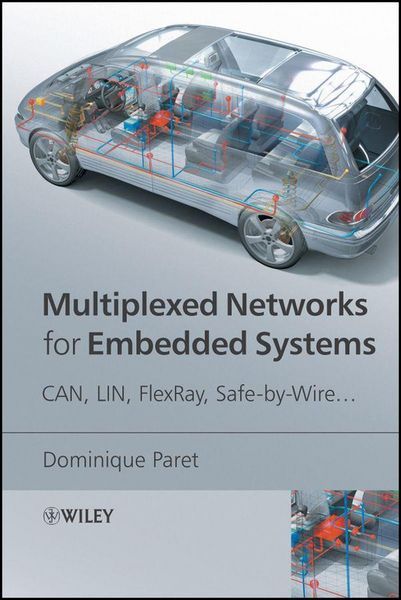
Produktbild: Multiplexed Networks for Embedded Systems

Multiplexed Networks for Embedded Systems CAN, LIN, Flexray, Safe-By-Wire...

182,99 €

inkl. gesetzl. MwSt., Versandkostenfrei


Beschreibung

Multiplexed networks are essential for the unified, efficient and cost-effective exchange of electronic information within embedded component systems. This is especially important in automotive manufacturing as vehicles become increasingly reliant on robust electronic networks and systems for improved...

Beschreibung

Multiplexed networks are essential for the unified, efficient and cost-effective exchange of electronic information within embedded component systems. This is especially important in automotive manufacturing as vehicles become increasingly reliant on robust electronic networks and systems for improved reliability, anti-lock brake systems (ABS), steering, on-board navigation systems, and much more. The latest systems such as X-by-Wire and FlexRay aim to produce faster, fault-tolerant network component interconnects, for state-of-the-art network implementation and safer, more reliable engineering of vehicular systems.
This book provides a thorough and comprehensive introduction to automotive multiplexed network buses, covering the technical principles, components, implementation issues and applications.
A valuable guide to embedded systems for a range of applications, Multiplexed Networks for Embedded Systems: CAN, LIN, FlexRay, Safe-by-Wire...is essential reading for electronics engineers and researchers developing electronics for the automotive industry. It is also useful for practising aerospace engineers and other practitioners interested in the application of network technologies, and advanced students taking courses on automotive and embedded system design. Key features:- Presents a thorough coverage of the controller area network (CAN) protocol, including information on physical layers, conformity problems, hardware and software tools, and application layers.
 
Gives a detailed description of the new local interconnect network (LIN) bus, setting out its developments, properties, problems and ways to overcome these.
 
Examines the existing and emerging network buses such as time-triggered CAN (TTCAN), FlexRay and X-by-Wire.
 
Explores the possibilities for linking the various buses that are discussed, explaining how the Fail-Safe-System basis chip (SBC) and other gateways are designed and constructed.
 
Analyses wired and wireless internal and external serial links, including Safe-by-Wire plus, I2C, Media Oriented Systems Transport (MOST), remote keyless entry, tyre pressure monitoring systems (TPMS) and Bluetooth.

Produktdetails

Einband

Gebundene Ausgabe

Erscheinungsdatum

01.06.2007

Verlag John Wiley & Sons Inc
Seitenzahl

448

Produktdetails

Einband

Gebundene Ausgabe

Erscheinungsdatum

01.06.2007

Verlag John Wiley & Sons Inc
Seitenzahl

448

Maße (L/B/H)

24,9/17,6/3 cm

Gewicht

966 g

Auflage

1. Auflage

Übersetzt von

Roderick Riesco

Sprache

Englisch

ISBN

978-0-470-03416-3

Herstelleradresse

Libri GmbH
Europaallee 1
36244 Bad Hersfeld
DE

Email: gpsr@libri.de

Ein neues Kapitel für Ihre Bücher

Ein neues Kapitel für Ihre Bücher

Schenken Sie Ihren alten Schätzen ein zweites Leben und erhalten Sie dafür eine Thalia Geschenkkarte.

Jetzt verkaufen
Jetzt verkaufen

Noch keine Bewertungen vorhanden

Verfassen Sie die erste Bewertung zu diesem Artikel

Helfen Sie anderen Kundinnen und Kunden durch Ihre Meinung.

Kundinnen und Kunden meinen

Bewertungen (0)

Die Leseprobe wird geladen.
  • Produktbild: Multiplexed Networks for Embedded Systems
  • Preface.
     
    Acknowledgements.
     
    Part A CAN: from concept to reality.
     
    1 The CAN bus: general.
     
    1.1 Concepts of bus access and arbitration.
     
    1.2 Error processing and management.
     
    1.3 Increase your word power.
     
    1.4 From concept to reality.
     
    1.5 Historical context of CAN.
     
    1.6 Patents, licences and certification.
     
    2 CAN: its protocol, its properties, its novel features.
     
    2.1 Definitions of the CAN protocol: 'ISO 11898-1'.
     
    2.2 Errors: their intrinsic properties, detection and processing.
     
    2.3 The rest of the frame.
     
    2.4 CAN 2.0B.
     
    3 The CAN physical layer.
     
    3.1 Introduction.
     
    3.2 The 'CAN bit'.
     
    3.3 Nominal bit time.
     
    3.4 CAN and signal propagation.
     
    3.5 Bit synchronization.
     
    3.6 Network speed.
     
    4 Medium, implementation and physical layers in CAN.
     
    4.1 The range of media and the types of coupling to the network.
     
    4.2 High speed CAN, from 125 kbits -1 to 1 Mbits -1: ISO 11898-2.
     
    4.3 Low speed CAN, from 10 to 125 kbits -1.
     
    4.4 Optical media.
     
    4.5 Electromagnetic media.
     
    4.6 Pollution and EMC conformity.
     
    5 Components, applications and tools for CAN.
     
    5.1 CAN components.
     
    5.2 Applications.
     
    5.3 Application layers and development tools for CAN.
     
    6 Time-triggered protocols - FlexRay.
     
    6.1 Some general remarks.
     
    6.2 Event-triggered and time-triggered aspects.
     
    6.3 TTCAN - Time-triggered communication on CAN.
     
    6.4 Towards high-speed, X-by-Wire and redundant systems.
     
    6.5 FlexRay.
     
    Part B New multiplexed bus concepts: LIN, FlexRay, Fail-safe SBC, Safe-by-Wire.
     
    7 LIN - Local Interconnect Network.
     
    7.1 Introduction.
     
    7.2 Basic concept of the LIN 2.0 protocol.
     
    7.3 Cost and market.
     
    7.4 Conformity of LIN.
     
    7.5 Examples of components for LIN 2.0.
     
    8 Think 'Bus', think 'Fail-safe SBC', 'Gateways'.
     
    8.1 Fail-safe SBCs: their multiple aspects and reasons for using them.
     
    8.2 The strategy and principles of re-use.
     
    8.3 Demo board.
     
    8.4 Gateways.
     
    8.5 Managing the application layers.
     
    9 Safe-by-Wire.
     
    9.1 A little history.
     
    9.2 Safe-by-Wire Plus.
     
    9.3 Some words of technology.
     
    10 Audio-video buses.
     
    10.1 I2C Bus.
     
    10.2 The D2B (Domestic digital) bus.
     
    10.3 The MOST (Media oriented systems transport) bus.
     
    10.4 The IEEE 1394 bus or 'FireWire'.
     
    11 RF communication and wireless mini-networks.
     
    11.1 Radio-frequency communication: internal.
     
    11.2 Radio-frequency communication: external.
     
    11.3 Wireless networks.
     
    Conclusion.
     
    Part C Appendices.
     
    Appendix A. CiA (CAN in Automation).
     
    Appendix B. Essential references.
     
    Appendix C. Further reading.
     
    Appendix D. Useful addresses.
     
    Index.