















































KI-Beratung Beta

Gutscheinbedingungen

Gültig bis 30.11.2026 | Gültig für nicht preisgebundene fremdsprachige Bücher | Einzelne Artikel können ausgeschlossen sein | Online auf thalia.de und in der Thalia App einlösbar | Click & Collect nur mit Online-Zahlung (Paypal/Kreditkarte) vorab | Nicht kombinierbar mit anderen Gutscheinen oder Preisaktionen | Nur einmal pro Einkauf einlösbar | Gutschein wird auf max. 500€ Bestellwert angerechnet | Keine Barauszahlung | Nicht gültig für Versandkosten und Services

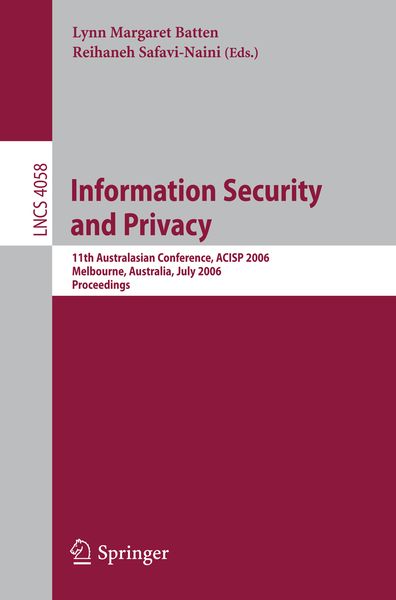
  • Produktbild: Information Security and Privacy
  • Produktbild: Information Security and Privacy
Band 4058

Information Security and Privacy 11th Australasian Conference, ACISP 2006, Melbourne, Australia, July 3-5, 2006, Proceedings

Aus der Reihe Security and Cryptology

49,99 €

inkl. gesetzl. MwSt., Versandkostenfrei


Beschreibung

The 11th Australasian Conference on Information Security and Privacy (ACISP 2006) was held in Melbourne, 3–5 July, 2006. The conference was sponsored by Deakin University, the Research Network for a Secure Australia, and was organized in cooperation with the University of Wollongong. The conference brought...

Beschreibung

The 11th Australasian Conference on Information Security and Privacy (ACISP 2006) was held in Melbourne, 3–5 July, 2006. The conference was sponsored by Deakin University, the Research Network for a Secure Australia, and was organized in cooperation with the University of Wollongong. The conference brought together researchers,practitioners and a wide range of other users from academia, industries and government organizations. The program included 35 papers covering important aspects of information security technologies. The papers were selected from 133 submissions through a two-stage anonymous review process. Each paper received at least three reviews by members of the Program Committee, and was then scrutinized by the whole committee during a two-week discussion. There were 19 papers eligible for the “best student paper” award. The award was given to Yang Cui from the U- versity of Tokyo for the paper “Tag-KEM from Set Partial Domain One-Way Permutations. ” In addition to the regular papers the program also included three invited talks. Bart Preneel gave an invited talk entitled “Electronic Identity Cards: Threats and Opportunities. ” Mike Burmester’s talk was “Towards Provable - curity for Ubiquitous Applications. ” The details of the third talk had not been ?nalized at the time of publication of these proceedings. We wish to thank all the authors of submitted papers for providing the c- tent for the conference;their high-quality submissions madethe task of selecting a program very di?cult.

Produktdetails

Einband

Taschenbuch

Erscheinungsdatum

21.06.2006

Abbildungen

XII, 446 p.

Herausgeber Lynn Batten + weitere

Produktdetails

Einband

Taschenbuch

Erscheinungsdatum

21.06.2006

Abbildungen

XII, 446 p.

Herausgeber
Verlag Springer Berlin
Seitenzahl

446

Maße (L/B/H)

23,5/15,5/2,5 cm

Gewicht

698 g

Auflage

2006

Sprache

Englisch

ISBN

978-3-540-35458-1

Herstelleradresse

Springer-Verlag KG
Sachsenplatz 4-6
1201 Wien
AT

Email: ProductSafety@springernature.com

Ein neues Kapitel für Ihre Bücher

Ein neues Kapitel für Ihre Bücher

Schenken Sie Ihren alten Schätzen ein zweites Leben und erhalten Sie dafür eine Thalia Geschenkkarte.

Jetzt verkaufen
Jetzt verkaufen

Noch keine Bewertungen vorhanden

Verfassen Sie die erste Bewertung zu diesem Artikel

Helfen Sie anderen Kundinnen und Kunden durch Ihre Meinung.

Kundinnen und Kunden meinen

Bewertungen (0)

  • Produktbild: Information Security and Privacy
  • Produktbild: Information Security and Privacy
  • Stream Ciphers.- Algebraic Attacks on Clock-Controlled Stream Ciphers.- Cache Based Power Analysis Attacks on AES.- Distinguishing Attack on SOBER-128 with Linear Masking.- Evaluating the Resistance of Stream Ciphers with Linear Feedback Against Fast Algebraic Attacks.- Symmetric Key Ciphers.- Ensuring Fast Implementations of Symmetric Ciphers on the Intel Pentium 4 and Beyond.- Improved Cryptanalysis of MAG.- On Exact Algebraic [Non-]Immunity of S-Boxes Based on Power Functions.- Network Security.- Augmented Certificate Revocation Lists.- Online/Offline Signatures and Multisignatures for AODV and DSR Routing Security.- Towards an Invisible Honeypot Monitoring System.- Cryptographic Applications.- Adaptively Secure Traitor Tracing Against Key Exposure and Its Application to Anywhere TV Service.- Fingercasting—Joint Fingerprinting and Decryption of Broadcast Messages.- More on Stand-Alone and Setup-Free Verifiably Committed Signatures.- Secure Implementation.- API Monitoring System for Defeating Worms and Exploits in MS-Windows System.- Hiding Circuit Topology from Unbounded Reverse Engineers.- The Role of the Self-Defending Object Concept in Developing Distributed Security-Aware Applications.- Signatures.- Efficient and Provably Secure Multi-receiver Identity-Based Signcryption.- Efficient Identity-Based Signatures Secure in the Standard Model.- Event-Oriented k-Times Revocable-iff-Linked Group Signatures.- Key Replacement Attack Against a Generic Construction of Certificateless Signature.- Theory.- A Novel Range Test.- Efficient Primitives from Exponentiation in ? p .- PA in the Two-Key Setting and a Generic Conversion for Encryption with Anonymity.- Statistical Decoding Revisited.- Invited Talk.- Towards Provable Security for Ubiquitous Applications.- SecurityApplications.- Oblivious Scalar-Product Protocols.- On Optimizing the k-Ward Micro-aggregation Technique for Secure Statistical Databases.- Provable Security.- Direct Chosen-Ciphertext Secure Identity-Based Key Encapsulation Without Random Oracles.- Generic Transforms to Acquire CCA-Security for Identity Based Encryption: The Cases of FOpkc and REACT.- Tag-KEM from Set Partial Domain One-Way Permutations.- Protocols.- An Extension to Bellare and Rogaway (1993) Model: Resetting Compromised Long-Term Keys.- Graphical Representation of Authorization Policies for Weighted Credentials.- Secure Cross-Realm C2C-PAKE Protocol.- Hashing and Message Authentication.- Constructing Secure Hash Functions by Enhancing Merkle-Damgård Construction.- Forgery and Key Recovery Attacks on PMAC and Mitchell’s TMAC Variant.- Side Channel Attacks Against HMACs Based on Block-Cipher Based Hash Functions.