















































KI-Beratung Beta

  • Produktbild: KI 2006
  • Produktbild: KI 2006
Band 4314

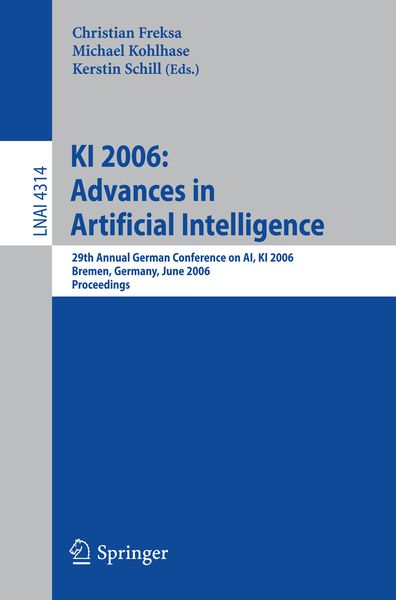
KI 2006 29th Annual German Conference on AI, KI 2006, Bremen, Germany, June 14-17, 2006, Proceedings

53,99 €

inkl. gesetzl. MwSt., Versandkostenfrei


Beschreibung

Produktdetails

Einband

Taschenbuch

Erscheinungsdatum

18.01.2007

Abbildungen

XII, 464 p.

Herausgeber

Christian Freksa + weitere

Verlag

Springer Berlin

Seitenzahl

464

Maße (L/B/H)

23,5/15,5/2,6 cm

Gewicht

715 g

Auflage

2007

Sprache

Englisch

ISBN

978-3-540-69911-8

Beschreibung

Produktdetails

Einband

Taschenbuch

Erscheinungsdatum

18.01.2007

Abbildungen

XII, 464 p.

Herausgeber

Verlag

Springer Berlin

Seitenzahl

464

Maße (L/B/H)

23,5/15,5/2,6 cm

Gewicht

715 g

Auflage

2007

Sprache

Englisch

ISBN

978-3-540-69911-8

Herstelleradresse

Springer-Verlag KG
Sachsenplatz 4-6
1201 Wien
AT

Email: ProductSafety@springernature.com

Ein neues Kapitel für Ihre Bücher

Ein neues Kapitel für Ihre Bücher

Schenken Sie Ihren alten Schätzen ein zweites Leben und erhalten Sie dafür eine Thalia Geschenkkarte.

Jetzt verkaufen
Jetzt verkaufen

Noch keine Bewertungen vorhanden

Verfassen Sie die erste Bewertung zu diesem Artikel

Helfen Sie anderen Kundinnen und Kunden durch Ihre Meinung.

Kundinnen und Kunden meinen

Bewertungen (0)

  • Produktbild: KI 2006
  • Produktbild: KI 2006
  • Session 1. Invited Talk.- Expressivity-Preserving Tempo Transformation for Music – A Case-Based Approach.- Session 2. Cognition and Emotion.- MicroPsi: Contributions to a Broad Architecture of Cognition.- Affective Cognitive Modeling for Autonomous Agents Based on Scherer’s Emotion Theory.- Session 3A. Semantic Web.- OWL and Qualitative Reasoning Models.- Techniques for Fast Query Relaxation in Content-Based Recommender Systems.- Session 3B. Analogy.- Solving Proportional Analogies by E–Generalization.- Building Robots with Analogy-Based Anticipation.- Session 4A. Natural Language.- Classification of Skewed and Homogenous Document Corpora with Class-Based and Corpus-Based Keywords.- Learning an Ensemble of Semantic Parsers for Building Dialog-Based Natural Language Interfaces.- Session 4B. Reasoning.- Game-Theoretic Agent Programming in Golog Under Partial Observability.- Finding Models for Blocked 3-SAT Problems in Linear Time by Systematical Refinement of a Sub-model.- Towards the Computation of Stable Probabilistic Model Semantics.- DiaWOz-II – A Tool for Wizard-of-Oz Experiments in Mathematics.- Session 5. Invited Talk.- Applications of Automated Reasoning.- Session 6A. Ontologies.- On the Scalability of Description Logic Instance Retrieval.- Relation Instantiation for Ontology Population Using the Web.- Session 6B. Spatio-temporal Reasoning.- GeTS – A Specification Language for Geo-Temporal Notions.- Active Monte Carlo Recognition.- Session 7A. Machine Learning.- Cross System Personalization and Collaborative Filtering by Learning Manifold Alignments.- A Partitioning Method for Mixed Feature-Type Symbolic Data Using a Squared Euclidean Distance.- Session 7B. Spatial Reasoning.- On Generalizing Orientation Information in .- Towards the Visualisation ofShape Features The Scope Histogram.- Session 8A. Robot Learning.- A Robot Learns to Know People—First Contacts of a Robot.- Recombinant Rule Selection in Evolutionary Algorithm for Fuzzy Path Planner of Robot Soccer.- Session 8B. Classical AI Problems.- A Framework for Quasi-exact Optimization Using Relaxed Best-First Search.- Gray Box Robustness Testing of Rule Systems.- A Unifying Framework for Hybrid Planning and Scheduling.- Session 9. Agents.- A Hybrid Time Management Approach to Agent-Based Simulation.- Adaptive Multi-agent Programming in GTGolog.- Agent Logics as Program Logics: Grounding KARO.- On the Relationship Between Playing Rationally and Knowing How to Play: A Logical Account.- Special Event. 50 Years Artificial Intelligence.- 1956-1966 How Did It All Begin? - Issues Then and Now.- Fundamental Questions.- Towards the AI Summer.- History of AI in Germany and The Third Industrial Revolution.- Three Decades of Human Language Technology in Germany.- 1996-2006 Autonomous Robots.- Projects and Vision in Robotics.- What Will Happen in Algorithm Country?.