
















































KI-Beratung Beta

Gutscheinbedingungen

Gültig bis 11.11.2026 | Gültig für Spielzeug, Filme, Musik, Software, Games, Geschenke & Trends, Schreibwaren, Hörbücher und Hörbuch-Downloads (außer Abo & Shelfies), gebrauchte Bücher, nicht preisgebundene Bücher und Kalender | Einlösbar unter thalia.de und in der Thalia App | Click & Collect nur mit Online-Zahlung (Paypal/Kreditkarte) vorab | Einzelne Artikel können ausgeschlossen sein | Nicht kombinierbar mit anderen Gutscheinen oder Preisaktionen | Nur einmal pro Einkauf einlösbar | Gutschein wird auf max. 500€ Bestellwert angerechnet | Keine Barauszahlung | Digitale Hörbücher nur für Android  | Nicht gültig für preisgebundene Artikel (aufgrund der Buchpreisbindung sind Gutscheine nicht auf Bücher, eBooks, Presse einlösbar), tolino eReader & Zubehör, Abonnements & Flatrates, Geschenkkarten, Versandkosten und Services

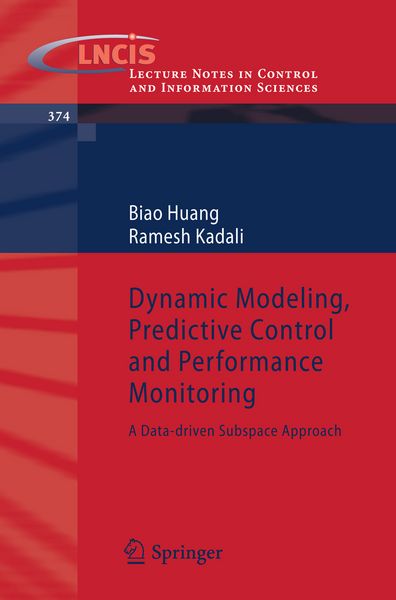
  • Produktbild: Dynamic Modeling, Predictive Control and Performance Monitoring
  • Produktbild: Dynamic Modeling, Predictive Control and Performance Monitoring
Band 374

Dynamic Modeling, Predictive Control and Performance Monitoring A Data-driven Subspace Approach

97,99 €

inkl. gesetzl. MwSt., Versandkostenfrei


Beschreibung

A typical design procedure for model predictive control or control performance monitoring consists of: 1. identification of a parametric or nonparametric model; 2. derivation of the output predictor from the model; 3. design of the control law or calculation of performance indices according to the predictor....

Beschreibung

A typical design procedure for model predictive control or control performance monitoring consists of: 1. identification of a parametric or nonparametric model; 2. derivation of the output predictor from the model; 3. design of the control law or calculation of performance indices according to the predictor.

Both design problems need an explicit model form and both require this three-step design procedure. Can this design procedure be simplified? Can an explicit model be avoided? With these questions in mind, the authors eliminate the first and second step of the above design procedure, a “data-driven” approach in the sense that no traditional parametric models are used; hence, the intermediate subspace matrices, which are obtained from the process data and otherwise identified as a first step in the subspace identification methods, are used directly for the designs. Without using an explicit model, the design procedure is simplified and the modelling error caused by parameterization is eliminated.

Produktdetails

Einband

Taschenbuch

Erscheinungsdatum

11.04.2008

Abbildungen

XXIV, 242 p. 63 illus.

Verlag Springer London

Produktdetails

Einband

Taschenbuch

Erscheinungsdatum

11.04.2008

Abbildungen

XXIV, 242 p. 63 illus.

Verlag Springer London
Seitenzahl

242

Maße (L/B/H)

23,5/15,5/1,5 cm

Gewicht

411 g

Auflage

2008

Sprache

Englisch

ISBN

978-1-84800-232-6

Herstelleradresse

Springer-Verlag KG
Sachsenplatz 4-6
1201 Wien
AT

Email: ProductSafety@springernature.com

Ein neues Kapitel für Ihre Bücher

Ein neues Kapitel für Ihre Bücher

Schenken Sie Ihren alten Schätzen ein zweites Leben und erhalten Sie dafür eine Thalia Geschenkkarte.

Jetzt verkaufen
Jetzt verkaufen

Noch keine Bewertungen vorhanden

Verfassen Sie die erste Bewertung zu diesem Artikel

Helfen Sie anderen Kundinnen und Kunden durch Ihre Meinung.

Kundinnen und Kunden meinen

Bewertungen (0)

  • Produktbild: Dynamic Modeling, Predictive Control and Performance Monitoring
  • Produktbild: Dynamic Modeling, Predictive Control and Performance Monitoring
  • I Dynamic Modeling through Subspace Identification.- System Identification: Conventional Approach.- Open-loop Subspace Identification.- Closed-loop Subspace Identification.- Identification of Dynamic Matrix and Noise Model Using Closed-loop Data.- II Predictive Control.- Model Predictive Control: Conventional Approach.- Data-driven Subspace Approach to Predictive Control.- III Control Performance Monitoring.- Control Loop Performance Assessment: Conventional Approach.- State-of-the-art MPC Performance Monitoring.- Subspace Approach to MIMO Feedback Control Performance Assessment.- Prediction Error Approach to Feedback Control Performance Assessment.- Performance Assessment with LQG-benchmark from Closed-loop Data.