















































KI-Beratung Beta

  • Produktbild: Multiple View Geom Comp Vision 2ed
  • Produktbild: Multiple View Geom Comp Vision 2ed

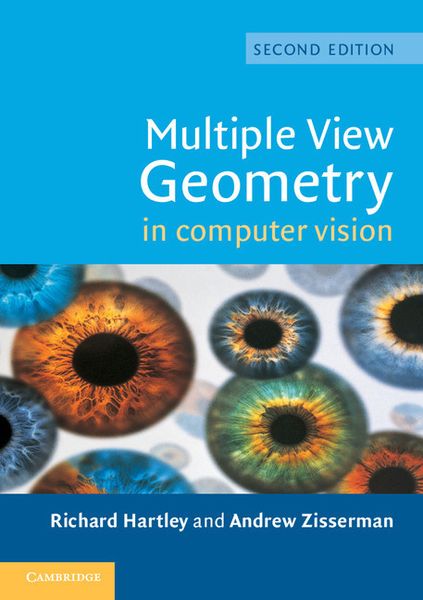
Multiple View Geom Comp Vision 2ed

204,99 €

inkl. gesetzl. MwSt., Versandkostenfrei


Beschreibung

A basic problem in computer vision is to understand the structure of a real world scene given several images of it. Techniques for solving this problem are taken from projective geometry and photogrammetry. Here, the authors cover the geometric principles and their algebraic representation in terms of...

Beschreibung

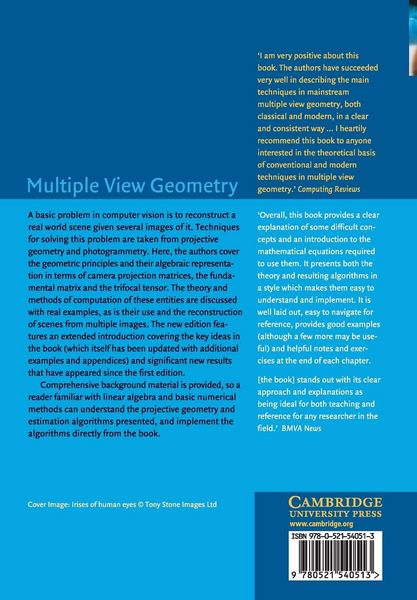
A basic problem in computer vision is to understand the structure of a real world scene given several images of it. Techniques for solving this problem are taken from projective geometry and photogrammetry. Here, the authors cover the geometric principles and their algebraic representation in terms of camera projection matrices, the fundamental matrix and the trifocal tensor. The theory and methods of computation of these entities are discussed with real examples, as is their use in the reconstruction of scenes from multiple images. The new edition features an extended introduction covering the key ideas in the book (which itself has been updated with additional examples and appendices) and significant new results which have appeared since the first edition. Comprehensive background material is provided, so readers familiar with linear algebra and basic numerical methods can understand the projective geometry and estimation algorithms presented, and implement the algorithms directly from the book.

Rezension

'I am very positive about this book. The authors have succeeded very well in describing the main techniques in mainstream multiple view geometry, both classical and modern, in a clear and consistent way.' Computing Reviews

Produktdetails

Einband

Taschenbuch

Erscheinungsdatum

12.02.2019

Abbildungen

36 colour illus. 35 tables 124 exercises

Verlag Cambridge University Press

Produktdetails

Einband

Taschenbuch

Erscheinungsdatum

12.02.2019

Abbildungen

36 colour illus. 35 tables 124 exercises

Verlag Cambridge University Press
Seitenzahl

672

Maße (L/B/H)

24,4/17/3,6 cm

Gewicht

1140 g

Auflage

2., überarbeitete Auflage

Sprache

Englisch

ISBN

978-0-521-54051-3

Herstelleradresse

Libri GmbH
Europaallee 1
36244 Bad Hersfeld
DE

Email: gpsr@libri.de

Ein neues Kapitel für Ihre Bücher

Ein neues Kapitel für Ihre Bücher

Schenken Sie Ihren alten Schätzen ein zweites Leben und erhalten Sie dafür eine Thalia Geschenkkarte.

Jetzt verkaufen
Jetzt verkaufen

Noch keine Bewertungen vorhanden

Verfassen Sie die erste Bewertung zu diesem Artikel

Helfen Sie anderen Kundinnen und Kunden durch Ihre Meinung.

Kundinnen und Kunden meinen

Bewertungen (0)

Die Leseprobe wird geladen.
  • Produktbild: Multiple View Geom Comp Vision 2ed
  • Produktbild: Multiple View Geom Comp Vision 2ed
  • 1. Introduction - a tour of multiple view geometry; Part 0. The Background: Projective Geometry, Transformations and Estimation: 2. Projective geometry and transformations of 2D; 3. Projective geometry and transformations of 3D; 4. Estimation - 2D projective transforms; 5. Algorithm evaluation and error analysis; Part I. Camera Geometry and Single View Geometry: 6. Camera models; 7. Computation of the camera matrix; 8. More single view geometry; Part II. Two-View Geometry: 9. Epipolar geometry and the fundamental matrix; 10. 3D reconstruction of cameras and structure; 11. Computation of the fundamental matrix F; 12. Structure computation; 13. Scene planes and homographies; 14. Affine epipolar geometry; Part III. Three-View Geometry: 15. The trifocal tensor; 16. Computation of the trifocal tensor T; Part IV. N -View Geometry: 17. N-linearities and multiple view tensors; 18. N-view computational methods; 19. Auto-calibration; 20. Duality; 21. Chirality; 22. Degenerate configurations; Part V. Appendices: Appendix 1. Tensor notation; Appendix 2. Gaussian (normal) and chi-squared distributions; Appendix 3. Parameter estimation. Appendix 4. Matrix properties and decompositions; Appendix 5. Least-squares minimization; Appendix 6. Iterative Estimation Methods; Appendix 7. Some special plane projective transformations; Bibliography; Index.