












































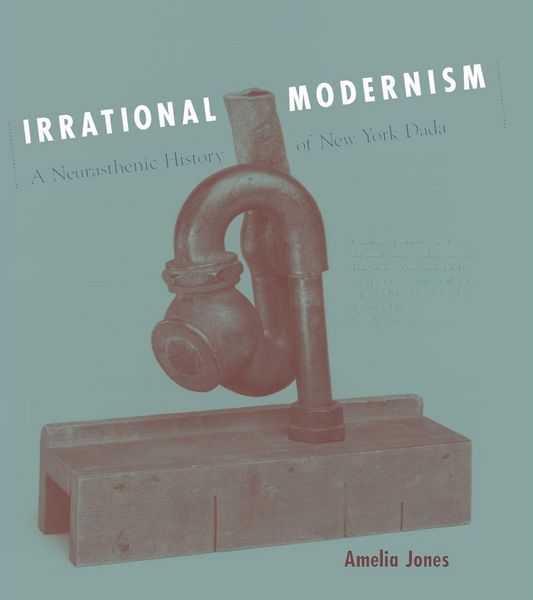
Irrational Modernism A Neurasthenic History of New York Dada
-
- Englisch ausgewählt
69,99 €
inkl. gesetzl. MwSt.,
Beschreibung
Produktdetails
Einband
Taschenbuch
Erscheinungsdatum
23.09.2005
Verlag
MIT PressSeitenzahl
346
Maße (L/B/H)
22,9/20,3/1,9 cm
Gewicht
670 g
Sprache
Englisch
ISBN
978-0-262-60066-8
A revisionist history of New York Dada, with appearances by Baroness Elsa as the embodiment of irrational modernism.
In Irrational Modernism, Amelia Jones gives us a history of New York Dada, reinterpreted in relation to the life and works of Baroness Elsa von Freytag-Loringhoven. Jones enlarges our conception of New York Dada beyond the male avant-garde heroics of Marcel Duchamp, Man Ray, and Francis Picabia to include the rebellious body of the Baroness. If they practiced Dada, she lived it, with her unorthodox personal life, wild assemblage objects, radical poetry and prose, and the flamboyant self-displays by which she became her own work of art. Through this reinterpretation, Jones not only provides a revisionist history of an art movement but also suggests a new method of art history. Jones argues that the accepted idea of New York Dada as epitomized by Duchamp's readymades and their implicit cultural critique does not take into consideration the contradictions within the movement—its misogyny, for example—or the social turmoil of the period caused by industrialization, urbanization, and the upheaval of World War I and its aftermath, which coincided with the Baroness's time in New York (1913-1923). Baroness Elsa, whose appearances in Jones's narrative of New York Dada mirror her volcanic intrusions into the artistic circles of the time, can be seen to embody a new way to understand the history of avant-gardism—one that embraces the irrational and marginal rather than promoting the canonical. Acknowledging her identification with the Baroness (as a "fellow neurasthenic"), and interrupting her own objective passages of art historical argument with what she describes in her introduction as "bursts of irrationality," Jones explores the interestedness of all art history, and proposes a new "immersive" understanding of history (reflecting the historian's own history) that parallels the irrational immersive trajectory of avant- gardism as practiced by Baroness Elsa.
Ein neues Kapitel für Ihre Bücher
Ein neues Kapitel für Ihre Bücher
Schenken Sie Ihren alten Schätzen ein zweites Leben und erhalten Sie dafür eine Thalia Geschenkkarte.
Noch keine Bewertungen vorhanden
Verfassen Sie die erste Bewertung zu diesem Artikel
Helfen Sie anderen Kundinnen und Kunden durch Ihre Meinung.
Kurze Frage zu unserer Seite
Vielen Dank für Ihr Feedback
Wir nutzen Ihr Feedback, um unsere Produktseiten zu verbessern. Bitte haben Sie Verständnis, dass wir Ihnen keine Rückmeldung geben können. Falls Sie Kontakt mit uns aufnehmen möchten, können Sie sich aber gerne an unseren Kund*innenservice wenden.
zum Kundenservice