















































KI-Beratung Beta

Gutscheinbedingungen

Gültig bis 30.11.2026 | Gültig für nicht preisgebundene fremdsprachige Bücher | Einzelne Artikel können ausgeschlossen sein | Online auf thalia.de und in der Thalia App einlösbar | Click & Collect nur mit Online-Zahlung (Paypal/Kreditkarte) vorab | Nicht kombinierbar mit anderen Gutscheinen oder Preisaktionen | Nur einmal pro Einkauf einlösbar | Gutschein wird auf max. 500€ Bestellwert angerechnet | Keine Barauszahlung | Nicht gültig für Versandkosten und Services

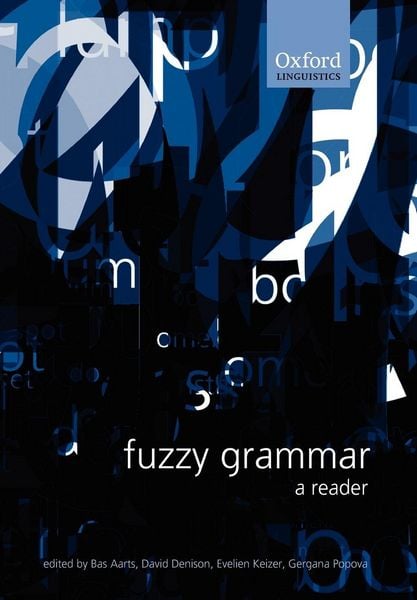
Produktbild: Fuzzy Grammar

Fuzzy Grammar A Reader

106,99 €

inkl. gesetzl. MwSt., Versandkostenfrei


Beschreibung

A collection of the best work by philosophers, cognitive scientists, and linguists on grammatical gradience and linguistic uncertainty - such as when warm becomes hot, how many grains make a heap, and when a puddle becomes a pond - introduced, explained, contextualized, and indexed.

Beschreibung

A collection of the best work by philosophers, cognitive scientists, and linguists on grammatical gradience and linguistic uncertainty - such as when warm becomes hot, how many grains make a heap, and when a puddle becomes a pond - introduced, explained, contextualized, and indexed.

Produktdetails

Einband

Taschenbuch

Erscheinungsdatum

01.03.2004

Herausgeber Bas Aarts + weitere
Verlag Oxford University Press

Produktdetails

Einband

Taschenbuch

Erscheinungsdatum

01.03.2004

Herausgeber
Verlag Oxford University Press
Seitenzahl

538

Maße (L/B/H)

24,4/17/2,9 cm

Gewicht

917 g

Sprache

Englisch

ISBN

978-0-19-926257-1

Herstelleradresse

Libri GmbH
Europaallee 1
36244 Bad Hersfeld
DE

Email: gpsr@libri.de

Ein neues Kapitel für Ihre Bücher

Ein neues Kapitel für Ihre Bücher

Schenken Sie Ihren alten Schätzen ein zweites Leben und erhalten Sie dafür eine Thalia Geschenkkarte.

Jetzt verkaufen
Jetzt verkaufen

Noch keine Bewertungen vorhanden

Verfassen Sie die erste Bewertung zu diesem Artikel

Helfen Sie anderen Kundinnen und Kunden durch Ihre Meinung.

Kundinnen und Kunden meinen

Bewertungen (0)

  • Produktbild: Fuzzy Grammar

    • Preface


    • Introduction


    • Fuzzy Grammar: the nature of grammatical categories and their representation


    • Part 1


    • Philosophical background


    • 1: Aristotle: Aristotle on the categories


    • 2: Gottlob Frege: Frege on concepts


    • 3: Bertrand Russell: Vagueness


    • 4: Ludwig Wittgenstein: Family resemblances


    • 5: Rosanna Keefe: The phenomena of vagueness


    • Part 2


    • Categories in cognition


    • 6: William Labov: The boundaries of words and their meanings


    • 7: Eleanor Rosch: Principles of categorization


    • 8: Ray Jackendoff: Jackendoff on categorisation, fuzziness and family resemblances


    • 9: Ronald W. Langacker: Discreteness


    • 10: George Lakoff: The importance of categorisation


    • Part 3


    • Categories in grammar


    • 11: Otto Jespersen: Jespersen on the parts of speech


    • 12: David Crystal: English word classes


    • 13: John Lyons: A notional approach to the parts of speech


    • 14: John M. Anderson: Syntactic categories and notional features


    • 15: Ronald W. Langacker: Bounded regions


    • 16: Paul Hopper and Sandra Thompson: The discourse basis for lexical categories in Universal Grammar


    • 17: John Taylor: Grammatical categories


    • Part 4


    • Gradience in grammar


    • 18: Dwight Bolinger: Bolinger on gradience


    • 19: Noam Chomsky: Degrees of grammaticalness


    • 20: Randolph Quirk: Descriptive statement and serial relationship


    • 21: J. V. Neustupnÿ: On the analysis of linguistic vagueness


    • 22: John Robert Ross: Nouniness


    • 23: Randolph Quirk, Sidney Greenbaum, Geoffrey Leech and Jan Svartvik: The coordination-subordination gradient


    • 24: Carson T. Schÿtze: The nature of graded judgments


    • Part 5


    • Criticisms and responses


    • 25: Martin Joos: Description of language design


    • 26: Anna Wierzbicka: Prototypes save


    • 27: Denis Bouchard: Fuzziness and categorization


    • 28: Frederick J. Newmeyer: The discrete nature of syntactic categories: against a prototype-based account