















































KI-Beratung Beta

Gutscheinbedingungen

Gültig bis 30.11.2026 | Gültig für nicht preisgebundene fremdsprachige Bücher | Einzelne Artikel können ausgeschlossen sein | Online auf thalia.de und in der Thalia App einlösbar | Click & Collect nur mit Online-Zahlung (Paypal/Kreditkarte) vorab | Nicht kombinierbar mit anderen Gutscheinen oder Preisaktionen | Nur einmal pro Einkauf einlösbar | Gutschein wird auf max. 500€ Bestellwert angerechnet | Keine Barauszahlung | Nicht gültig für Versandkosten und Services

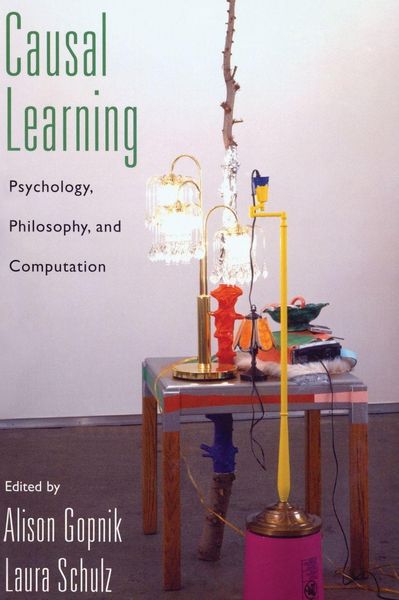
Produktbild: CAUSAL LEARNING

CAUSAL LEARNING PSYCH,PHILOS & COMPUT C

55,99 €

inkl. gesetzl. MwSt., Versandkostenfrei


Beschreibung

The world has a causal structure, in the sense that some events make other events happen. Although understanding causal structure is essential for predicting and controlling the environment, causal structure is, at least usually, not obvious from superficial, perceptual cues. How then do our minds infer...

Beschreibung

The world has a causal structure, in the sense that some events make other events happen. Although understanding causal structure is essential for predicting and controlling the environment, causal structure is, at least usually, not obvious from superficial, perceptual cues. How then do our minds infer this structure? In the last few years, questions about causal inference and learning have become an important focus of investigation in many different disciplines - developmental psychology, cognitive psychology, ethology, philosophy, and computer science. As is common in scientific research, there has been relatively little interaction on the topic between these disciplines. However, in spite of the minimal interaction, a general review of the research shows the beginning of a formal way of determining how, in principle, the problem of causal inference and learning can be solved, and a wealth of methods for determining how it is, in fact, solved by children, adults, and animals. This volume brings together this research and provides a more sophisticated understanding of causal inference and learning.

Produktdetails

Einband

Gebundene Ausgabe

Erscheinungsdatum

26.08.2010

Abbildungen

108 line illustrations, 10 black and white photographs, 8 shaded line illustrations

Herausgeber Gopnik Alison + weitere

Produktdetails

Einband

Gebundene Ausgabe

Erscheinungsdatum

26.08.2010

Abbildungen

108 line illustrations, 10 black and white photographs, 8 shaded line illustrations

Herausgeber
Verlag Oxford University Press
Seitenzahl

372

Maße (L/B/H)

26/18,3/2,5 cm

Gewicht

832 g

Sprache

Englisch

ISBN

978-0-19-517680-3

Herstelleradresse

Libri GmbH
Europaallee 1
36244 Bad Hersfeld
DE

Email: gpsr@libri.de

Ein neues Kapitel für Ihre Bücher

Ein neues Kapitel für Ihre Bücher

Schenken Sie Ihren alten Schätzen ein zweites Leben und erhalten Sie dafür eine Thalia Geschenkkarte.

Jetzt verkaufen
Jetzt verkaufen

Noch keine Bewertungen vorhanden

Verfassen Sie die erste Bewertung zu diesem Artikel

Helfen Sie anderen Kundinnen und Kunden durch Ihre Meinung.

Kundinnen und Kunden meinen

Bewertungen (0)

Die Leseprobe wird geladen.
  • Produktbild: CAUSAL LEARNING
    • Part I: Causation and Intervention
    • 1: Interventionist Theories of Causation in Psychological Perspective
    • 2: Infants' Causal Learning: Intervention, Observation, Imitation
    • 3: Detecting Causal Structure: The Role of Interventions in Infants' Understanding of Psychological and Physical Causal Relations
    • 4: An Interventionist Approach to Causation in Psychology
    • 5: Learning From Doing: Intervention and Causal Inference
    • 6: Causal Reasoning Through Intervention
    • 7: On the Importance of Causal Taxonomy
    • Part II: Causation and Probability
    • Introduction to Part II: Causation and Probability
    • 8: Teaching the Normative Theory of Causal Reasoning
    • 9: Interactions Between Causal and Statistical Learning
    • 10: Beyond Covariation: Cues to Causal Structure
    • 11: Theory Unification and Graphical Models in Human Categorization
    • 12: Essentialism as a Generative Theory of Classification
    • 13: Data-Mining Probalists or Experimental Determinists? A Dialogue on the Principles Underlying Causal Learning in Children
    • 14: Learning the Structure of Deterministic Systems
    • Part III: Causation, Theories, and Mechanisms
    • Introduction to Part III: Causation, Theories, and Mechanisms
    • 15: Why Represent Causal Relations?
    • 16: Causal Reasoning as Informed by the Early Development of Explanations
    • 17: Dynamic Interpretations of Covariation Data
    • 18: Statistical Jokes and Social Effects: Intervention and Invariance in Causal Relations
    • 19: Intuitive Theories as Grammars for Causal Inference
    • 20: Two Proposals for Causal Grammars