















































KI-Beratung Beta

Gutscheinbedingungen

Gültig bis 30.11.2026 | Gültig für nicht preisgebundene fremdsprachige Bücher | Einzelne Artikel können ausgeschlossen sein | Online auf thalia.de und in der Thalia App einlösbar | Click & Collect nur mit Online-Zahlung (Paypal/Kreditkarte) vorab | Nicht kombinierbar mit anderen Gutscheinen oder Preisaktionen | Nur einmal pro Einkauf einlösbar | Gutschein wird auf max. 500€ Bestellwert angerechnet | Keine Barauszahlung | Nicht gültig für Versandkosten und Services

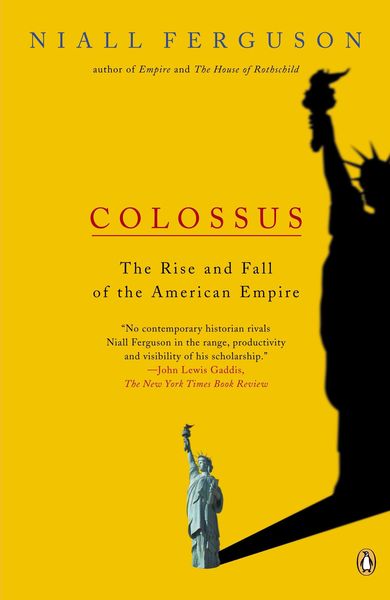
Produktbild: Colossus

Colossus The Rise and Fall of the American Empire

29,99 €

inkl. gesetzl. MwSt., Versandkostenfrei


Beschreibung

From the bestselling author of The Ascent of Money and The Square and the Tower Is America an empire? Certainly not, according to our government. Despite the conquest of two sovereign states in as many years, despite the presence of more than 750 military installations in two thirds of the world s countries...

Beschreibung

From the bestselling author of The Ascent of Money and The Square and the Tower
Is America an empire? Certainly not, according to our government. Despite the conquest of two sovereign states in as many years, despite the presence of more than 750 military installations in two thirds of the world s countries and despite his stated intention "to extend the benefits of freedom...to every corner of the world," George W. Bush maintains that "America has never been an empire." "We don t seek empires," insists Defense Secretary Rumsfeld. "We re not imperialistic."

Nonsense, says Niall Ferguson. In Colossus he argues that in both military and economic terms America is nothing less than the most powerful empire the world has ever seen. Just like the British Empire a century ago, the United States aspires to globalize free markets, the rule of law, and representative government. In theory it s a good project, says Ferguson. Yet Americans shy away from the long-term commitments of manpower and money that are indispensable if rogue regimes and failed states really are to be changed for the better. Ours, he argues, is an empire with an attention deficit disorder, imposing ever more unrealistic timescales on its overseas interventions. Worse, it s an empire in denial a hyperpower that simply refuses to admit the scale of its global responsibilities. And the negative consequences will be felt at home as well as abroad. In an alarmingly persuasive final chapter Ferguson warns that this chronic myopia also applies to our domestic responsibilities. When overstretch comes, he warns, it will come from within and it will reveal that more than just the feet of the American colossus is made of clay.

Rezension

"Every page of Colossus is provocative."  Ernest May

"Amid the seemingly endless writings and decisions about America as Empire, the most prominent recent voice is that of Niall Ferguson."  Paul Kennedy, New York Review of Books

Produktdetails

Einband

Taschenbuch

Erscheinungsdatum

29.03.2005

Verlag Penguin US
Seitenzahl

418

Produktdetails

Einband

Taschenbuch

Erscheinungsdatum

29.03.2005

Verlag Penguin US
Seitenzahl

418

Maße (L/B/H)

21,4/14/2,2 cm

Gewicht

519 g

Sprache

Englisch

ISBN

978-0-14-303479-7

Herstelleradresse

Libri GmbH
Europaallee 1
36244 Bad Hersfeld
DE

Email: gpsr@libri.de

Ein neues Kapitel für Ihre Bücher

Ein neues Kapitel für Ihre Bücher

Schenken Sie Ihren alten Schätzen ein zweites Leben und erhalten Sie dafür eine Thalia Geschenkkarte.

Jetzt verkaufen
Jetzt verkaufen

Noch keine Bewertungen vorhanden

Verfassen Sie die erste Bewertung zu diesem Artikel

Helfen Sie anderen Kundinnen und Kunden durch Ihre Meinung.

Kundinnen und Kunden meinen

Bewertungen (0)

Die Leseprobe wird geladen.
  • Produktbild: Colossus
  • Introduction

    Part I Rise
    1. The Limits of the American Empire
    2. The Imperialism of Anti-Imperialism
    3. The Civilization of Clashes
    4. Splendid Multilateralism

    Part II Fall?
    5. The Case for Liberal Empire
    6. Going Home or Organizing Hypocrisy
    7. "Impire": Europe Between Brussels and Byzantium
    8. The Closing Door

    Conclusion: Looking Homeward
    Statistical Appendix
    Acknowledgments
    Notes
    Bibliography
    Index