















































KI-Beratung Beta

Produktbild: Roman Battle Tactics 109bc-Ad313
Band 155

Roman Battle Tactics 109bc-Ad313

Aus der Reihe Elite

19,99 €

inkl. gesetzl. MwSt., Versandkostenfrei


Beschreibung

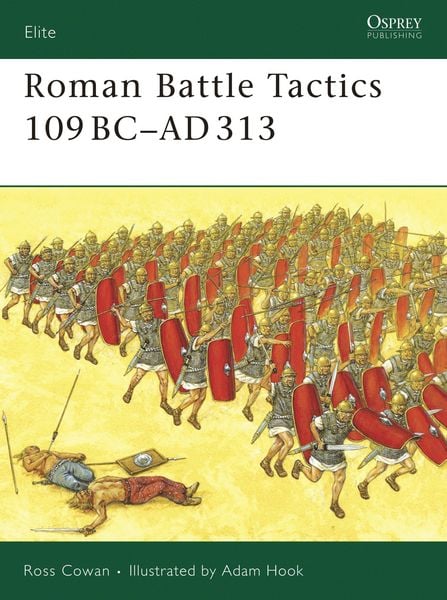
How, exactly, did Rome become master of the ancient world? This book examines and illustrates the tactics employed by the legions of late Republican and early Imperial Rome, from the evidence of ancient writers. The greatest military machine in the Western world for at least four centuries, the Roman...

Beschreibung

How, exactly, did Rome become master of the ancient world?
This book examines and illustrates the tactics employed by the legions of late Republican and early Imperial Rome, from the evidence of ancient writers. The greatest military machine in the Western world for at least four centuries, the Roman Army was the foundation of the Western military tradition, and its doctrines were central to the later revival of trained, drilled professional armies.
Here the evidence is discussed in clear detail, and brought to life with battle plans and full colour interpretations of tactical scenarios.

Produktdetails

Einband

Taschenbuch

Erscheinungsdatum

24.07.2007

Abbildungen

8 col

Illustriert von

Adam Hook

Produktdetails

Einband

Taschenbuch

Erscheinungsdatum

24.07.2007

Abbildungen

8 col

Illustriert von

Adam Hook

Verlag Bloomsbury Academic
Seitenzahl

64

Maße (L/B/H)

25/18,2/0,7 cm

Gewicht

271 g

Sprache

Englisch

ISBN

978-1-84603-184-7

Herstelleradresse

Libri GmbH
Europaallee 1
36244 Bad Hersfeld
DE

Email: gpsr@libri.de

Ein neues Kapitel für Ihre Bücher

Ein neues Kapitel für Ihre Bücher

Schenken Sie Ihren alten Schätzen ein zweites Leben und erhalten Sie dafür eine Thalia Geschenkkarte.

Jetzt verkaufen
Jetzt verkaufen

Noch keine Bewertungen vorhanden

Verfassen Sie die erste Bewertung zu diesem Artikel

Helfen Sie anderen Kundinnen und Kunden durch Ihre Meinung.

Kundinnen und Kunden meinen

Bewertungen (0)

  • Produktbild: Roman Battle Tactics 109bc-Ad313
  • INTRODUCTION: The size and organization of the legion - campaign attrition - From maniple to cohort: the cohort's functional identity - command structure - Basic battle formations - Intervals in the battle line: control and cohesion - the - interval as a channel for attack and a defensive trap -
    the size of intervals
    LEGIONARY BATTLE LINES AND MANOEUVRES: Simplex acies: Forum Gallorum, 43 BC - Ruspina, 46 BC - Carrhae, 53 BC: disastrous result of the abandonment of the simplex acies - Duplex acies: Ilerda, 49 BC - Maximinus' agmen quadratum, AD 238 - Arrian's array against the Alans, AD 135 - Triplex and quadruplex acies: Ilerda, 49 BC - the muthul, 109 BC - Chaeronea, 86 BC - Pistoria, 62 BC - Caesar in Gaul, 58 BC - Pharsalus, 48 BC: the devotio - Uzzita, 46 BC - the Rhyndacus, 85 BC: use of field entrenchments - Thapsus, 46 BC: mixed triplex and quadruplex acies - Second Philippi, 42 BC - Detached forces and surprise attacks: Tigranocerta, 69 BC - Aquae Sextiae, 102 BC: the morale value of noise - Lauron, 76 BC - Segovia, 75 BC: the refused centre - Downhill and uphill charges: Mts Armanus & Gindarus, 39 & 38 BC - Ilerda and Dyrrachium, 49 and 48 BC - First Philippi, 42 BC - Mons Graupius, 84 AD
    OFFENSIVE AND DEFENSIVE FORMATIONS: The cuneus and 'pig's head': use at Bonn, AD 69 - in Britain, AD 61 - at Cremona, AD 69 - The orbis: use at Cirta, 105 BC - by Sabinus and Cotta, 54 BC - by Caesar in Britain, 55 BC - by Chariovalda in Germany, AD 16 - by legio XXXVI at Nicopolis, 47 BC - at Adretum, AD 9 - on the Danube, AD 173/174
    - The testudo: use at Issus, AD 194 - at Daphne, AD 272 -
    at Cremona, AD 69 - The agmen quadratum and testudo: in Mark Antony's retreat from Media, 36 BC - failure against Ardashir, AD 233
    EPILOGUE: Adrianople, AD 313 - Ctesiphon, AD 363
    REFERENCES AND FURTHER READING
    PLATE COMMENTARIES
    INDEX