















































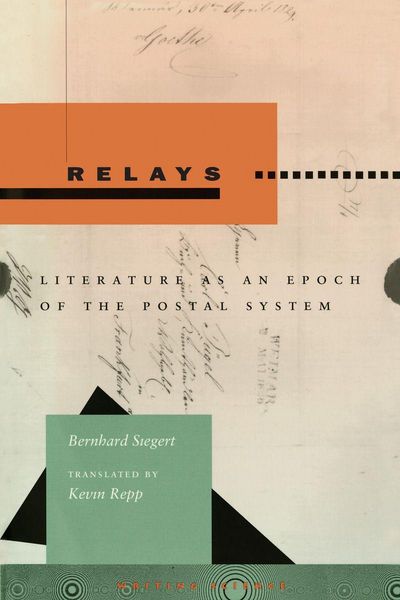
Relays Literature as an Epoch of the Postal System
-
- Hardcover
- Taschenbuch ausgewählt
-
Sprache:Englisch
34,99 €
inkl. gesetzl. MwSt.,
Beschreibung
Produktdetails
Einband
Taschenbuch
Erscheinungsdatum
01.06.1999
Abbildungen
1 table, 13 figures
Verlag
Stanford University PressSeitenzahl
340
Maße (L/B/H)
22,8/15,2/2 cm
Gewicht
476 g
Übersetzt von
Kevin Repp
Sprache
Englisch
ISBN
978-0-8047-3238-3
This book examines how one aspect of the social and technological situation of literature-namely, the postal system-determined how literature was produced and what was produced within literature. Language itself has the structure of a relay, where what is transmitted depends on a prior withholding. The social arrangements and technologies for achieving this transmission thus have had a particularly powerful impact on the imagination of literature as a medium.
The book has three parts. The first part reconstructs the postal conditions of classic and Romantic literature: the invention of postage in the seventeenth century, which transformed the postal system into a service meant to be used by the population (instead of by the prince alone); the sexualization of letter writing, which was introduced in the middle of the eighteenth century and changed the reading of a letter into an interpretation of intimate confessions of the soul; and Goethe's turning of this new ontology of the letter into a logistics of literature whereby literary authorship was constructed by means of postal logistics, with the precision of engineering.
The second part analyzes nineteenth-century postal innovations that facilitated communication through letters and examines how literary works were able to live off such communication. These innovations included the reform of the post office; the invention of the postage stamp; the Universal Postal Union, which subjected letter writing to an economy of materials and uniform standards; and the telegraph and the telephone, which surpassed literature in terms of speed, economy, and analog-signal processing.
In the third part, on the basis of a close reading of Franz Kafka's letters to his typist-fiancée, the author demonstrates how postal logistics of love and authorship have worked in the era of modern postal systems and technical media. Kafka's correspondence is deciphered as a "war of nerves" waged by means of all available techniques and conditions of transmission.
Ein neues Kapitel für Ihre Bücher
Ein neues Kapitel für Ihre Bücher
Schenken Sie Ihren alten Schätzen ein zweites Leben und erhalten Sie dafür eine Thalia Geschenkkarte.
Noch keine Bewertungen vorhanden
Verfassen Sie die erste Bewertung zu diesem Artikel
Helfen Sie anderen Kundinnen und Kunden durch Ihre Meinung.
Kurze Frage zu unserer Seite
Vielen Dank für Ihr Feedback
Wir nutzen Ihr Feedback, um unsere Produktseiten zu verbessern. Bitte haben Sie Verständnis, dass wir Ihnen keine Rückmeldung geben können. Falls Sie Kontakt mit uns aufnehmen möchten, können Sie sich aber gerne an unseren Kund*innenservice wenden.
zum Kundenservice