















































KI-Beratung Beta

Gutscheinbedingungen

Gültig bis 30.11.2026 | Gültig für nicht preisgebundene fremdsprachige Bücher | Einzelne Artikel können ausgeschlossen sein | Online auf thalia.de und in der Thalia App einlösbar | Click & Collect nur mit Online-Zahlung (Paypal/Kreditkarte) vorab | Nicht kombinierbar mit anderen Gutscheinen oder Preisaktionen | Nur einmal pro Einkauf einlösbar | Gutschein wird auf max. 500€ Bestellwert angerechnet | Keine Barauszahlung | Nicht gültig für Versandkosten und Services

Produktbild: Regimes of Description

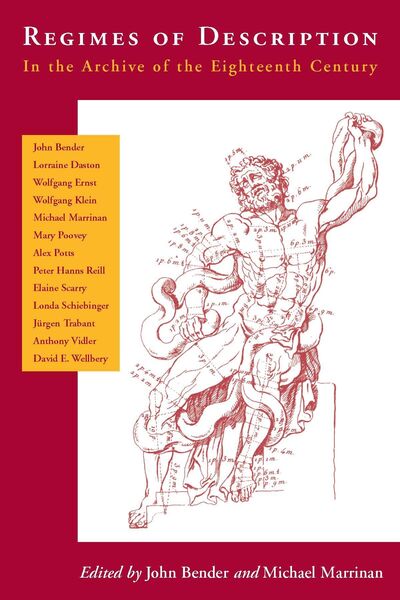
Regimes of Description In the Archive of the Eighteenth Century

31,99 €

inkl. gesetzl. MwSt., Versandkostenfrei


Beschreibung

Regimes of Description responds to the perception-however imprecise-that forms of knowledge in every sector of contemporary culture are being fundamentally reshaped by the digital revolution: music, speech, engineering diagrams, weather reports, works of visual art, even the words most of us write are...

Beschreibung

Regimes of Description responds to the perception-however imprecise-that forms of knowledge in every sector of contemporary culture are being fundamentally reshaped by the digital revolution: music, speech, engineering diagrams, weather reports, works of visual art, even the words most of us write are now subject, as Lyotard points out in The Inhuman, to a logic of the bit, the elemental unit of electronic information. It is now possible to slice, graft, and splice this knowledge in ways never before imagined using technologies that treat vast bodies of information as a stream of data bits. Programs and technical algorithms specify the criteria for discriminating between the data stream of a Mozart string quartet and the CAT scan of a diseased organ. But are these machine instructions and design parameters descriptions, or merely mechanical filters? And if the latter, what constitutes a description of digitally encoded knowledge? As a group, the essays in this volume pose that question as a first attempt to write the archaeology of the nature and history of description in the digital age.

Produktdetails

Einband

Taschenbuch

Erscheinungsdatum

18.01.2005

Abbildungen

15 illustrations

Herausgeber John Bender + weitere

Produktdetails

Einband

Taschenbuch

Erscheinungsdatum

18.01.2005

Abbildungen

15 illustrations

Herausgeber
Verlag Stanford University Press
Seitenzahl

304

Maße (L/B/H)

23/15,3/1,8 cm

Gewicht

408 g

Sprache

Englisch

ISBN

978-0-8047-4742-4

Herstelleradresse

Libri GmbH
Europaallee 1
36244 Bad Hersfeld
DE

Email: gpsr@libri.de

Ein neues Kapitel für Ihre Bücher

Ein neues Kapitel für Ihre Bücher

Schenken Sie Ihren alten Schätzen ein zweites Leben und erhalten Sie dafür eine Thalia Geschenkkarte.

Jetzt verkaufen
Jetzt verkaufen

Noch keine Bewertungen vorhanden

Verfassen Sie die erste Bewertung zu diesem Artikel

Helfen Sie anderen Kundinnen und Kunden durch Ihre Meinung.

Kundinnen und Kunden meinen

Bewertungen (0)

  • Produktbild: Regimes of Description
  • Introduction
    -John Bender and Michael Marrinan
    Description: Fantasies of General Knowledge
    Description by Omission: Nature Enlightened and Obscured
    -Lorraine Daston
    Nature's Unruly Body: The Limits of Scientific Description
    -Londa Schiebinger
    Mithridates in Paradise: Describing Languages in a Universalistic World
    -Jürgen Trabant
    Between Political Arithmetic and Political Economy
    -Mary Poovey
    Describing: Imagination and Knowing
    Problems of Description in Art: Realism
    -Wolfgang Klein
    Imagining Flowers: Perceptual Mimesis (Particularly Delphinium)
    -Elaine Scarry
    Not Seeing the Laocoön: Lessing in the Archive of the Eighteenth Century
    -Wolfgang Ernst
    Disparities between Part and Whole in the Description of Works of Art
    -Alex Potts
    The Undescribed: Horizons of the Known
    Between Mechanism and Romantic Naturphilosophie: Vitalizing Nature and Naturalizing Historical Discourse in the Late Enlightenment
    -Peter Hanns Reill
    Transparency and Utopia: Constructing the Void from Pascal to Foucault
    -Anthony Vidler
    Aesthetic Media: The Structure of Aesthetic Theory before Kant
    -David E. Wellbery