















































KI-Beratung Beta

Gutscheinbedingungen

Gültig bis 30.11.2026 | Gültig für nicht preisgebundene fremdsprachige Bücher | Einzelne Artikel können ausgeschlossen sein | Online auf thalia.de und in der Thalia App einlösbar | Click & Collect nur mit Online-Zahlung (Paypal/Kreditkarte) vorab | Nicht kombinierbar mit anderen Gutscheinen oder Preisaktionen | Nur einmal pro Einkauf einlösbar | Gutschein wird auf max. 500€ Bestellwert angerechnet | Keine Barauszahlung | Nicht gültig für Versandkosten und Services

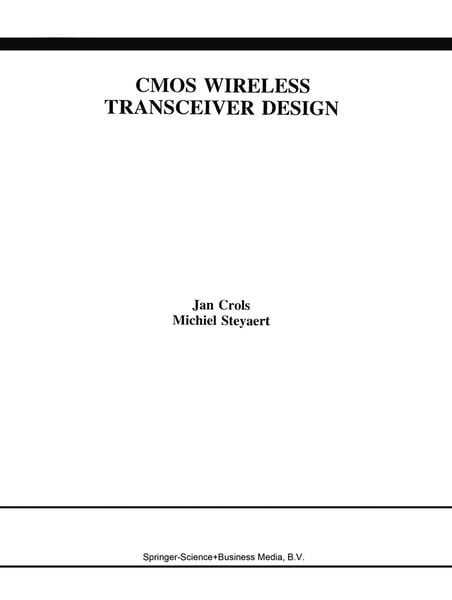
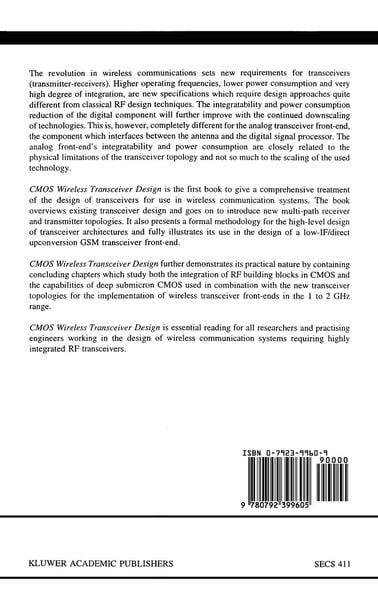
  • Produktbild: CMOS Wireless Transceiver Design
  • Produktbild: CMOS Wireless Transceiver Design
Band 411

CMOS Wireless Transceiver Design

159,99 €

inkl. gesetzl. MwSt., Versandkostenfrei


Beschreibung

The world of wireless communications is changing very rapidly since a few years. The introduction of digital data communication in combination with digital signal process ing has created the foundation for the development of many new wireless applications. High-quality digital wireless networks for voice...

Beschreibung

The world of wireless communications is changing very rapidly since a few years. The introduction of digital data communication in combination with digital signal process ing has created the foundation for the development of many new wireless applications. High-quality digital wireless networks for voice communication with global and local coverage, like the GSM and DECT system, are only faint and early examples of the wide variety of wireless applications that will become available in the remainder of this decade. The new evolutions in wireless communications set new requirements for the trans ceivers (transmitter-receivers). Higher operating frequencies, a lower power consump tion and a very high degree of integration, are new specifications which ask for design approaches quite different from the classical RF design techniques. The integrata bility and power consumption reduction of the digital part will further improve with the continued downscaling of technologies. This is however completely different for the analog transceiver front-end, the part which performs the interfacing between the antenna and the digital signal processing. The analog front-end's integratability and power consumption are closely related to the physical limitations of the transceiver topology and not so much to the scaling of the used technology. Chapter 2 gives a detailed study of the level of integration in current transceiver realization and analyzes their limitations. In chapter 3 of this book the complex signal technique for the analysis and synthesis of multi-path receiver and transmitter topologies is introduced.

Rezension

"The book is well-written and it has good chances to be an essential reading for researchers and practicing engineers working in the design of highly integrated RF transceivers of wireless communication systems."
(Zentralblatt für Mathematik)

Produktdetails

Einband

Gebundene Ausgabe

Erscheinungsdatum

30.06.1997

Abbildungen

XIV, 240 p.

Verlag Springer Us

Produktdetails

Einband

Gebundene Ausgabe

Erscheinungsdatum

30.06.1997

Abbildungen

XIV, 240 p.

Verlag Springer Us
Seitenzahl

240

Maße (L/B/H)

24,1/16/1,9 cm

Gewicht

507 g

Auflage

1997

Sprache

Englisch

ISBN

978-0-7923-9960-5

Herstelleradresse

Springer-Verlag GmbH
Europaplatz 3
69115 Heidelberg
DE

Email: ProductSafety@springernature.com

Ein neues Kapitel für Ihre Bücher

Ein neues Kapitel für Ihre Bücher

Schenken Sie Ihren alten Schätzen ein zweites Leben und erhalten Sie dafür eine Thalia Geschenkkarte.

Jetzt verkaufen
Jetzt verkaufen

Noch keine Bewertungen vorhanden

Verfassen Sie die erste Bewertung zu diesem Artikel

Helfen Sie anderen Kundinnen und Kunden durch Ihre Meinung.

Kundinnen und Kunden meinen

Bewertungen (0)

  • Produktbild: CMOS Wireless Transceiver Design
  • Produktbild: CMOS Wireless Transceiver Design
  • 1. Wireless Communications.- 2. Transmitters and Receivers.- 3. Transceivers in the Frequency Domain.- 4. Performance of Transceivers.- 5. High-Level Synthesis.- 6. Building Blocks for CMOS Transceivers.- 7. Realizing a CMOS Transceiver.- 8. General Conclusions.- Appendix A—Process Information.