















































KI-Beratung Beta

Gutscheinbedingungen

Gültig bis 30.11.2026 | Gültig für nicht preisgebundene fremdsprachige Bücher | Einzelne Artikel können ausgeschlossen sein | Online auf thalia.de und in der Thalia App einlösbar | Click & Collect nur mit Online-Zahlung (Paypal/Kreditkarte) vorab | Nicht kombinierbar mit anderen Gutscheinen oder Preisaktionen | Nur einmal pro Einkauf einlösbar | Gutschein wird auf max. 500€ Bestellwert angerechnet | Keine Barauszahlung | Nicht gültig für Versandkosten und Services

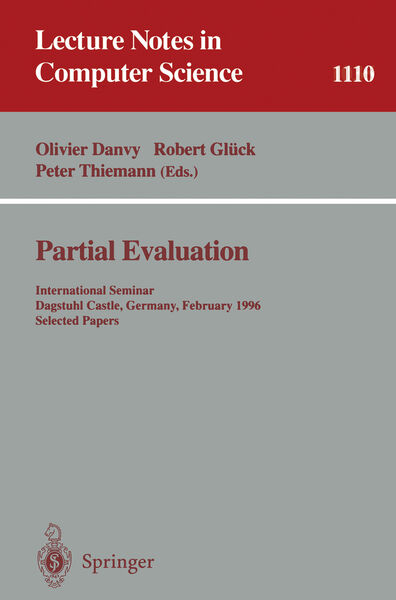
  • Produktbild: Partial Evaluation
  • Produktbild: Partial Evaluation
Band 1110

Partial Evaluation International Seminar, Dagstuhl Castle, Germany, February 12 - 16, 1996. Selected Papers

49,99 €

inkl. gesetzl. MwSt., Versandkostenfrei


Beschreibung

Partial Evaluation has reached a point where theory and techniques have matured, substantial systems have been developed, and realistic applications can benefit from partial evaluation. This book is based on the International Seminar on Partial Evaluation held in Dagstuhl Castle, Germany in February...

Beschreibung

Partial Evaluation has reached a point where theory and techniques have matured, substantial systems have been developed, and realistic applications can benefit from partial evaluation.
This book is based on the International Seminar on Partial Evaluation held in Dagstuhl Castle, Germany in February 1996. The 24 strictly refereed full papers included evaluate the progress achieved in the field during the last decade. Also included is a detailed preface by the volume editors and a subject index. All in all, this book competently reports the state of the art and future perspectives in partial evaluation and is thus compulsory reading for anybody interested in the area.

Produktdetails

Einband

Taschenbuch

Erscheinungsdatum

14.08.1996

Abbildungen

XII, 520 p.

Herausgeber Olivier Danvy + weitere

Produktdetails

Einband

Taschenbuch

Erscheinungsdatum

14.08.1996

Abbildungen

XII, 520 p.

Herausgeber
Verlag Springer Berlin
Seitenzahl

520

Maße (L/B/H)

23,5/15,5/2,9 cm

Gewicht

797 g

Auflage

1996

Sprache

Englisch

ISBN

978-3-540-61580-4

Herstelleradresse

Springer-Verlag KG
Sachsenplatz 4-6
1201 Wien
AT

Email: ProductSafety@springernature.com

Ein neues Kapitel für Ihre Bücher

Ein neues Kapitel für Ihre Bücher

Schenken Sie Ihren alten Schätzen ein zweites Leben und erhalten Sie dafür eine Thalia Geschenkkarte.

Jetzt verkaufen
Jetzt verkaufen

Noch keine Bewertungen vorhanden

Verfassen Sie die erste Bewertung zu diesem Artikel

Helfen Sie anderen Kundinnen und Kunden durch Ihre Meinung.

Kundinnen und Kunden meinen

Bewertungen (0)

  • Produktbild: Partial Evaluation
  • Produktbild: Partial Evaluation
  • An automatic interprocedural analysis for the understanding of scientific application programs.- Practical aspects of specialization of Algol-like programs.- Synchronization analyses for multiple recursion parameters.- A uniform approach for compile-time and run-time specialization.- Pragmatics of type-directed partial evaluation.- Compiler generation for interactive graphics using intermediate code.- Regular approximation of computation paths in logic and functional languages.- A roadmap to metacomputation by supercompilation.- Reasoning about hierarchies of online program specialization systems.- Type specialisation for the ?-calculus; or, a new paradigm for partial evaluation based on type inference.- What not to do when writing an interpreter for specialisation.- Efficiently generating efficient generating extensions in prolog.- Global control for partial deduction through characteristic atoms and global trees.- Squeezing intermediate construction in equational programs.- Evolution of partial evaluators: Removing inherited limits.- A Self-Applicable supercompiler.- Multi-Level Lambda-Calculi: An algebraic description.- A comparative revisitation of some program transformation techniques.- A theory of logic program specialization and generalization for dealing with input data properties.- Program specialization via program slicing.- Specialization of imperative programs through analysis of relational expressions.- ML pattern match compilation and partial evaluation.- Self-applicable online partial evaluation.- Metacomputation: Metasystem transitions plus supercompilation.