
















































KI-Beratung Beta

  • Produktbild: Punishment and Social Structure
  • Produktbild: Punishment and Social Structure

Punishment and Social Structure

77,99 €

inkl. gesetzl. MwSt., Versandkostenfrei


Beschreibung

Why are certain methods of punishment adopted or rejected in a given social situation? To what extent is the development of penal methods determined by basic social relations? The answers to these questions are complex, and go well beyond the thesis that institutionalized punishment is simply for the...

Beschreibung

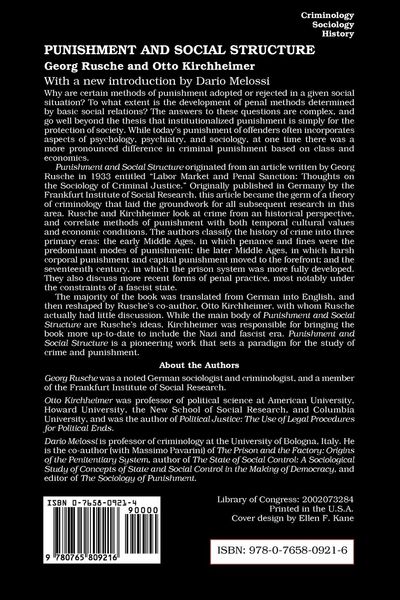
Why are certain methods of punishment adopted or rejected in a given social situation? To what extent is the development of penal methods determined by basic social relations? The answers to these questions are complex, and go well beyond the thesis that institutionalized punishment is simply for the protection of society. While today's punishment of offenders often incorporates aspects of psychology, psychiatry, and sociology, at one time there was a more pronounced difference in criminal punishment based on class and economics. Punishment and Social Structure originated from an article written by Georg Rusche in 1933 entitled "Labor Market and Penal Sanction: Thoughts on the Sociology of Criminal Justice." Originally published in Germany by the Frankfurt Institute of Social Research, this article became the germ of a theory of criminology that laid the groundwork for all subsequent research in this area. Rusche and Kirchheimer look at crime from an historical perspective, and correlate methods of punishment with both temporal cultural values and economic conditions. The authors classify the history of crime into three primary eras: the early Middle Ages, in which penance and fines were the predominant modes of punishment; the later Middle Ages, in which harsh corporal punishment and capital punishment moved to the forefront; and the seventeenth century, in which the prison system was more fully developed. They also discuss more recent forms of penal practice, most notably under the constraints of a fascist state.The majority of the book was translated from German into English, and then reshaped by Rusche's co-author, Otto Kirchheimer, with whom Rusche actually had little discussion. While the main body of Punishment and Social Structure are Rusche's ideas, Kirchheimer was responsible for bringing the book more up-to-date to include the Nazi and fascist era. Punishment and Social Structure is a pioneering work that sets a paradigm for the study of crime and punishment.

Produktdetails

Einband

Taschenbuch

Erscheinungsdatum

30.01.2003

Herausgeber Otto Kirchheimer
Verlag Taylor & Francis

Produktdetails

Einband

Taschenbuch

Erscheinungsdatum

30.01.2003

Herausgeber Otto Kirchheimer
Verlag Taylor & Francis
Seitenzahl

324

Maße (L/B/H)

22,8/14,9/1,8 cm

Gewicht

431 g

Sprache

Englisch

ISBN

978-0-7658-0921-6

EU-Ansprechpartner

Taylor & Francis Verlag GmbH
Kaufingerstraße 24
80331 München
DE
GPSR@taylorandfrancis.com

Herstelleradresse

Taylor & Francis Group
5 Howick Place
SW1P 1WG London
UK
GPSR@taylorandfrancis.com

Ein neues Kapitel für Ihre Bücher

Ein neues Kapitel für Ihre Bücher

Schenken Sie Ihren alten Schätzen ein zweites Leben und erhalten Sie dafür eine Thalia Geschenkkarte.

Jetzt verkaufen
Jetzt verkaufen

Noch keine Bewertungen vorhanden

Verfassen Sie die erste Bewertung zu diesem Artikel

Helfen Sie anderen Kundinnen und Kunden durch Ihre Meinung.

Kundinnen und Kunden meinen

Bewertungen (0)

Die Leseprobe wird geladen.
  • Produktbild: Punishment and Social Structure
  • Produktbild: Punishment and Social Structure
  • I. INTRODUCTION II. SOCIAL CONDITIONS AND PENAL ADMINISTRATION IN THE LATER MIDDLE AGES III. MERCANTILISM AND THE RISE OF IMPRISONMENT V. DEVELOPMENTS IN CRIMINAL THEORY AND LAW DURING THE AGE OF ENLIGHTENMENT VI. Social AND PENAL CONSEQUENCES OF THE INDUS[1]TRIAL REVOLUTION VII. THE ABOLITION OF TRANSPORTATION VIII. THE FAlLURE OF SoLITARY CONFINEMENT IX. MODERN PRISON REFORM AND ITs LIMITS X. THE FINE IN RECENT PENAL PRACTICE XI. NEW TRENDS IN PENAL PoLICY UNDER FASCISM XII. PENAL PoLICY AND CRIME RATE XIII. CONCLUSION