















































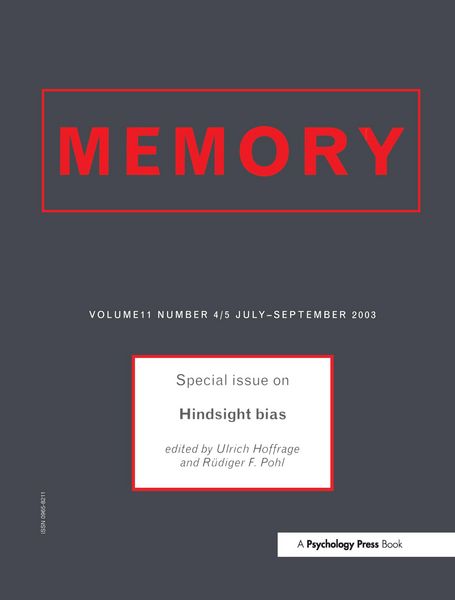
Hindsight Bias A Special Issue of Memory
-
- Englisch ausgewählt
59,99 €
inkl. gesetzl. MwSt.,
Beschreibung
Produktdetails
Einband
Taschenbuch
Erscheinungsdatum
07.08.2003
Herausgeber
Ulrich Hoffrage + weitereVerlag
Taylor and FrancisSeitenzahl
176
Maße (L/B/H)
27,3/20,3/0,9 cm
Gewicht
422 g
Sprache
Englisch
ISBN
978-1-84169-938-7
With hindsight, we tend to exaggerate what we had known with foresight. This phenomenon can be observed in a memory design in which previous judgements have to be recalled after outcome information has been made available, or in a hypothetical design in which participants receive outcome information but are asked to ignore it when subsequently judging what they would have said without this information. Since the introduction of this so-called hindsight bias or knew-it-all-along effect to the psychological literature in the mid-seventies, there has been immense research on this topic. This special issue presents ten articles that describe the most recent theoretical developments and empirical results. After a brief introductory overview of the state of the art, the issue commences with two process models (SARA, Pohl, Eisenhauer & Hardt; and RAFT, Hertwig, Fanselow & Hoffrage), which are formalized enough to allow for computer simulations. Subsequently, Hardt and Pohl demonstrate how the hindsight bias is related to the phenomenon of anchoring, and Schwarz and Stahlberg propose that due to meta-cognitive processes, the outcome information is deliberately chosen as such an anchor. In a variant of the meta-cognitive approach, Werth and Strack argue that ease of retrieval of an answer is used as a cue to infer its correctness and to determine one's confidence in its correctness. Similarly, Pezzo proposes a model that predicts hindsight bias from feelings that arise when trying to make sense of the outcome information in light of prior expectations. Mark et al. and Renner adopt a motivational perspective and explore the impact of self-relevance of the outcome information. Blank, Fischer, and Erdfelder report a successful replication of the hindsight bias in two political elections, and Musch explains some of the variance in hindsight bias using personality factors.
Ein neues Kapitel für Ihre Bücher
Ein neues Kapitel für Ihre Bücher
Schenken Sie Ihren alten Schätzen ein zweites Leben und erhalten Sie dafür eine Thalia Geschenkkarte.
Noch keine Bewertungen vorhanden
Verfassen Sie die erste Bewertung zu diesem Artikel
Helfen Sie anderen Kundinnen und Kunden durch Ihre Meinung.
Kurze Frage zu unserer Seite
Vielen Dank für Ihr Feedback
Wir nutzen Ihr Feedback, um unsere Produktseiten zu verbessern. Bitte haben Sie Verständnis, dass wir Ihnen keine Rückmeldung geben können. Falls Sie Kontakt mit uns aufnehmen möchten, können Sie sich aber gerne an unseren Kund*innenservice wenden.
zum Kundenservice