
















































KI-Beratung Beta

Gutscheinbedingungen

Gültig bis 30.11.2026 | Gültig für nicht preisgebundene fremdsprachige Bücher | Einzelne Artikel können ausgeschlossen sein | Online auf thalia.de und in der Thalia App einlösbar | Click & Collect nur mit Online-Zahlung (Paypal/Kreditkarte) vorab | Nicht kombinierbar mit anderen Gutscheinen oder Preisaktionen | Nur einmal pro Einkauf einlösbar | Gutschein wird auf max. 500€ Bestellwert angerechnet | Keine Barauszahlung | Nicht gültig für Versandkosten und Services

  • Produktbild: Surveillance as Social Sorting
  • Produktbild: Surveillance as Social Sorting

Surveillance as Social Sorting Privacy, Risk and Automated Discrimination

79,99 €

inkl. gesetzl. MwSt., Versandkostenfrei


Beschreibung

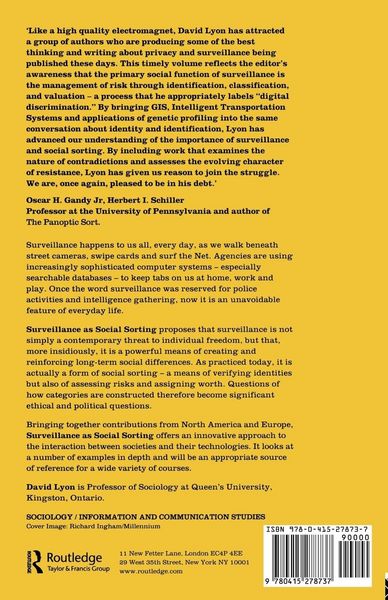
Surveillance happens to all of us, everyday, as we walk beneath street cameras, swipe cards, surf the net. Agencies are using increasingly sophisticated computer systems - especially searchable databases - to keep tabs on us at home, work and play. Once the word surveillance was reserved for police activities...

Beschreibung

Surveillance happens to all of us, everyday, as we walk beneath street cameras, swipe cards, surf the net. Agencies are using increasingly sophisticated computer systems - especially searchable databases - to keep tabs on us at home, work and play. Once the word surveillance was reserved for police activities and intelligence gathering, now it is an unavoidable feature of everyday life.
Surveillance as Social Sorting proposes that surveillance is not simply a contemporary threat to individual freedom, but that, more insidiously, it is a powerful means of creating and reinforcing long-term social differences. As practiced today, it is actually a form of social sorting - a means of verifying identities but also of assessing risks and assigning worth. Questions of how categories are constructed therefore become significant ethical and political questions.
Bringing together contributions from North America and Europe, Surveillance as Social Sorting offers an innovative approach to the interaction between societies and their technologies. It looks at a number of examples in depth and will be an appropriate source of reference for a wide variety of courses.

Rezension

'...Surveillance as Social Sorting is an interesting collection. It is well produced and makes a valuable contribution to the burgeoning field of 'surveillance studies'. The breadth of coverage also means this book represents an excellent starting point for those interested in, but unfamiliar with, social science analysis of contemporary surveillance issues.' -Martin Dodge, UCL, in Environment and Planning B, 2005

Produktdetails

Einband

Taschenbuch

Erscheinungsdatum

24.10.2002

Abbildungen

5 Tabellen

Herausgeber David Lyon

Produktdetails

Einband

Taschenbuch

Erscheinungsdatum

24.10.2002

Abbildungen

5 Tabellen

Herausgeber David Lyon
Verlag Taylor & Francis
Seitenzahl

302

Maße (L/B/H)

21,6/14/1,6 cm

Gewicht

383 g

Sprache

Englisch

ISBN

978-0-415-27873-7

Herstelleradresse

Libri GmbH
Europaallee 1
36244 Bad Hersfeld
DE

Email: gpsr@libri.de

Ein neues Kapitel für Ihre Bücher

Ein neues Kapitel für Ihre Bücher

Schenken Sie Ihren alten Schätzen ein zweites Leben und erhalten Sie dafür eine Thalia Geschenkkarte.

Jetzt verkaufen
Jetzt verkaufen

Noch keine Bewertungen vorhanden

Verfassen Sie die erste Bewertung zu diesem Artikel

Helfen Sie anderen Kundinnen und Kunden durch Ihre Meinung.

Kundinnen und Kunden meinen

Bewertungen (0)

Die Leseprobe wird geladen.
  • Produktbild: Surveillance as Social Sorting
  • Produktbild: Surveillance as Social Sorting
  • Part One: Orientations 1. Surveillance as Social Sorting: Computer Codes and Mobile Bodies 2. Theorizing Surveillance: The Case of the Workplace 3. Biometrics and the Body as Information: Normative Issues of the Socio-technical Coding of the Body Part Two: Verifying Identities: Constituting Life-Chances 4. Electronic Identity Cards and Social Classification 5. Surveillance Creep in the Genetic Age 6. "Racial" Categories and Health Risks: Epidemiological Surveillance Among Canadian First Nations Part Three: Regulating Mobilities: Places and Spaces 7. Privacy and the Phenetic Urge: Geodemographics and the Changing Spatiality of Local Practice 8. People and Place: Patterns of Individual Identification within Intelligent Transportation Systems 9. Netscapes of Power: Convergence, Network Design, Walled Gardens, and other Strategies of Control in the Information Age Part Four: Targeting Trouble: Social Divisions 10. Categorizing the Workers: Electronic Surveillance and Social Ordering in the Call Centre 11. Private Security and Surveillance: From the "Dossier Society" to Database Networks 12. From Personal to Digital: CCTV, the Panopticon, and the Technological Meditation of Suspicion and Social Control