















































KI-Beratung Beta

Gutscheinbedingungen

Gültig bis 30.11.2026 | Gültig für nicht preisgebundene fremdsprachige Bücher | Einzelne Artikel können ausgeschlossen sein | Online auf thalia.de und in der Thalia App einlösbar | Click & Collect nur mit Online-Zahlung (Paypal/Kreditkarte) vorab | Nicht kombinierbar mit anderen Gutscheinen oder Preisaktionen | Nur einmal pro Einkauf einlösbar | Gutschein wird auf max. 500€ Bestellwert angerechnet | Keine Barauszahlung | Nicht gültig für Versandkosten und Services

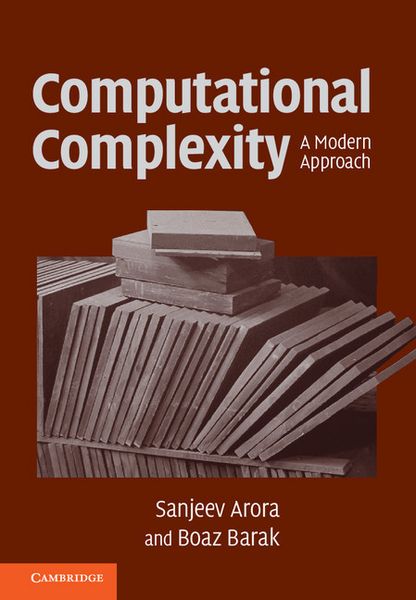
  • Produktbild: Computational Complexity
  • Produktbild: Computational Complexity

Computational Complexity A Modern Approach

77,99 €

inkl. gesetzl. MwSt., Versandkostenfrei


Beschreibung

This beginning graduate textbook describes both recent achievements and classical results of computational complexity theory. Requiring essentially no background apart from mathematical maturity, the book can be used as a reference for self-study for anyone interested in complexity, including physicists,...

Beschreibung

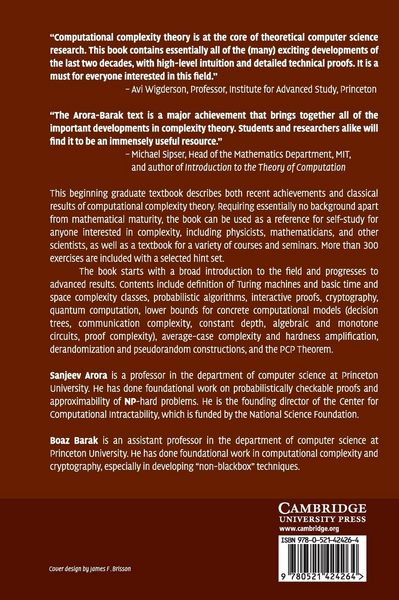
This beginning graduate textbook describes both recent achievements and classical results of computational complexity theory. Requiring essentially no background apart from mathematical maturity, the book can be used as a reference for self-study for anyone interested in complexity, including physicists, mathematicians, and other scientists, as well as a textbook for a variety of courses and seminars. More than 300 exercises are included with a selected hint set. The book starts with a broad introduction to the field and progresses to advanced results. Contents include: definition of Turing machines and basic time and space complexity classes, probabilistic algorithms, interactive proofs, cryptography, quantum computation, lower bounds for concrete computational models (decision trees, communication complexity, constant depth, algebraic and monotone circuits, proof complexity), average-case complexity and hardness amplification, derandomization and pseudorandom constructions, and the PCP theorem.

Rezension

'This book by two leading theoretical computer scientists provides a comprehensive, insightful and mathematically precise overview of computational complexity theory, ranging from early foundational work to emerging areas such as quantum computation and hardness of approximation. It will serve the needs of a wide audience, ranging from experienced researchers to graduate students and ambitious undergraduates seeking an introduction to the mathematical foundations of computer science. I will keep it at my side as a useful reference for my own teaching and research.' Richard M. Karp, University of California at Berkeley

Produktdetails

Einband

Gebundene Ausgabe

Erscheinungsdatum

01.05.2009

Abbildungen

72 line figures, 1 halftone, 6 tables, 307 exercises

Verlag Cambridge University Press

Produktdetails

Einband

Gebundene Ausgabe

Erscheinungsdatum

01.05.2009

Abbildungen

72 line figures, 1 halftone, 6 tables, 307 exercises

Verlag Cambridge University Press
Seitenzahl

579

Maße (L/B/H)

25,7/18,2/3,7 cm

Gewicht

1381 g

Farbe

Tabak

Sprache

Englisch

ISBN

978-0-521-42426-4

Herstelleradresse

Libri GmbH
Europaallee 1
36244 Bad Hersfeld
DE

Email: gpsr@libri.de

Ein neues Kapitel für Ihre Bücher

Ein neues Kapitel für Ihre Bücher

Schenken Sie Ihren alten Schätzen ein zweites Leben und erhalten Sie dafür eine Thalia Geschenkkarte.

Jetzt verkaufen
Jetzt verkaufen

Noch keine Bewertungen vorhanden

Verfassen Sie die erste Bewertung zu diesem Artikel

Helfen Sie anderen Kundinnen und Kunden durch Ihre Meinung.

Kundinnen und Kunden meinen

Bewertungen (0)

Die Leseprobe wird geladen.
  • Produktbild: Computational Complexity
  • Produktbild: Computational Complexity
  • Part I. Basic Complexity Classes: 1. The computational model - and why it doesn't matter; 2. NP and NP completeness; 3. Diagonalization; 4. Space complexity; 5. The polynomial hierarchy and alternations; 6. Boolean circuits; 7. Randomized computation; 8. Interactive proofs; 9. Cryptography; 10. Quantum computation; 11. PCP theorem and hardness of approximation: an introduction; Part II. Lower Bounds for Concrete Computational Models: 12. Decision trees; 13. Communication complexity; 14. Circuit lower bounds; 15. Proof complexity; 16. Algebraic computation models; Part III. Advanced Topics: 17. Complexity of counting; 18. Average case complexity: Levin's theory; 19. Hardness amplification and error correcting codes; 20. Derandomization; 21. Pseudorandom constructions: expanders and extractors; 22. Proofs of PCP theorems and the Fourier transform technique; 23. Why are circuit lower bounds so difficult?; Appendix A: mathematical background.