















































KI-Beratung Beta

Gutscheinbedingungen

Gültig bis 30.11.2026 | Gültig für nicht preisgebundene fremdsprachige Bücher | Einzelne Artikel können ausgeschlossen sein | Online auf thalia.de und in der Thalia App einlösbar | Click & Collect nur mit Online-Zahlung (Paypal/Kreditkarte) vorab | Nicht kombinierbar mit anderen Gutscheinen oder Preisaktionen | Nur einmal pro Einkauf einlösbar | Gutschein wird auf max. 500€ Bestellwert angerechnet | Keine Barauszahlung | Nicht gültig für Versandkosten und Services

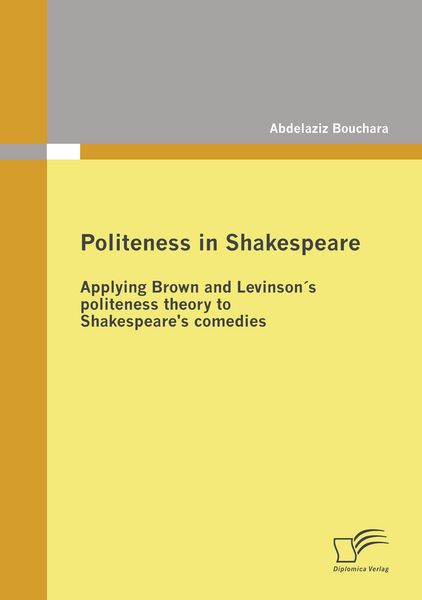
Produktbild: Politeness in Shakespeare: Applying Brown and Levinson´s politeness theory to Shakespeare's comedies

Politeness in Shakespeare: Applying Brown and Levinson´s politeness theory to Shakespeare's comedies

48,00 €

inkl. gesetzl. MwSt., Versandkostenfrei


Beschreibung

Penelope Brown and Stephen Levinson have proposed that power (P), distance (D), and the ranked extremity (R) of a face-threatening act are the universal determinants of politeness levels in dyadic discourse. This claim is tested here for Shakespeare's use of Early Modern English in Much Ado about Nothing,...

Beschreibung

Penelope Brown and Stephen Levinson have proposed that power (P), distance (D), and the ranked extremity (R) of a face-threatening act are the universal determinants of politeness levels in dyadic discourse. This claim is tested here for Shakespeare's use of Early Modern English in Much Ado about Nothing, Measure for Measure, The Taming of the Shrew, and Twelfth Night. The comedies are used because: (1) dramatic texts provide the best information on colloquial speech of the period; (2) the psychological soliloquies in the comedies provide the access to inner life that is necessary for a proper test of politeness theory; and (3) the comedies represent the full range of society in a period of high relevance to politeness theory. The four plays are systematically searched for pairs of minimally contrasting dyads where the dimensions of contrast are power (P), distance (D), and intrinsic extremity (R). Whenever such a pair is found, there are two speeches to be scored for politeness and a prediction from theory as to which should be more polite. The results for P and for R are those predicted by theory, but the results for D are not. The two components of D, interactive closeness and affect, are not closely associated in the plays. Affect strongly influences politeness (increased liking increases politeness and decreased liking decreases politeness); interactive closeness has little or no effect on politeness. The uses of politeness for the delineation of character in the comedies are illustrated.

Produktdetails

Einband

Taschenbuch

Erscheinungsdatum

13.08.2009

Abbildungen

w. 12 figs.

Verlag Diplomica Verlag GmbH

Produktdetails

Einband

Taschenbuch

Erscheinungsdatum

13.08.2009

Abbildungen

w. 12 figs.

Verlag Diplomica Verlag GmbH
Seitenzahl

126

Maße (L/B/H)

27/19/0,9 cm

Gewicht

320 g

Auflage

1. Auflage

Sprache

Englisch

ISBN

978-3-8366-7753-0

Herstelleradresse

Disserta Verlag
Hermannsthal 119k
22119 Hamburg
DE

Email: info@bedey-media.de

Ein neues Kapitel für Ihre Bücher

Ein neues Kapitel für Ihre Bücher

Schenken Sie Ihren alten Schätzen ein zweites Leben und erhalten Sie dafür eine Thalia Geschenkkarte.

Jetzt verkaufen
Jetzt verkaufen

Noch keine Bewertungen vorhanden

Verfassen Sie die erste Bewertung zu diesem Artikel

Helfen Sie anderen Kundinnen und Kunden durch Ihre Meinung.

Kundinnen und Kunden meinen

Bewertungen (0)

  • Produktbild: Politeness in Shakespeare: Applying Brown and Levinson´s politeness theory to Shakespeare's comedies