















































KI-Beratung Beta

Produktbild: Full-Spectrum Economics

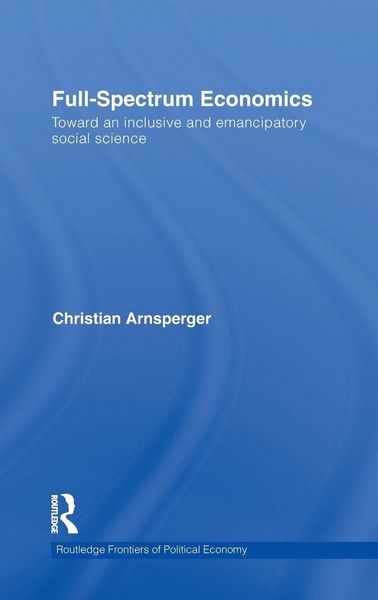
Full-Spectrum Economics Toward an Inclusive and Emancipatory Social Science

256,99 €

inkl. gesetzl. MwSt., Versandkostenfrei


Beschreibung

Economics is essential in today's world, and yet mainstream economists are increasingly under criticism for not taking into account sufficiently many dimensions of real life, such as political and moral values, human development, spirituality, and people's widely shared aspiration to live more liberated...

Beschreibung

Economics is essential in today's world, and yet mainstream economists are increasingly under criticism for not taking into account sufficiently many dimensions of real life, such as political and moral values, human development, spirituality, and people's widely shared aspiration to live more liberated lives. This book offers a critical assessment of contemporary mainstream economics by showing that the discipline has become much too narrow and misses out on the full spectrum of human existence.

The book presents a careful, detailed analysis of the limitations of neoclassical economics and of its post-neoclassical successors: behavioral economics, neuroeconomics, and experimental economics. It offers a deconstruction rooted in the "Integral" philosophy developed over the past three decades by the contemporary American thinker Ken Wilber. Distinguishing between exterior and interior dimensions of human existence, it suggests that economics could be made into a more inclusive and more emancipatory science if it started to truly honor the genuinely interior aspects of individuals and communities. Instead of remaining stuck in the limitations of post-neoclassical theory, we should make the move toward a new paradigm that, in the name of science, promotes objectivity as well as subjectivity, and material causality as well as existential awareness.

The result is a highly expanded sense of relevance for economists, sociologists, and social scientists in general. Combining methodologies from systems science, brain science, ethno-methodology, and existentialism as well as from the great spiritual traditions of humanity, Christian Arnsperger delineates the requirements of a genuinely integral economics beyond today's crippling reductionism.

Rezension

"The results are superb and in many ways groundbreaking. What Arnsperger essentially does is apply the Integral framework (of quadrants and levels) to the field of economics, thus filling in those many areas that traditional economics has left out of the picture. Arnsperger is able to flesh out the beginnings of a truly comprehensive and Integral economics. All of the interior factors (of the "I" and "we"), overlooked or unseen by the previous models, are taken into account in this model, and thus a truly Integral Economic Model begins to emerge, covering all of the major dimensions of human being-in-the-world. This is a major accomplishment, sure to have an impact for decades to come."
Ken Wilber, from the foreword

Produktdetails

Einband

Gebundene Ausgabe

Erscheinungsdatum

14.12.2009

Abbildungen

23 SW-Abb., 23 SW-Zeichn., 4 Tabellen

Verlag Taylor & Francis

Produktdetails

Einband

Gebundene Ausgabe

Erscheinungsdatum

14.12.2009

Abbildungen

23 SW-Abb., 23 SW-Zeichn., 4 Tabellen

Verlag Taylor & Francis
Seitenzahl

304

Maße (L/B/H)

24/16,1/2,1 cm

Gewicht

572 g

Sprache

Englisch

ISBN

978-0-415-55547-0

Herstelleradresse

Libri GmbH
Europaallee 1
36244 Bad Hersfeld
DE

Email: gpsr@libri.de

Ein neues Kapitel für Ihre Bücher

Ein neues Kapitel für Ihre Bücher

Schenken Sie Ihren alten Schätzen ein zweites Leben und erhalten Sie dafür eine Thalia Geschenkkarte.

Jetzt verkaufen
Jetzt verkaufen

Noch keine Bewertungen vorhanden

Verfassen Sie die erste Bewertung zu diesem Artikel

Helfen Sie anderen Kundinnen und Kunden durch Ihre Meinung.

Kundinnen und Kunden meinen

Bewertungen (0)

Die Leseprobe wird geladen.
  • Produktbild: Full-Spectrum Economics
  • Foreword Ken Wilber 1. Introduction: Why economics should go "full spectrum" Part I: The broadness of knowledge 2. The structure of economic knowledge 3. An Integral approach: The four quadrants of reality Part II: Neoclassical reductionism 4. Individualism, intrumentalism, and equilibrium 5. The political philosophy of macro-management Part III: Post-neoclassical reductionism 6. Game theory and strategic interaction 7. Complexity economics and "out-of-equilibrium" systems 8. Behavioral economics, neuroeconomics, and the experimental approach Part IV: Beyond reductionism: The quest for Full-Spectrum Economics 9. Mainstream economics: A full-spectrum critique 10. Full-Spectrum Economics: A first perspective 11. Paradigms, quadrants, and levels: The toolbox of Full-Spectrum Economics 12. Full-Spectrum Economics