















































KI-Beratung Beta

Gutscheinbedingungen

Gültig bis 30.11.2026 | Gültig für nicht preisgebundene fremdsprachige Bücher | Einzelne Artikel können ausgeschlossen sein | Online auf thalia.de und in der Thalia App einlösbar | Click & Collect nur mit Online-Zahlung (Paypal/Kreditkarte) vorab | Nicht kombinierbar mit anderen Gutscheinen oder Preisaktionen | Nur einmal pro Einkauf einlösbar | Gutschein wird auf max. 500€ Bestellwert angerechnet | Keine Barauszahlung | Nicht gültig für Versandkosten und Services

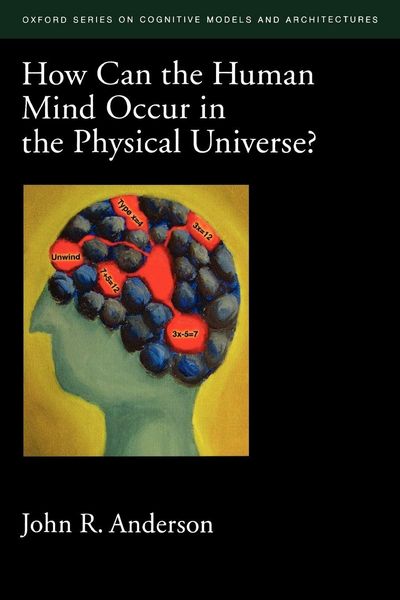
Produktbild: How Can the Human Mind Occur in the Physical Universe?

How Can the Human Mind Occur in the Physical Universe?

71,99 €

inkl. gesetzl. MwSt., Versandkostenfrei


Beschreibung

'The question for me is how can the human mind occur in the physical universe. We now know that the world is governed by physics. We now understand the way biology nestles comfortably within that. The issue is how will the mind do that as well.' --Alan Newell, December 4, 1991, Carnegie Mellon University...

Beschreibung

'The question for me is how can the human mind occur in the physical universe. We now know that the world is governed by physics. We now understand the way biology nestles comfortably within that. The issue is how will the mind do that as well.' --Alan Newell, December 4, 1991, Carnegie Mellon University The argument John Anderson gives in this book was inspired by the passage above, from the last lecture by one of the pioneers of cognitive science. Newell describes what, for him, is the pivotal question of scientific inquiry, and Anderson gives an answer that is emerging from the study of brain and behavior. Humans share the same basic cognitive architecture with all primates, but they have evolved abilities to exercise abstract control over cognition and process more complex relational patterns. The human cognitive architecture consists of a set of largely independent modules associated with different brain regions. In this book, Anderson discusses in detail how these various modules can combine to produce behaviors as varied as driving a car and solving an algebraic equation, but focuses principally on two of the modules: the declarative and procedural. The declarative module involves a memory system that, moment by moment, attempts to give each person the most appropriate possible window into his or her past. The procedural module involves a central system that strives to develop a set of productions that will enable the most adaptive response from any state of the modules. Newell argued that the answer to his question must take the form of a cognitive architecture, and Anderson organizes his answer around the ACT-R architecture, but broadens it by bringing in research from all areas of cognitive science, including how recent work in brain imaging maps onto the cogntive architecture.

Produktdetails

Einband

Taschenbuch

Erscheinungsdatum

01.07.2009

Verlag Oxford University Press
Seitenzahl

302

Produktdetails

Einband

Taschenbuch

Erscheinungsdatum

01.07.2009

Verlag Oxford University Press
Seitenzahl

302

Maße (L/B/H)

23,4/15,6/1,7 cm

Gewicht

462 g

Sprache

Englisch

ISBN

978-0-19-539895-3

Herstelleradresse

Libri GmbH
Europaallee 1
36244 Bad Hersfeld
DE

Email: gpsr@libri.de

Ein neues Kapitel für Ihre Bücher

Ein neues Kapitel für Ihre Bücher

Schenken Sie Ihren alten Schätzen ein zweites Leben und erhalten Sie dafür eine Thalia Geschenkkarte.

Jetzt verkaufen
Jetzt verkaufen

Noch keine Bewertungen vorhanden

Verfassen Sie die erste Bewertung zu diesem Artikel

Helfen Sie anderen Kundinnen und Kunden durch Ihre Meinung.

Kundinnen und Kunden meinen

Bewertungen (0)

Die Leseprobe wird geladen.
  • Produktbild: How Can the Human Mind Occur in the Physical Universe?
    • Preface
    • 1 Cognitive Architecture
    • 2 The Modular Organization of the Mind
    • 3 Human Associative Memory
    • 4 The Adaptive Control of Thought
    • 5 What does it Take to be Human? Lessons from High-School Algebra
    • 6 How Can the Human Mind Occur?
    • Bibiliography