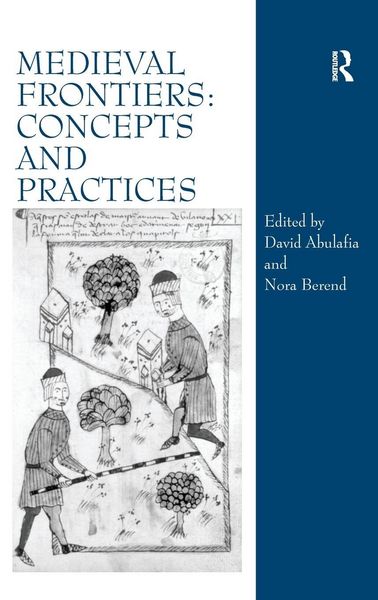
Medieval Frontiers: Concepts and Practices Concepts and Practices
-
- Englisch ausgewählt
67,99 €
inkl. gesetzl. MwSt.,
Beschreibung
Produktdetails
Einband
Gebundene Ausgabe
Erscheinungsdatum
18.06.2002
Verlag
Taylor and FrancisSeitenzahl
307
Maße (L/B/H)
23,4/15,6/1,9 cm
Gewicht
608 g
Sprache
Englisch
ISBN
978-0-7546-0522-5
In recent years, the 'medieval frontier' has been the subject of extensive research. But the term has been understood in many different ways: political boundaries; fuzzy lines across which trade, religions and ideas cross; attitudes to other peoples and their customs. This book draws attention to the differences between the medieval and modern understanding of frontiers, questioning the traditional use of the concepts of 'frontier' and 'frontier society'. It contributes to the understanding of physical boundaries as well as metaphorical and ideological frontiers, thus providing a background to present-day issues of political and cultural delimitation. In a major introduction, David Abulafia analyses these various ambiguous meanings of the term 'frontier', in political, cultural and religious settings. The articles that follow span Europe from the Baltic to Iberia, from the Canary Islands to central Europe, Byzantium and the Crusader states. The authors ask what was perceived as a frontier during the Middle Ages? What was not seen as a frontier, despite the usage in modern scholarship? The articles focus on a number of themes to elucidate these two main questions. One is medieval ideology. This includes the analysis of medieval formulations of what frontiers should be and how rulers had a duty to defend and/or extend the frontiers; how frontiers were defined (often in a different way in rhetorical-ideological formulations than in practice); and how in certain areas frontier ideologies were created. The other main topic is the emergence of frontiers, how medieval people created frontiers to delimit areas, how they understood and described frontiers. The third theme is that of encounters, and a questioning of medieval attitudes to such encounters. To what extent did medieval observers see a frontier between themselves and other groups, and how does real interaction compare with ideological or narrative formulations of such interaction?
Ein neues Kapitel für Ihre Bücher
Ein neues Kapitel für Ihre Bücher
Schenken Sie Ihren alten Schätzen ein zweites Leben und erhalten dafür eine Thalia Geschenkkarte.
Noch keine Bewertungen vorhanden
Verfassen Sie die erste Bewertung zu diesem Artikel
Helfen Sie anderen Kundinnen und Kunden durch Ihre Meinung.
Kurze Frage zu unserer Seite
Vielen Dank für Ihr Feedback
Wir nutzen Ihr Feedback, um unsere Produktseiten zu verbessern. Bitte haben Sie Verständnis, dass wir Ihnen keine Rückmeldung geben können. Falls Sie Kontakt mit uns aufnehmen möchten, können Sie sich aber gerne an unseren Kund*innenservice wenden.
zum Kundenservice