















































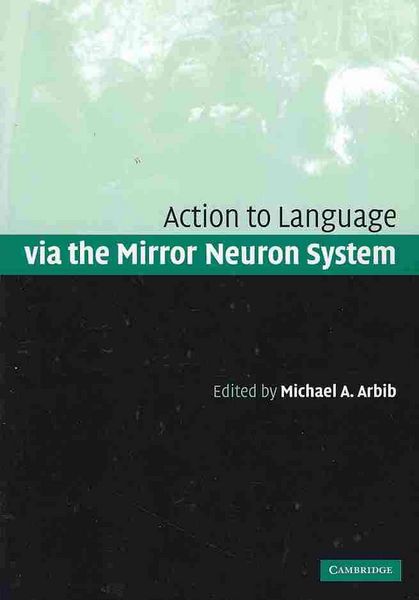
Action to Language Via the Mirror Neuron System
-
- Hardcover
- Taschenbuch ausgewählt
- eBook
-
Sprache:Englisch
99,99 €
inkl. gesetzl. MwSt.,
Beschreibung
Produktdetails
Einband
Taschenbuch
Erscheinungsdatum
25.11.2010
Herausgeber
Arbib Michael A.Verlag
Cambridge AcademicSeitenzahl
568
Maße (L/B/H)
24,4/17/3 cm
Gewicht
890 g
Sprache
Englisch
ISBN
978-0-521-18268-3
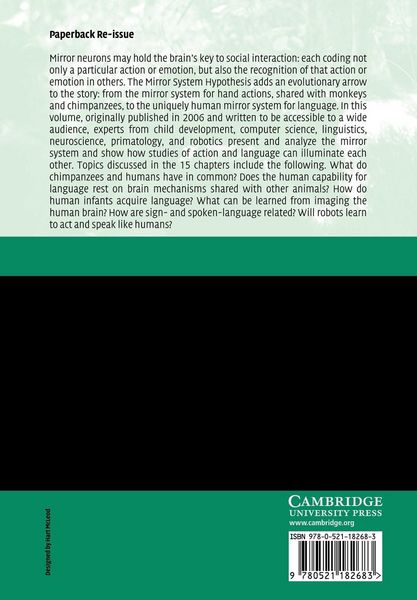
Mirror neurons may hold the brain's key to social interaction - each coding not only a particular action or emotion but also the recognition of that action or emotion in others. The Mirror System Hypothesis adds an evolutionary arrow to the story - from the mirror system for hand actions, shared with monkeys and chimpanzees, to the uniquely human mirror system for language. In this accessible volume, experts from child development, computer science, linguistics, neuroscience, primatology and robotics present and analyse the mirror system and show how studies of action and language can illuminate each other. Topics discussed in the fifteen chapters include: what do chimpanzees and humans have in common? Does the human capability for language rest on brain mechanisms shared with other animals? How do human infants acquire language? What can be learned from imaging the human brain? How are sign- and spoken-language related? Will robots learn to act and speak like humans?
Ein neues Kapitel für Ihre Bücher
Ein neues Kapitel für Ihre Bücher
Schenken Sie Ihren alten Schätzen ein zweites Leben und erhalten Sie dafür eine Thalia Geschenkkarte.
Noch keine Bewertungen vorhanden
Verfassen Sie die erste Bewertung zu diesem Artikel
Helfen Sie anderen Kundinnen und Kunden durch Ihre Meinung.
Kurze Frage zu unserer Seite
Vielen Dank für Ihr Feedback
Wir nutzen Ihr Feedback, um unsere Produktseiten zu verbessern. Bitte haben Sie Verständnis, dass wir Ihnen keine Rückmeldung geben können. Falls Sie Kontakt mit uns aufnehmen möchten, können Sie sich aber gerne an unseren Kund*innenservice wenden.
zum Kundenservice