















































KI-Beratung Beta

Gutscheinbedingungen

Gültig bis 11.11.2026 | Gültig für Spielzeug, Filme, Musik, Software, Games, Geschenke & Trends, Schreibwaren, Hörbücher und Hörbuch-Downloads (außer Abo & Shelfies), gebrauchte Bücher, nicht preisgebundene Bücher und Kalender | Einlösbar unter thalia.de und in der Thalia App | Click & Collect nur mit Online-Zahlung (Paypal/Kreditkarte) vorab | Einzelne Artikel können ausgeschlossen sein | Nicht kombinierbar mit anderen Gutscheinen oder Preisaktionen | Nur einmal pro Einkauf einlösbar | Gutschein wird auf max. 500€ Bestellwert angerechnet | Keine Barauszahlung | Digitale Hörbücher nur für Android  | Nicht gültig für preisgebundene Artikel (aufgrund der Buchpreisbindung sind Gutscheine nicht auf Bücher, eBooks, Presse einlösbar), tolino eReader & Zubehör, Abonnements & Flatrates, Geschenkkarten, Versandkosten und Services

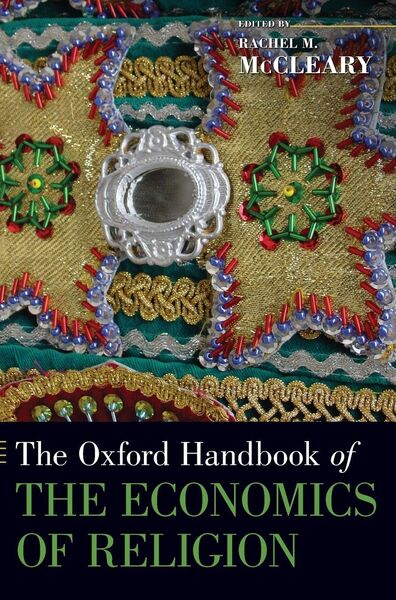
Produktbild: Oxford Handbook of the Economics of Religion

Oxford Handbook of the Economics of Religion

217,99 €

inkl. gesetzl. MwSt., Versandkostenfrei


Beschreibung

This is a one-of-kind volume bringing together leading scholars in the economics of religion for the first time. The treatment of topics is interdisciplinary, comparative, as well as global in nature. Scholars apply the economics of religion approach to contemporary issues such as immigrants in the United...

Beschreibung

This is a one-of-kind volume bringing together leading scholars in the economics of religion for the first time. The treatment of topics is interdisciplinary, comparative, as well as global in nature. Scholars apply the economics of religion approach to contemporary issues such as immigrants in the United States and ask historical questions such as why did Judaism as a religion promote investment in education?
The economics of religion applies economic concepts (for example, supply and demand) and models of the market to the study of religion. Advocates of the economics of religion approach look at ways in which the religion market influences individual choices as well as institutional development. For example, economists would argue that when a large denomination declines, the religion is not supplying the right kind of religious good that appeals to the faithful. Like firms, religions compete and supply goods. The economics of religion approach using rational choice theory, assumes that all human beings, regardless of their cultural context, their socio-economic situation, act rationally to further his/her ends.
The wide-ranging topics show the depth and breadth of the approach to the study of religion.

Rezension

a solid addition to the prestigious series. Titus Hjelm, Journal of Religion in Europe

Produktdetails

Einband

Gebundene Ausgabe

Erscheinungsdatum

01.01.2011

Abbildungen

w. 17 ill.

Herausgeber Rachel M. McCleary + weitere

Produktdetails

Einband

Gebundene Ausgabe

Erscheinungsdatum

01.01.2011

Abbildungen

w. 17 ill.

Herausgeber
Verlag Oxford University Press
Seitenzahl

416

Maße (L/B/H)

25/17,5/2,7 cm

Gewicht

894 g

Sprache

Englisch

ISBN

978-0-19-539004-9

Herstelleradresse

Libri GmbH
Europaallee 1
36244 Bad Hersfeld
DE

Email: gpsr@libri.de

Ein neues Kapitel für Ihre Bücher

Ein neues Kapitel für Ihre Bücher

Schenken Sie Ihren alten Schätzen ein zweites Leben und erhalten Sie dafür eine Thalia Geschenkkarte.

Jetzt verkaufen
Jetzt verkaufen

Noch keine Bewertungen vorhanden

Verfassen Sie die erste Bewertung zu diesem Artikel

Helfen Sie anderen Kundinnen und Kunden durch Ihre Meinung.

Kundinnen und Kunden meinen

Bewertungen (0)

  • Produktbild: Oxford Handbook of the Economics of Religion
    • List of Contributors
    • Part I: Introduction
    • 1: The Economics of Religion as a Field of Inquiry - Rachel M. McCleary, Harvard University
    • Part II: Religion and Human Capital
    • 2: Religion, Human Capital Investments, and the Family in the United States - Evelyn L. Lehrer, University of
    • Illinois at Chicago
    • 3: Religious Norms, Human Capital, and Money Lending in Jewish European history - Maristella Botticini, Università Bocconi, and Zvi Eckstein, Tel Aviv University
    • 4: Islam and Human Capital Formation: Evidence from Pre-Modern Science - Eric Chaney, Harvard University
    • 5: The Effects of the Protestant Reformation on Human Capital - Sascha O. Becker University of Stirling and Ludger Woessman, University of Munich
    • 6: Religion and the Spread of Human Capital and Political Institutions: Christian Missions as a Quasi-Natural Experiment - Robert D. Woodberry, University of Texas at Austin
    • Part III: The Nature of Religious Economies
    • 7: Towards Better Measures of Supply and Demand for Testing Theories of Religious Participation - Dan Olson, Purdue University
    • 8: Immigrants, Migration, and Religious Economies - Darren E. Sherkat, University of Southern Illinois
    • 9: On the (Lack of) Stability of Communes: An Economic Perspective - Ran Abramitzky, Stanford University
    • 10: The Economics of Sainthood (A Preliminary Investigation) - Robert J. Barro, Harvard University, Rachel M. McCleary, Harvard University, and Alexander McQuoid, Columbia University
    • 11: On the Socioeconomic Consequences of Religious Strife and Coexistence - Murat Iyigun, University of Colorado
    • Part IV: Regulation of the Religion Market
    • 12: Religion under Communism: State Regulation, Atheist Competition, and the Dynamics of Supply and Demand - Steven Pfaff, University of Washington
    • 13: Rethinking the Study of Religious Markets - Daniel M. Hungerman, Notre Dame
    • 14: Religion and Civil Liberties in the United States - Anthony Gill, University of Washington
    • 15: Secularization and Economic Models of Religious Behavior - Steve Bruce, University of Aberdeen
    • Part V: Economic Aspects of Religion
    • 16: The Political Economy of the Medieval Church - Robert B. Ekelund, Robert F. Hébert, Auburn University, and
    • Robert D. Tollison, Clemson University
    • 17: Funding the Faiths: Toward a Theory of Religious Finance - Laurence R. Iannaccone, Chapman University, and
    • Feler Bose, Alma College
    • Part VI: Data Sets on Religion
    • 18: Data and Directions for Research in the Economics of Religion - Roger Finke, Pennsylvania State University,
    • and Christopher D. Bader, Baylor University
    • 19: International Religious Demography: An Overview of Sources and Methodology - Todd M. Johnson, Gordon-Conwell Theological Seminary, and Brian Grim, Pew Forum
    • Index