















































KI-Beratung Beta

Gutscheinbedingungen

Gültig bis 11.11.2026 | Gültig für Spielzeug, Filme, Musik, Software, Games, Geschenke & Trends, Schreibwaren, Hörbücher und Hörbuch-Downloads (außer Abo & Shelfies), gebrauchte Bücher, nicht preisgebundene Bücher und Kalender | Einlösbar unter thalia.de und in der Thalia App | Click & Collect nur mit Online-Zahlung (Paypal/Kreditkarte) vorab | Einzelne Artikel können ausgeschlossen sein | Nicht kombinierbar mit anderen Gutscheinen oder Preisaktionen | Nur einmal pro Einkauf einlösbar | Gutschein wird auf max. 500€ Bestellwert angerechnet | Keine Barauszahlung | Digitale Hörbücher nur für Android  | Nicht gültig für preisgebundene Artikel (aufgrund der Buchpreisbindung sind Gutscheine nicht auf Bücher, eBooks, Presse einlösbar), tolino eReader & Zubehör, Abonnements & Flatrates, Geschenkkarten, Versandkosten und Services

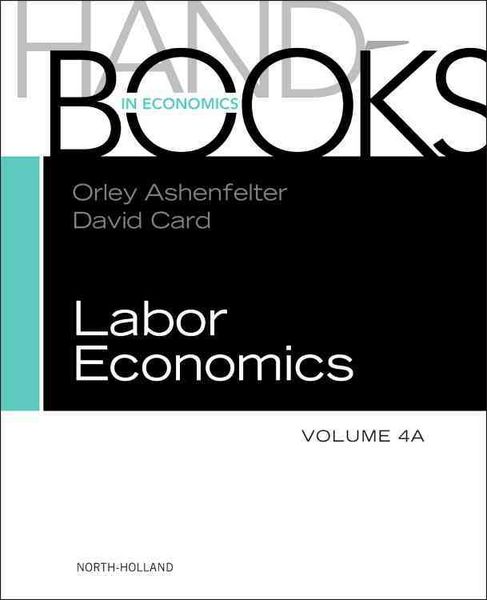
Produktbild: Handbook of Labor Economics
Band 4

Handbook of Labor Economics Volume 4a

Aus der Reihe Handbooks in Economics

162,99 €

inkl. gesetzl. MwSt., Versandkostenfrei


Beschreibung

Produktdetails

Einband

Gebundene Ausgabe

Erscheinungsdatum

09.12.2010

Abbildungen

w. figs. and tabs.

Herausgeber

Orley Ashenfelter + weitere

Verlag

North Holland

Seitenzahl

864

Maße (L/B/H)

24,1/19,4/5 cm

Gewicht

1800 g

Sprache

Englisch

ISBN

978-0-444-53450-7

Beschreibung

Rezension

"Labor economics" has continued to expand both in the extent and depth of coverage in recent years. Volume 4 of the Handbook has succeeded in not only updating coverage in many areas, but in synthesizing studies and approaches in ways that contribute importantly to the field. Economists with interests in many areas, ranging from field experiments to gender to early-life human capital investments, will benefit from the excellent chapters in this volume." --Jere R. Behrman, University of Pennsylvania

"Volume 4 very nicely illustrates several important trends in labor economics: increased concern about proper research design, more contact with those in other social sciences, greater reliance on data collected by those conducting the research, and (in some areas) more productive interplay between theory and data. The authors have themselves been major contributors to these developments; they combine a participant's enthusiasm with a detached perspective on the challenges and gaps that remain." --Charles C. Brown, University of Michigan

"The entries in the Handbook of Labor Economics update, deepen, and broaden the analyses contained in earlier volumes. The first-rate papers here address important problems in labor economics, often from new perspectives. As is the case with Volumes 1-3, many of the papers in volume 4 are "must-reads" and sure to make it onto graduate reading lists." --Henry Farber, Princeton University

Produktdetails

Einband

Gebundene Ausgabe

Erscheinungsdatum

09.12.2010

Abbildungen

w. figs. and tabs.

Herausgeber

Verlag

North Holland

Seitenzahl

864

Maße (L/B/H)

24,1/19,4/5 cm

Gewicht

1800 g

Sprache

Englisch

ISBN

978-0-444-53450-7

EU-Ansprechpartner

Elsevier B.V.
Radarweg 29
1043 NX Amsterdam
NL
productsafety@elsevier.com

Herstelleradresse

Elsevier Science & Technology
London Wall 125
EC2Y 5AS London
GB
tradeorders@elsevier.com

Ein neues Kapitel für Ihre Bücher

Ein neues Kapitel für Ihre Bücher

Schenken Sie Ihren alten Schätzen ein zweites Leben und erhalten Sie dafür eine Thalia Geschenkkarte.

Jetzt verkaufen
Jetzt verkaufen

Noch keine Bewertungen vorhanden

Verfassen Sie die erste Bewertung zu diesem Artikel

Helfen Sie anderen Kundinnen und Kunden durch Ihre Meinung.

Kundinnen und Kunden meinen

Bewertungen (0)

Die Leseprobe wird geladen.
  • Produktbild: Handbook of Labor Economics
  • Developments in Research Methods and their Application
    1. Decomposition Methods in Economics
    Nicole Fortin (University of British Columbia), Thomas Lemieux (University of British Columbia), and Sergio Firpo (Escola de Economia de São Paulo)
    2. Field Experiments in Labor Economics
    John List (University of Chicago) and Imran Rasul (University College London)
    3. Lab Labor: What Can Labor Economists Learn from the Lab?
    Gary Charness and Peter Kuhn (University of California at Santa Barbara)
    4. The Structural Estimation of Behavioral Models: Discrete Choice Dynamic Programming Methods and Applications
    Michael P. Keane (University of Technology, New South Wales), Kenneth I. Wolpin and Petra E. Todd (University of Pennsylvania)
    5. Program Evaluation and Research Designs
    John DiNardo (University of Michigan) and David S. Lee (Princeton University)
    6. Identification of Models of Labor Market
    Eric French (Federal Reserve Bank of Chicago) and Christopher Taber (University of Wisconsin at Madison)
    7. Search in Macroeconomic Models of the Labor Market
    Richard Rogerson (Arizona State University) and Robert Shimer (University of Chicago)
    8. Extrinsic Rewards and Intrinsic Motives: Standard and Behavioral Approaches to Agency and Labor Markets
    James B. Rebitzer (Boston University) and Lowell J. Taylor (Carnegie Mellon University)