















































KI-Beratung Beta

Gutscheinbedingungen

Gültig bis 30.11.2026 | Gültig für nicht preisgebundene fremdsprachige Bücher | Einzelne Artikel können ausgeschlossen sein | Online auf thalia.de und in der Thalia App einlösbar | Click & Collect nur mit Online-Zahlung (Paypal/Kreditkarte) vorab | Nicht kombinierbar mit anderen Gutscheinen oder Preisaktionen | Nur einmal pro Einkauf einlösbar | Gutschein wird auf max. 500€ Bestellwert angerechnet | Keine Barauszahlung | Nicht gültig für Versandkosten und Services

  • Produktbild: Dialogic Learning
  • Produktbild: Dialogic Learning

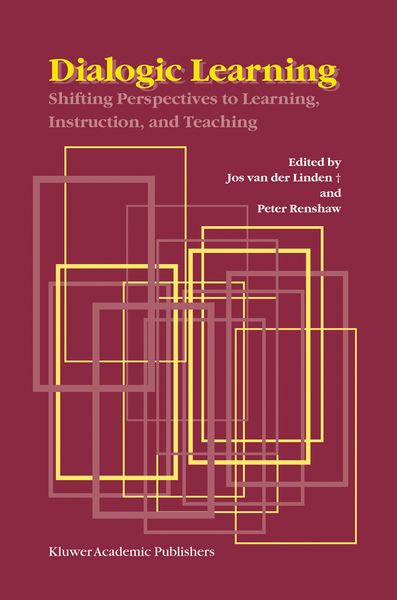
Dialogic Learning Shifting Perspectives to Learning, Instruction, and Teaching

97,99 €

inkl. gesetzl. MwSt., Versandkostenfrei


Beschreibung

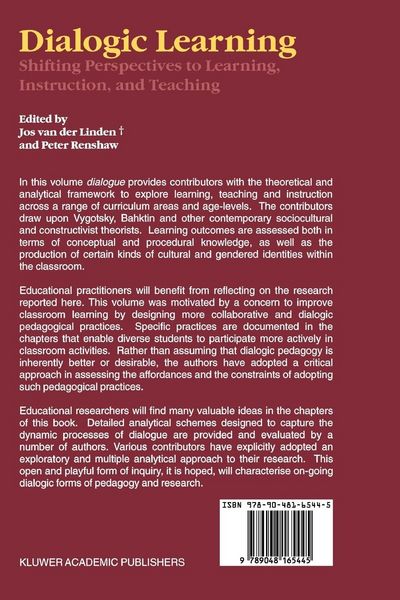
Contemporary researchers have analysed dialogue primarily in terms of instruction, conversation or inquiry. There is an irreducible tension when the terms ‘dialogue’ and ‘instruction’ are brought together, because the former implies an emergent process of give-and-take, whereas the latter implies a sequence...

Beschreibung

Contemporary researchers have analysed dialogue primarily in terms of instruction, conversation or inquiry. There is an irreducible tension when the terms ‘dialogue’ and ‘instruction’ are brought together, because the former implies an emergent process of give-and-take, whereas the latter implies a sequence of predetermined moves. It is argued that effective teachers have learned how to perform in this contradictory space to both follow and lead, to be both responsive and directive, to require both independence and receptiveness from learners. Instructional dialogue, therefore, is an artful performance rather than a prescribed technique. Dialogues also may be structured as conversations which function to build consensus, conformity to everyday ritualistic practices, and a sense of community. The dark side of the dialogic ‘we’ and the community formed around ‘our’ and ‘us’ is the inevitable boundary that excludes ‘them’ and ‘theirs’. When dialogues are structured to build consensus and community, critical reflection on the bases of that consensus is required and vigilance to ensure that difference and diversity are not being excluded or assimilated (see Renshaw, 2002). Again it is argued that there is an irreducible tension here because understanding and appreciating diversity can be achieved only through engagement and living together in communities. Teachers who work to create such communities in their classrooms need to balance the need for common practices with the space to be different, resistant or challenging – again an artful performance that is difficult to articulate in terms of specific teaching techniques.

Produktdetails

Einband

Taschenbuch

Erscheinungsdatum

19.10.2010

Abbildungen

VIII, 263 p.

Herausgeber Jos van den Linden + weitere

Produktdetails

Einband

Taschenbuch

Erscheinungsdatum

19.10.2010

Abbildungen

VIII, 263 p.

Herausgeber
Verlag Springer Netherland
Seitenzahl

263

Maße (L/B/H)

23,5/15,5/1,6 cm

Gewicht

423 g

Auflage

Softcover reprint of the original 1st ed. 2004

Sprache

Englisch

ISBN

978-90-481-6544-5

Herstelleradresse

Springer-Verlag KG
Sachsenplatz 4-6
1201 Wien
AT

Email: ProductSafety@springernature.com

Ein neues Kapitel für Ihre Bücher

Ein neues Kapitel für Ihre Bücher

Schenken Sie Ihren alten Schätzen ein zweites Leben und erhalten Sie dafür eine Thalia Geschenkkarte.

Jetzt verkaufen
Jetzt verkaufen

Noch keine Bewertungen vorhanden

Verfassen Sie die erste Bewertung zu diesem Artikel

Helfen Sie anderen Kundinnen und Kunden durch Ihre Meinung.

Kundinnen und Kunden meinen

Bewertungen (0)

  • Produktbild: Dialogic Learning
  • Produktbild: Dialogic Learning
  • Introduction. Dialogic teaching, learning and instruction: Theoretical roots and analytical frameworks.- Part I: Dialogic Learning: Culture And Identity. Dialogic learning in the multi-ethnic classroom: Cultural resources and modes of collaboration. Third space in cyberspace: Indigenous youth, new technologies and literacies. Making sense through participation: Social differences in learning and identity development. Diverse voices, dialogue and intercultural learning in a second language classroom. Learning to plan: A study of reflexivity and discipline in modern pedagogy.- Part II: Dialogic Learning: Multiple Perspectives On The Social Construction Of Knowledge. Studying peer interaction from three perspectives: The example of collaborative concept learning. Working together on assignments: Multiple analysis of learning events. On participating in communities of practice: Cases from science classrooms. Dynamics of coordination in collaboration. The social regulation of cognition: From colour identification in the Stroop Task to classroom performances. Shared and unshared knowledge resources: The collaborative analysis of a classroom case by pre-service teachers.- Epilogue. Notes on classroom practices, dialogicality, and the transformation of learning.- Index.