
















































KI-Beratung Beta

Gutscheinbedingungen

Gültig bis 30.11.2026 | Gültig für nicht preisgebundene fremdsprachige Bücher | Einzelne Artikel können ausgeschlossen sein | Online auf thalia.de und in der Thalia App einlösbar | Click & Collect nur mit Online-Zahlung (Paypal/Kreditkarte) vorab | Nicht kombinierbar mit anderen Gutscheinen oder Preisaktionen | Nur einmal pro Einkauf einlösbar | Gutschein wird auf max. 500€ Bestellwert angerechnet | Keine Barauszahlung | Nicht gültig für Versandkosten und Services

  • Produktbild: Agricultural Biotechnology in Developing Countries
  • Produktbild: Agricultural Biotechnology in Developing Countries
- 12%

Agricultural Biotechnology in Developing Countries Towards Optimizing the Benefits for the Poor

12% sparen

139,99 € UVP 160,49 €

inkl. gesetzl. MwSt., Versandkostenfrei


Beschreibung

Biotechnology offers great potential to contribute to sustainable agricultural growth, food security and poverty alleviation in developing countries. Yet there are economic and institutional constraints at national and international levels that inhibit the poor people's access to appropriate biotechnological...

Beschreibung

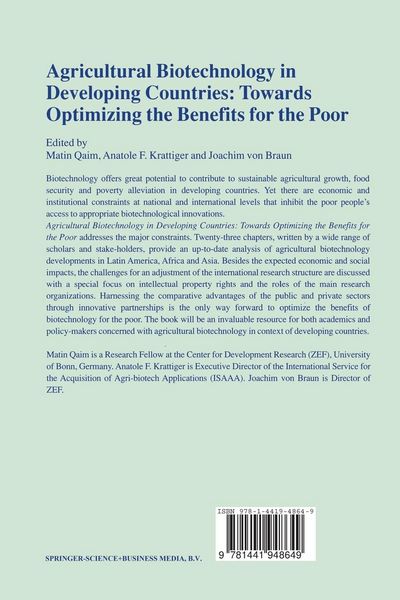
Biotechnology offers great potential to contribute to sustainable agricultural growth, food security and poverty alleviation in developing countries. Yet there are economic and institutional constraints at national and international levels that inhibit the poor people's access to appropriate biotechnological innovations.
Agricultural Biotechnology in Developing Countries: Towards Optimizing
the Benefits for the Poor
addresses the major constraints. Twenty-three chapters, written by a wide range of scholars and stake-holders, provide an up-to-date analysis of agricultural biotechnology developments in Latin America, Africa and Asia. Besides the expected economic and social impacts, the challenges for an adjustment of the international research structure are discussed, with a special focus on intellectual property rights and the roles of the main research organizations. Harnessing the comparative advantages of the public and private sectors through innovative partnerships is the only way forward to optimize the benefits of biotechnology for the poor. The book will be an invaluable resource for both academics and policy-makers concerned with agricultural biotechnology in context of developing-countries.

Portrait


Matin Qaim
is a Research Fellow at the Center for Development Research (ZEF), University of Bonn, Germany.
Anatole F. Krattiger
is Executive Director of the International Service for the Acquisition of Agri-biotech Applications (ISAAA).
Joachim von Braun
is Director of ZEF.

Produktdetails

Einband

Taschenbuch

Erscheinungsdatum

03.12.2010

Abbildungen

X, 434 p.

Herausgeber Matin Qaim + weitere

Produktdetails

Einband

Taschenbuch

Erscheinungsdatum

03.12.2010

Abbildungen

X, 434 p.

Herausgeber
Verlag Springer Us
Seitenzahl

434

Maße (L/B/H)

23,5/15,5/2,5 cm

Gewicht

674 g

Auflage

Softcover reprint of hardcover 1st edition 2000

Sprache

Englisch

ISBN

978-1-4419-4864-9

Herstelleradresse

Springer-Verlag GmbH
Tiergartenstr. 17
69121 Heidelberg
DE

Email: ProductSafety@springernature.com

Ein neues Kapitel für Ihre Bücher

Ein neues Kapitel für Ihre Bücher

Schenken Sie Ihren alten Schätzen ein zweites Leben und erhalten Sie dafür eine Thalia Geschenkkarte.

Jetzt verkaufen
Jetzt verkaufen

Noch keine Bewertungen vorhanden

Verfassen Sie die erste Bewertung zu diesem Artikel

Helfen Sie anderen Kundinnen und Kunden durch Ihre Meinung.

Kundinnen und Kunden meinen

Bewertungen (0)

  • Produktbild: Agricultural Biotechnology in Developing Countries
  • Produktbild: Agricultural Biotechnology in Developing Countries
  • 1 Introduction.- I The General Framework.- 2 Transgenic Crops Worldwide: Current Situation and Future Outlook.- 3 Molecular Tools for Plant Breeding.- 4 Managing Biosafety Capacity Development: Technical and Political Aspects.- II Regional Outlook.- 5 The Situation of Agricultural Biotechnology Capacities and Exploitation in Latin America and the Caribbean.- 6 The Current and Future Situation of Agricultural Biotechnology in Africa: Challenges and Opportunities.- 7 Biotechnology Research in Rice for Asia: Priorities, Focus and Directions.- III Expected Impacts.- 8 The Roles of Economic Research in the Evolution of International Agricultural Biotechnology.- 9 Welfare Prospects of Transgenic Crops in Developing Countries.- 10 Institutional Issues in Biotechnology Applications: Concepts and Empirical Evidence from Kenya.- 11 The Role of Biotechnology for Food Consumers in Developing Countries.- 12 Biotechnology and Global Food Security: A Private-Sector View.- 13 Agricultural Biotechnology and the Seed Industry: Some Implications for Food Production and Security.- 14 A Danger to the World’s Food: Genetic Engineering and the Economic Interests of the Life-Science Industry.- 15 Of Terminator Genes and Developing Countries: What are the Impacts of Appropriation Technologies on Technological Diffusion?.- IV Intellectual Property Rights.- 16 The Economics of Intellectual Property Rights in the Agricultural Biotechnology Sector.- 17 Intellectual Property Rights Issues and Developing Countries: A Private-Sector Perspective.- 18 Intellectual Property Rights Challenges and International Research Collaborations in Agricultural Biotechnology.- V The Role of Different Players.- 19 The Role of the Private Sector in Providing Biotechnology Access to the Poor.- 20 Bringing the Benefitsof Biotechnology to the Poor: The Role of the CGIAR Centers.- 21 The Role of National Agricultural Research Systems in Providing Biotechnology Access to the Poor: Grassroots for an Ivory Tower?.- 22 Agricultural Biotechnology and the Poor: The Role of Development Assistance Agencies.- 23 Conclusions.- Contributing Authors.