















































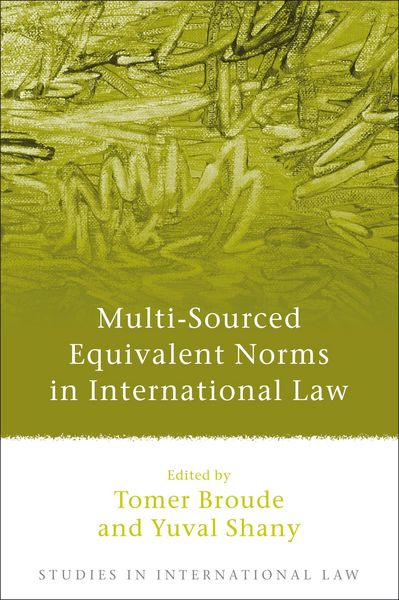
Multi-Sourced Equivalent Norms in International Law
139,99 €
inkl. gesetzl. MwSt.,
Beschreibung
Produktdetails
Einband
Gebundene Ausgabe
Erscheinungsdatum
21.03.2011
Herausgeber
Tomer Broude + weitereVerlag
Bloomsbury AcademicSeitenzahl
354
Maße (L/B/H)
24/16,1/2,4 cm
Gewicht
696 g
Sprache
Englisch
ISBN
978-1-84946-145-0
Recent decades have witnessed an impressive process of normative development in international law. Numerous new treaties have been concluded, at global and regional levels, establishing far-reaching international legal and regulatory regimes in important areas such as human rights, international trade, environmental protection, criminal law, intellectual property, and more. New political and judicial institutions have been established to develop, apply and adjudicate these rules. This trend has been accompanied by the growing consolidation of treaty norms into international custom, and increased references to international law in domestic settings. As a result of these developments, international relations have now reached an unprecedented level of normative density and intensity, but they have also given rise to the phenomenon of 'fragmentation'.
The debate over the fragmentation of international law has largely focused on conflicts: conflicts of norms and conflicts of authority. However, the same developments that have given rise to greater conflict and contradiction in international law, have also produced a growing amount of normative equivalence between rules in different fields of international law. New treaty rules often echo existing international customary norms. Regional arrangements reinforce undertakings that already exist at the global level; and common concerns and solutions appear in many international legal fields. This book focuses on such instances of normative parallelism, developing the concept of 'multisourced equivalent norms' in international law, with contributions by leading international law experts exploring the legal and political implications of the concept in a variety of contexts that span the full spectrum of international legal norms and institutions. By concentrating on situations governed by a multitude of similar norms, the book emphasizes the importance of legal contexts and institutional settings to international law-interpretation and application.
Ein neues Kapitel für Ihre Bücher
Ein neues Kapitel für Ihre Bücher
Schenken Sie Ihren alten Schätzen ein zweites Leben und erhalten Sie dafür eine Thalia Geschenkkarte.
Noch keine Bewertungen vorhanden
Verfassen Sie die erste Bewertung zu diesem Artikel
Helfen Sie anderen Kundinnen und Kunden durch Ihre Meinung.
Kurze Frage zu unserer Seite
Vielen Dank für Ihr Feedback
Wir nutzen Ihr Feedback, um unsere Produktseiten zu verbessern. Bitte haben Sie Verständnis, dass wir Ihnen keine Rückmeldung geben können. Falls Sie Kontakt mit uns aufnehmen möchten, können Sie sich aber gerne an unseren Kund*innenservice wenden.
zum Kundenservice