















































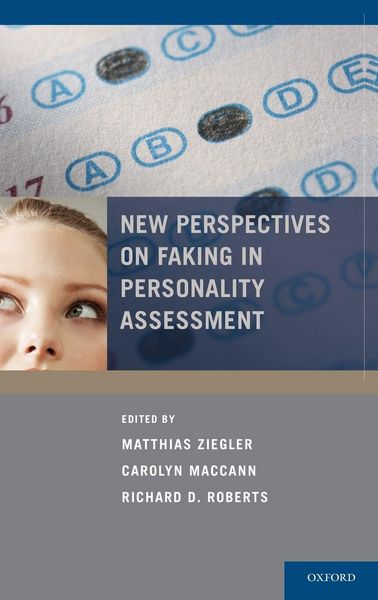
New Perspectives on Faking in Personality Assessment
121,99 €
inkl. gesetzl. MwSt.,
Beschreibung
Produktdetails
Einband
Gebundene Ausgabe
Erscheinungsdatum
01.08.2011
Herausgeber
Ziegler Matthias + weitereVerlag
Oxford University PressSeitenzahl
386
Maße (L/B/H)
24/16,1/2,5 cm
Gewicht
743 g
Sprache
Englisch
ISBN
978-0-19-538747-6
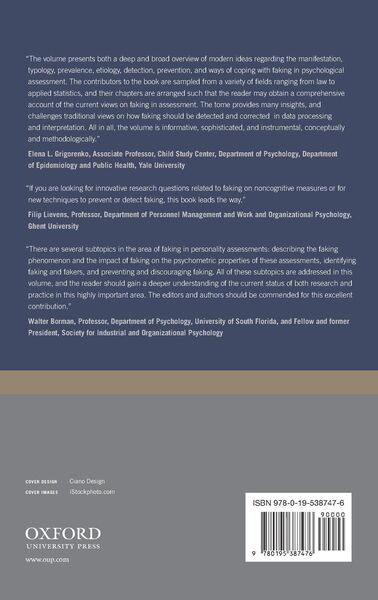
In this volume, a diverse group of world experts in personality assessment showcase a range of different viewpoints on response distortion. Contributors consider what it means to "fake" a personality assessment, why and how people try to obtain particular scores on personality tests, and what types of tests people can successfully manipulate. The authors present and discuss the usefulness of a range of traditional and cutting-edge methods for detecting and controlling the practice of faking. These methods include social desirability (lie) scales, warnings, affective neutralization, unidimensional and multidimensional pairwise preferences, decision trees, linguistic analysis, situational measures, and methods based on item response theory. The wide range of viewpoints presented in this book are then summarized, synthesized, and evaluated. The authors make practical recommendations and suggest areas for future research. Anyone who wonders whether people exaggerate or lie outright on personality tests -- or questions what psychologists can and should do about it -- will find in this book stimulating questions and useful answers.
Ein neues Kapitel für Ihre Bücher
Ein neues Kapitel für Ihre Bücher
Schenken Sie Ihren alten Schätzen ein zweites Leben und erhalten Sie dafür eine Thalia Geschenkkarte.
Noch keine Bewertungen vorhanden
Verfassen Sie die erste Bewertung zu diesem Artikel
Helfen Sie anderen Kundinnen und Kunden durch Ihre Meinung.
Kurze Frage zu unserer Seite
Vielen Dank für Ihr Feedback
Wir nutzen Ihr Feedback, um unsere Produktseiten zu verbessern. Bitte haben Sie Verständnis, dass wir Ihnen keine Rückmeldung geben können. Falls Sie Kontakt mit uns aufnehmen möchten, können Sie sich aber gerne an unseren Kund*innenservice wenden.
zum Kundenservice